UEG's educational platform for gastroenterology education bringing recordings, courses, guidelines, and more together in one place.
Most popular content
Rate for better recommendations!
Your feedback helps us show you more of what you like and less of what you dislike!
Log in to access this content.
Free for all myUEG account holders. Your access level is set automatically based on your occupation. Medical professionals get full access to all content. If you are a non-medical user, you can only access UEG Week content from congresses you attended.
Not sure what you can access? Learn more about account types.

DIVERSION STOMA IS INDEPENDENTLY ASSOCIATED WITH RADIOLOGICAL REMISSION IN COMPLEX PERIANAL FISTULA: A PROPENSITY SCORE-MATCHED STUDY
oguz bakkaloglu 1, Tugce Eskazan 1, Meliksah Bayar 2, Atilla Akpinar 1, Sabri Sirolu 1, Onur Tutar 1, Sezgin Uludag 1, Bilgi Baca 3, Ali Ibrahim Hatemi 1, Yusuf Ziya Erzin 1, Aykut Ferhat Çelik 1
1 I.U.C. Cerrahpasa Medical Faculty, Istanbul, Türkiye
2 Zonguldak Bulent Ecevit University Faculty of Medicine, Zonguldak, Türkiye
3 Acibadem Altunizade Hospital, Istanbul, Türkiye
Conference
Topics
Submission format
Citation
Published
Log in to access this content.
Free for all myUEG account holders. Your access level is set automatically based on your occupation. Medical professionals get full access to all content. If you are a non-medical user, you can only access UEG Week content from congresses you attended.
Not sure what you can access? Learn more about account types.
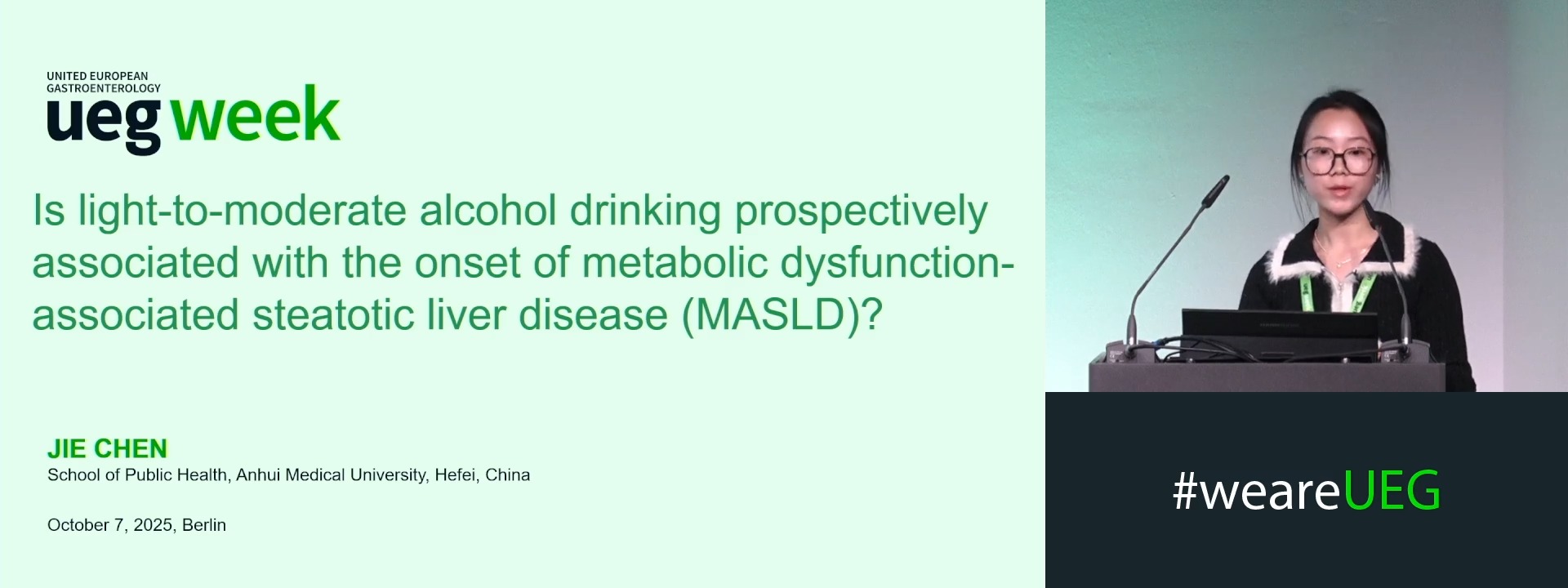
IS LIGHT TO MODERATE ALCOHOL DRINKING PROSPECTIVELY ASSOCIATED WITH THE ONSET OF METABOLIC DYSFUNCTION-ASSOCIATED STEATOTIC LIVER DISEASE?
Jie Chen 1, Yangxin Xu 1, Yu Chang 1, Qin Xinsheng 1, Hongjuan Cao 2, Zhuang Zhang 1, Wanshui Yang 1
1 Anhui Medical University, Hefei, China
2 Lu'an Municipal Center for Disease Control and Prevention, Lu'an, China
Event
Topics
Submission format
Citation
Published
Log in to access this content.
Free for all myUEG account holders. Your access level is set automatically based on your occupation. Medical professionals get full access to all content. If you are a non-medical user, you can only access UEG Week content from congresses you attended.
Not sure what you can access? Learn more about account types.
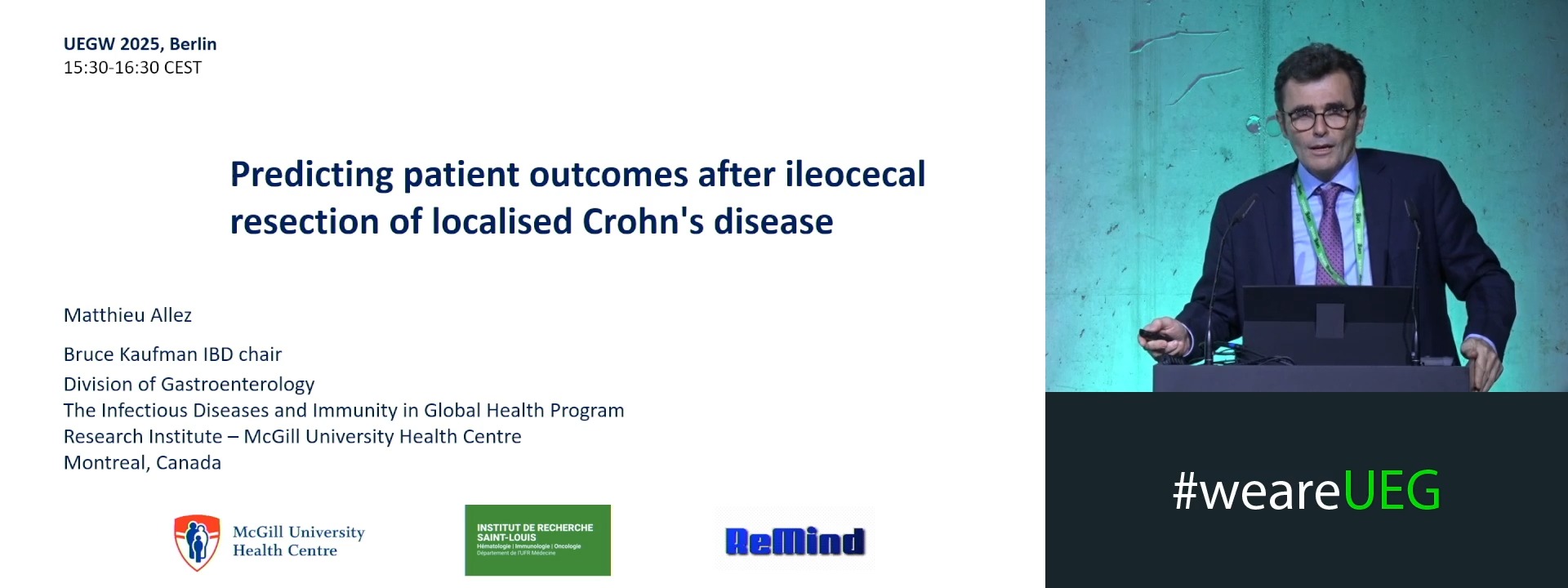
… after ileocecal resection of localised Crohn's disease
1 Saint-Louis Hospital, AP-HP, Université Paris Cité, Paris, France
Event
Topics
Session
Citation
Published
Log in to access this content.
Free for all myUEG account holders. Your access level is set automatically based on your occupation. Medical professionals get full access to all content. If you are a non-medical user, you can only access UEG Week content from congresses you attended.
Not sure what you can access? Learn more about account types.
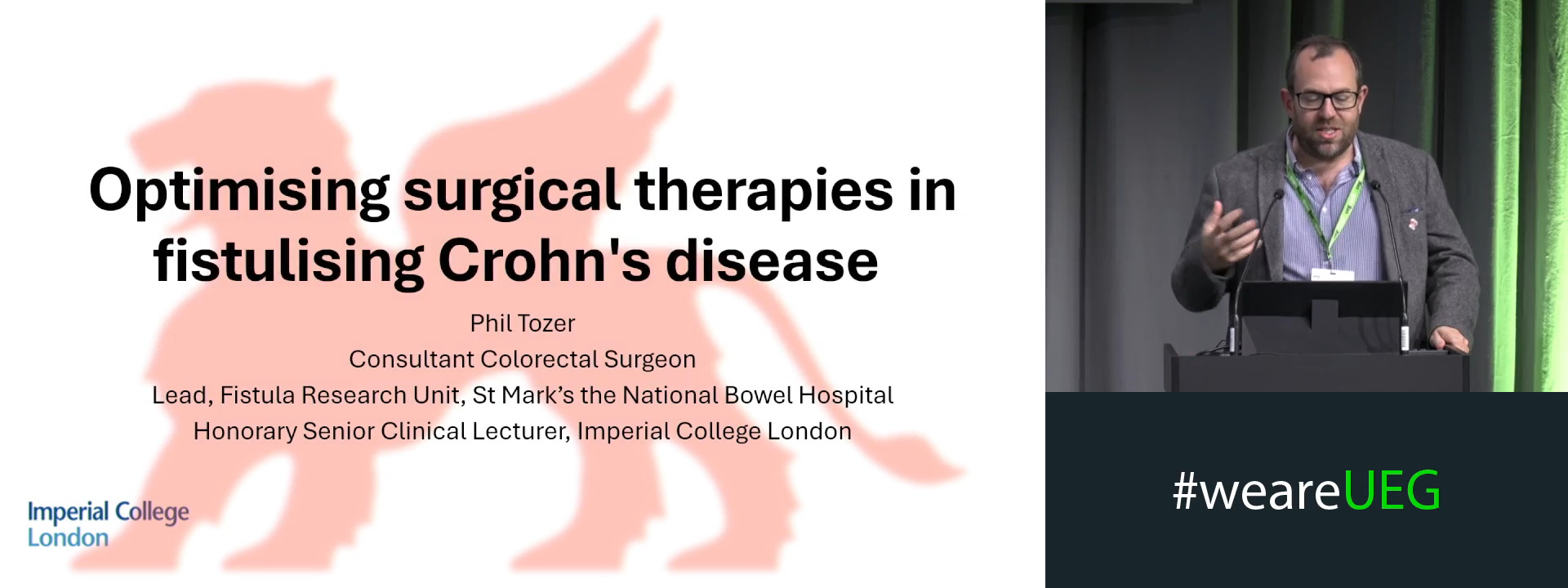
Optimising surgical therapies in fistulising Crohn's disease
1 St Marks Hospital, London, United Kingdom
Event
Citation
Published
Log in to access this content.
Free for all myUEG account holders. Your access level is set automatically based on your occupation. Medical professionals get full access to all content. If you are a non-medical user, you can only access UEG Week content from congresses you attended.
Not sure what you can access? Learn more about account types.
A CHALLENGING CASE OF PENETRATING AND GENITAL CROHN’S DISEASE
Francisco Vara-Luiz 1, Ivo Mendes 1, Carolina Palma 1, Margarida André 2, António Magarreiro Silva 2, Sofia Antunes 2, Eduardo Fernandes 2, Marta Patita 2, Irina Mocanu 2, Ana Isabel Vieira 2, Unknown Unknown 2
1 Hospital Garcia de Orta, Almada, Portugal|||Egas Moniz Center for Interdisciplinary Research (CiiEM), Egas Moniz School of Health and Science, Almada, Portugal
2 Hospital Garcia de Orta, Almada, Portugal
Conference
Topics
Submission format
Session
Published
Log in to access this content.
Free for all myUEG account holders. Your access level is set automatically based on your occupation. Medical professionals get full access to all content. If you are a non-medical user, you can only access UEG Week content from congresses you attended.
Not sure what you can access? Learn more about account types.
EXPLORING MICROBIOTA-IMMUNE INTERACTIONS IN SHORT BOWEL SYNDROME AND CROHN’S DISEASE IN A MODEL OF HUMAN MICROBIOTA ASSOCIATED MICE
Letizia Masi 1, Valentina Petito 1, Sara Troisi 2, Valeria Emoli 1, Sara Deleu 3, Guia Becherucci 1, Aurora Sveva Carlà 1, Greta Migliore 1, Cesare Pane 4, Miriam Di Mattia 4, Elisa Foscarini 1, Francesca Profeta 1, Marcello Chieppa 5, Giammarco Mocci 6, Loris Riccardo Lopetuso 7, Antonio Gasbarrini 8, Alfredo Papa 9, Franco Scaldaferri 8
1 Fondazione Policlinico Universitario “A. Gemelli”, IRCCS, Rome, Italy
2 Fondazione Policlinico Universitario “A. Gemelli”, IRCCS, Rome, Italy|||University of Chieti-Pescara, Chieti, Italy
3 KU Leuven, Leuven, Belgium
4 University of Chieti-Pescara, Chieti, Italy
5 University of Salento Centro Ecotekne, Lecce, Italy
6 ARNAS G. Brotzu, Cagliari, Italy
7 Link Campus University, Rome, Italy|||Fondazione Policlinico Universitario “A. Gemelli”, IRCCS, Rome, Italy
8 Catholic University of the Sacred Heart, Rome, Italy|||Fondazione Policlinico Universitario “A. Gemelli”, IRCCS, Rome, Italy|||Fondazione Policlinico Universitario “A. Gemelli”, IRCCS, Rome, Italy
9 Fondazione Policlinico Universitario “A. Gemelli”, IRCCS, Rome, Italy|||Catholic University of the Sacred Heart, Rome, Italy
Conference
Topics
Submission format
Session
Citation
Published
Log in to access this content.
Free for all myUEG account holders. Your access level is set automatically based on your occupation. Medical professionals get full access to all content. If you are a non-medical user, you can only access UEG Week content from congresses you attended.
Not sure what you can access? Learn more about account types.
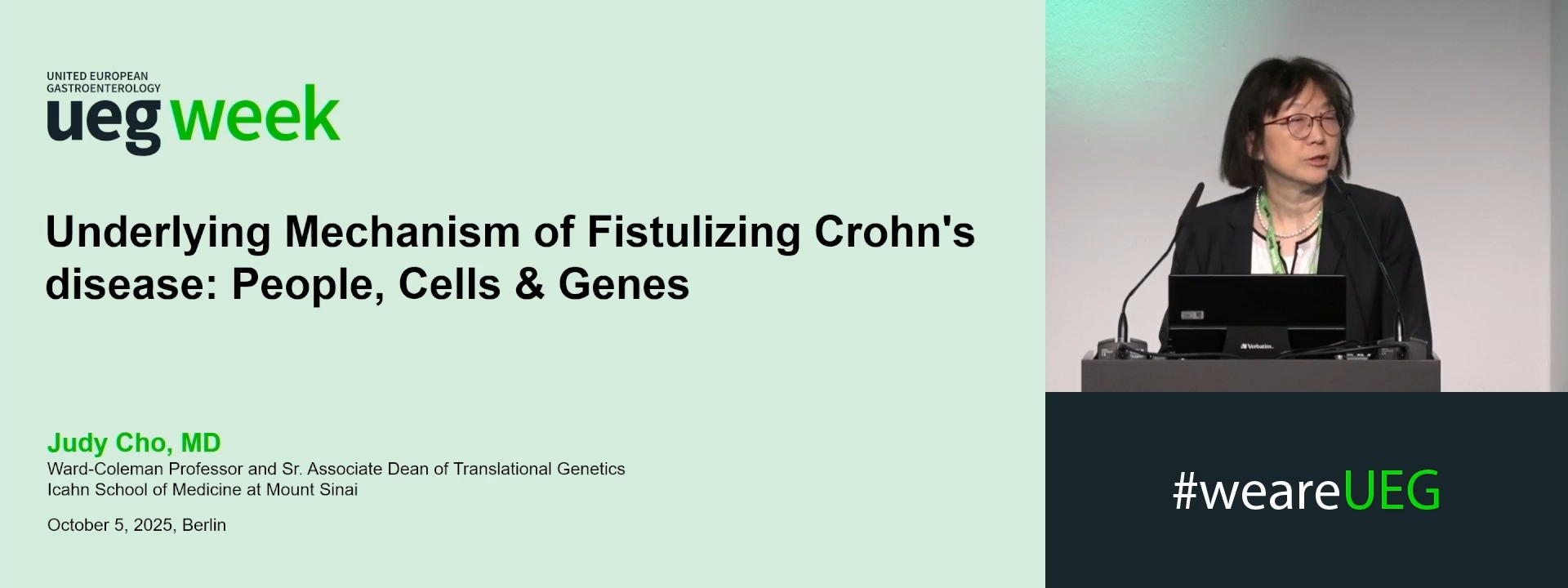
Fistulising Crohn's disease: Underlying mechanism
1 Icahn School of Medicine at Mount Sinai, New York, United States of America
Event
Topics