UEG's educational platform for gastroenterology education bringing recordings, courses, guidelines, and more together in one place.
Most popular content
Rate for better recommendations!
Your feedback helps us show you more of what you like and less of what you dislike!
Log in to access this content.
Free for all myUEG account holders. Your access level is set automatically based on your occupation. Medical professionals get full access to all content. If you are a non-medical user, you can only access UEG Week content from congresses you attended.
Not sure what you can access? Learn more about account types.

ADVANCED CANNULATION TECHNIQUES VS DIRECT EUS-GUIDED BILIARY DRAINAGE IN CASE OF DIFFICULT BILIARY CANNULATION IN PATIENTS WITH DISTAL MALIGNANT BILIARY OBSTRUCTION: AN INTERNATIONAL MULTI-CENTER PROPENSITY SCORE-MATCHED ANALYSIS
Marco Spadaccini 1, Cecilia Binda 2, Aurelio Mauro 3, Romain Legros 4, Marta Andreozzi 1, Silvia Carrara 1, Daryl Ramai 5, Jeremie Albouys 4, Chiara Coluccio 6, Antonio Facciorusso 7, Jérémie Jacques 4, Alessandro De Marco 1, Matteo Colombo 1, gianluca franchellucci 1, Alessandro Fugazza 8, Stefano Mazza 3, Carlo Fabbri 9, Andrea Anderloni 3, Cesare Hassan 10, Alessandro Repici 11
1 Humanitas University, Rozzano, Italy
2 AUSL Romagna, Forlì, Italy
3 San Matteo Hospital, Pavia, Italy
4 CHU Limoges, Limoges, France
5 Brigham and Women's Hospital, Boston, United States
6 Ospedale Sant'Andrea, Rome, Italy
7 University of Foggia, Foggia, Italy
8 Humanitas Research Hospital, Rozzano, Italy
9 AUSL Romagna, Forlì-Cesena Gastroenterology, Bologna, Italy
10 Humanitas University, Pieve Emanuele, Italy
11 Ist. Clinico Humanitas Rozzano, Milano, Italy
Conference
Topics
Submission format
Citation
Published
Log in to access this content.
Free for all myUEG account holders. Your access level is set automatically based on your occupation. Medical professionals get full access to all content. If you are a non-medical user, you can only access UEG Week content from congresses you attended.
Not sure what you can access? Learn more about account types.
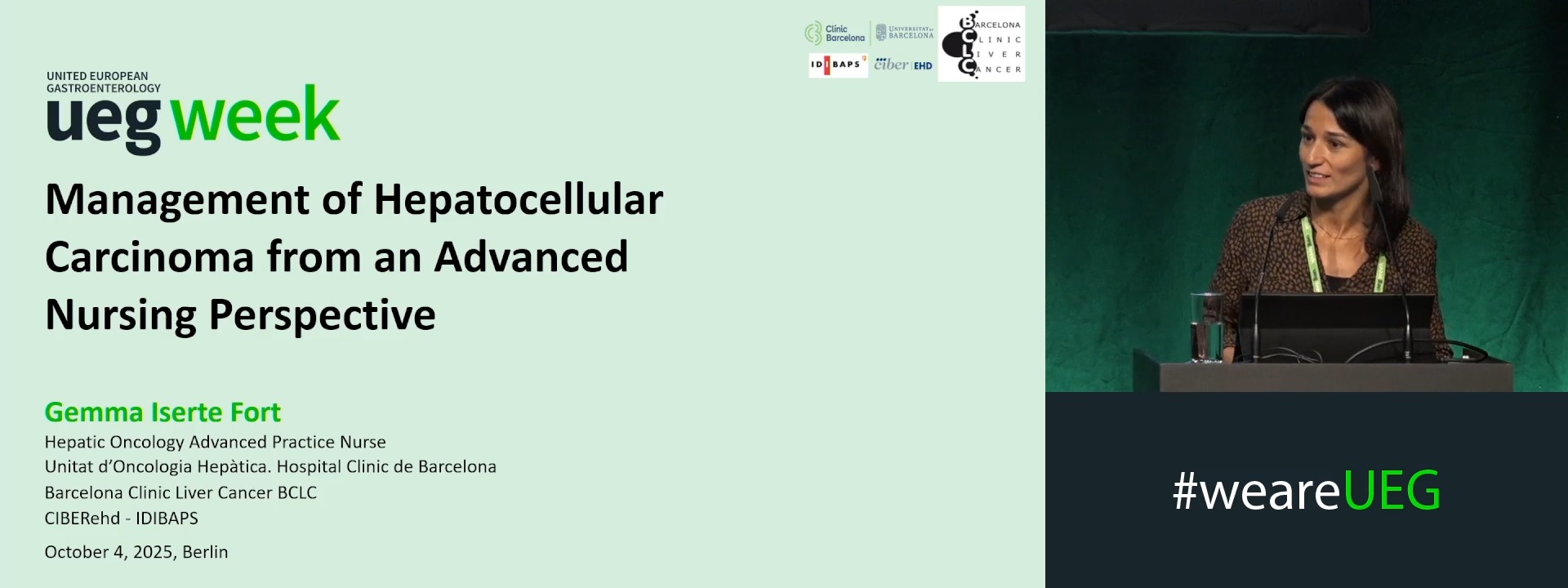
Management of hepatocellular carcinoma from an advanced nursing perspective
1 None, Barcelona, Spain
Event
Topics
Citation
Published
Log in to access this content.
Free for all myUEG account holders. Your access level is set automatically based on your occupation. Medical professionals get full access to all content. If you are a non-medical user, you can only access UEG Week content from congresses you attended.
Not sure what you can access? Learn more about account types.
Early onset life-long impact: Caustic injury/atresia (Complete Session)
Event
Topics
Citation
Published
Log in to access this content.
Free for all myUEG account holders. Your access level is set automatically based on your occupation. Medical professionals get full access to all content. If you are a non-medical user, you can only access UEG Week content from congresses you attended.
Not sure what you can access? Learn more about account types.
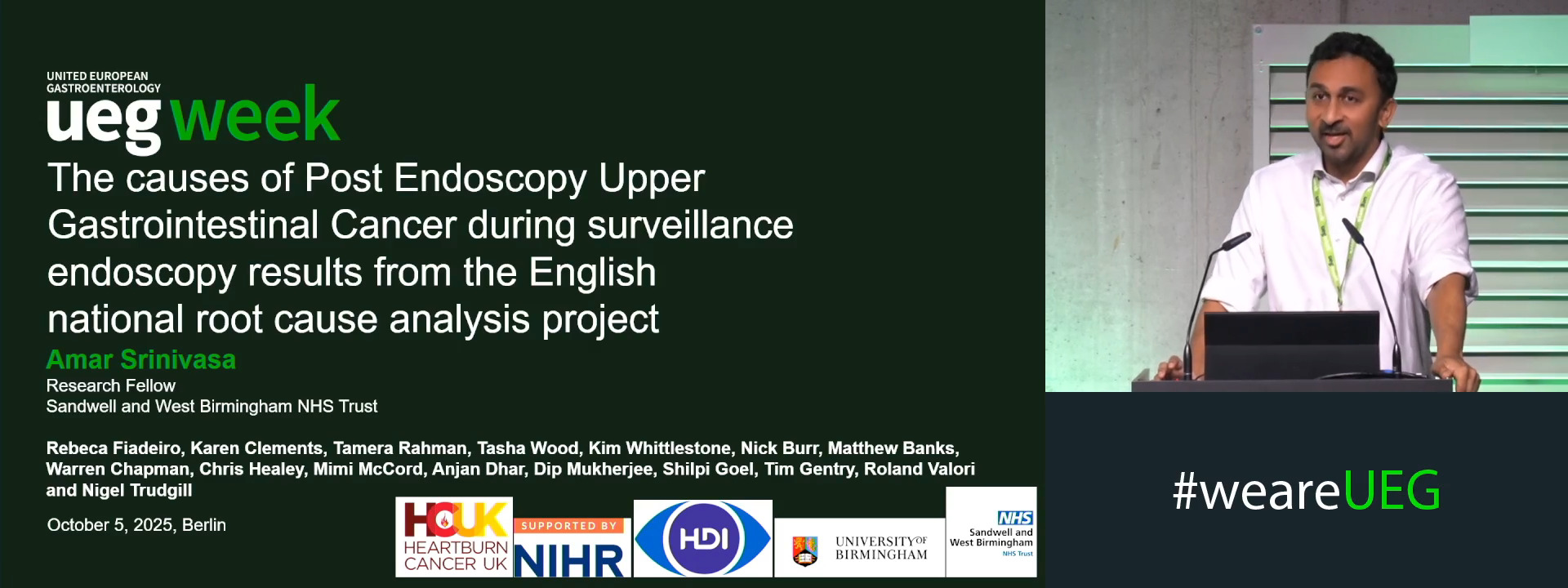
THE CAUSES OF POST ENDOSCOPY UPPER GASTROINTESTINAL CANCER DURING SURVEILLANCE ENDOSCOPY: RESULTS FROM THE ENGLISH NATIONAL ROOT CAUSE ANALYSIS PROJECT
Amar Srinivasa 1, Rebeca Fiadeiro 2, Karen Clements 2, Tameera Rahman 2, Shilpi Goel 2, Tim Gentry 2, Nicholas E Burr 3, Matthew Banks 4, Anjan Dhar 5, Chris Healey 6, Mimi McCord 7, Dipankar Mukherjee 8, warren chapman 9, Roland Valori 10, Nigel Trudgill 11
1 Sandwell and West Birmingham NHS Trust, Birmingham, United Kingdom
2 Health Data Insight CIC, Cambridge, United Kingdom
3 Leeds Institute for Biomedical and Clinical Sciences, Leeds, United Kingdom
4 University College London Hospital NHS Trust (UCLH), London, United Kingdom
5 Darlington Memorial & Bishop Auckland Hospitals, Darlington, United Kingdom
6 Airedale Nhs foundation trust, Airdale, United Kingdom
7 Heartburn Cancer UK, Basingstoke, United Kingdom
8 Barking, Havering And Redbridge University Hospitals NHS Trust, Romford, United Kingdom
9 University Hospitals NHS Foundation Trust, Birmingham, United Kingdom
10 Gloucestershire NHS Foundation Trust - Medicine, Gloucestershire NHS Foundation Trust; Cheltenham/GB, Cheltenham, United Kingdom
11 Sandwell & West Birmingham Hospitals NHS Trust, West Bromwich, United Kingdom
Event
Topics
Submission format
Citation
Published
Log in to access this content.
Free for all myUEG account holders. Your access level is set automatically based on your occupation. Medical professionals get full access to all content. If you are a non-medical user, you can only access UEG Week content from congresses you attended.
Not sure what you can access? Learn more about account types.
MY FAILURES IN ENDOSCOPIC RETROGRADE CHOLANGIOPANCREATOGRAPHY (ERCP) - STRATEGIES THAT CAN BE LEARNED BY EMBRACING SETBACKS
Jose Masegosa Ataz 1, MAITE SERRANO DUEÑAS 2, Arfan Mahmood 1, Mustafa Jalal 2, Shihaz Ambalathu Veettil Hussain 3, Adriana Guerra Romero 4
1 University Hospital North Durham, Durham, United Kingdom
2 University Hospitals Dorset NHS Foundation Trust, Bournemouth, United Kingdom
3 Cairns and Hinterland Hospital and Health Service, Cairns, Australia
4 University Hospital Limerick, Limerick, Ireland
Conference
Topics
Submission format
Citation
Published
Log in to access this content.
Free for all myUEG account holders. Your access level is set automatically based on your occupation. Medical professionals get full access to all content. If you are a non-medical user, you can only access UEG Week content from congresses you attended.
Not sure what you can access? Learn more about account types.
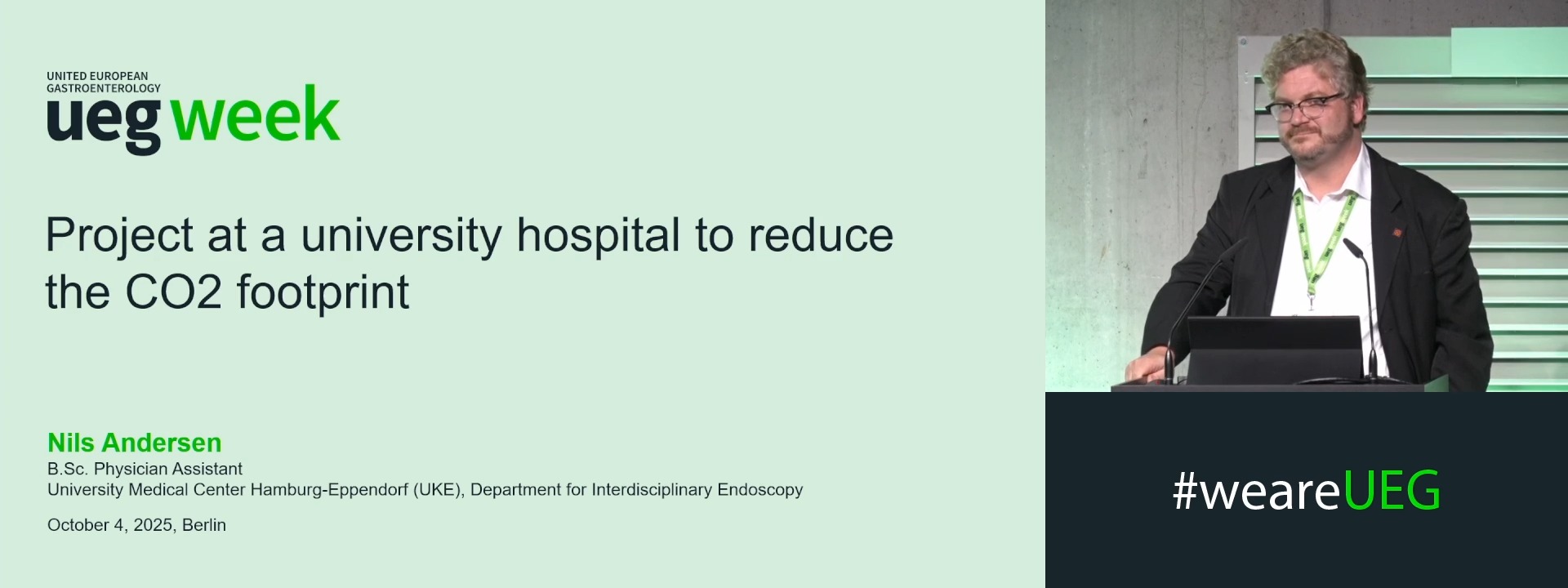
Project at a university hospital to reduce the CO2 footprint
1 UKE Hamburg-Eppendorf Abt. Endoskopie, Hamburg, Germany
Event
Topics
Citation
Published
Log in to access this content.
Free for all myUEG account holders. Your access level is set automatically based on your occupation. Medical professionals get full access to all content. If you are a non-medical user, you can only access UEG Week content from congresses you attended.
Not sure what you can access? Learn more about account types.
Cancer early but high-risk
1 Cliniques Universitaire Saint-Luc, Université de Louvain - Dept. de Hepato-gastroenterologie, Cliniq, Brussels, Belgium