UEG's educational platform for gastroenterology education bringing recordings, courses, guidelines, and more together in one place.
Most popular content
Rate for better recommendations!
Your feedback helps us show you more of what you like and less of what you dislike!
Log in to access this content.
Free for all myUEG account holders. Your access level is set automatically based on your occupation. Medical professionals get full access to all content. If you are a non-medical user, you can only access UEG Week content from congresses you attended.
Not sure what you can access? Learn more about account types.
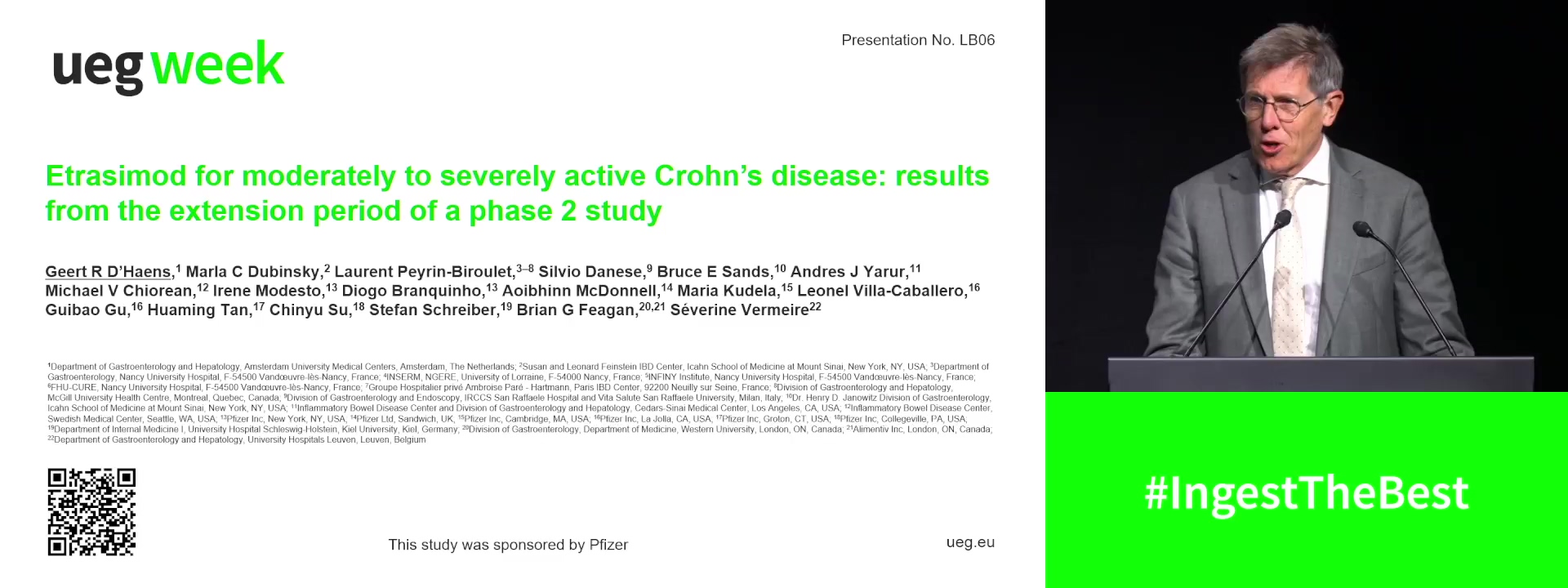
ETRASIMOD FOR MODERATELY TO SEVERELY ACTIVE CROHN’S DISEASE: RESULTS FROM THE EXTENSION PERIOD OF A PHASE 2 STUDY
Geert R. D'Haens 1, Marla C. Dubinsky 2, Laurent Peyrin-Biroulet 3, Silvio Danese 4, Bruce E. Sands 2, Andres Yarur 5, Michael Chiorean 6, Irene Modesto 7, Diogo Branquinho 7, Aoibhinn McDonnell 8, Maria Kudela 9, Leonel Villa-Caballero 10, Guibao Gu 10, Huaming Tan 11, Chinyu Su 12, Stefan Schreiber 13, Brian G. Feagan 14, Severine Vermeire 15
1 Amsterdam University Medical Centers, Amsterdam, Netherlands
2 Icahn School of Medicine at Mount Sinai, New York, United States
3 Nancy University Hospital, F-54500 Vandœuvre-lès-Nancy, France|||University of Lorraine, F-54000 Nancy, France|||Nancy University Hospital, F-54500 Vandœuvre-lès-Nancy, France|||Nancy University Hospital, F-54500 Vandœuvre-lès-Nancy, France|||Paris IBD Ce
4 IRCCS San Raffaele Hospital and Vita Salute San Raffaele University, Milan, Italy
5 Cedars-Sinai Medical Center, Los Angeles, United States
6 Swedish Medical Center, Seattle, United States
7 Pfizer Inc, New York, United States
8 Pfizer Ltd, Sandwich, United Kingdom
9 Pfizer Inc, Cambridge, United States
10 Pfizer Inc, La Jolla, United States
11 Pfizer Inc, Groton, United States
12 Pfizer Inc, Collegeville, United States
13 University Hospital Schleswig-Holstein, Kiel University, Kiel, Germany
14 Western University, London, Canada|||Alimentiv Inc, London, Canada
15 University Hospitals Leuven, Leuven, Belgium
Event
Submission format
Citation
Published
Log in to access this content.
Free for all myUEG account holders. Your access level is set automatically based on your occupation. Medical professionals get full access to all content. If you are a non-medical user, you can only access UEG Week content from congresses you attended.
Not sure what you can access? Learn more about account types.
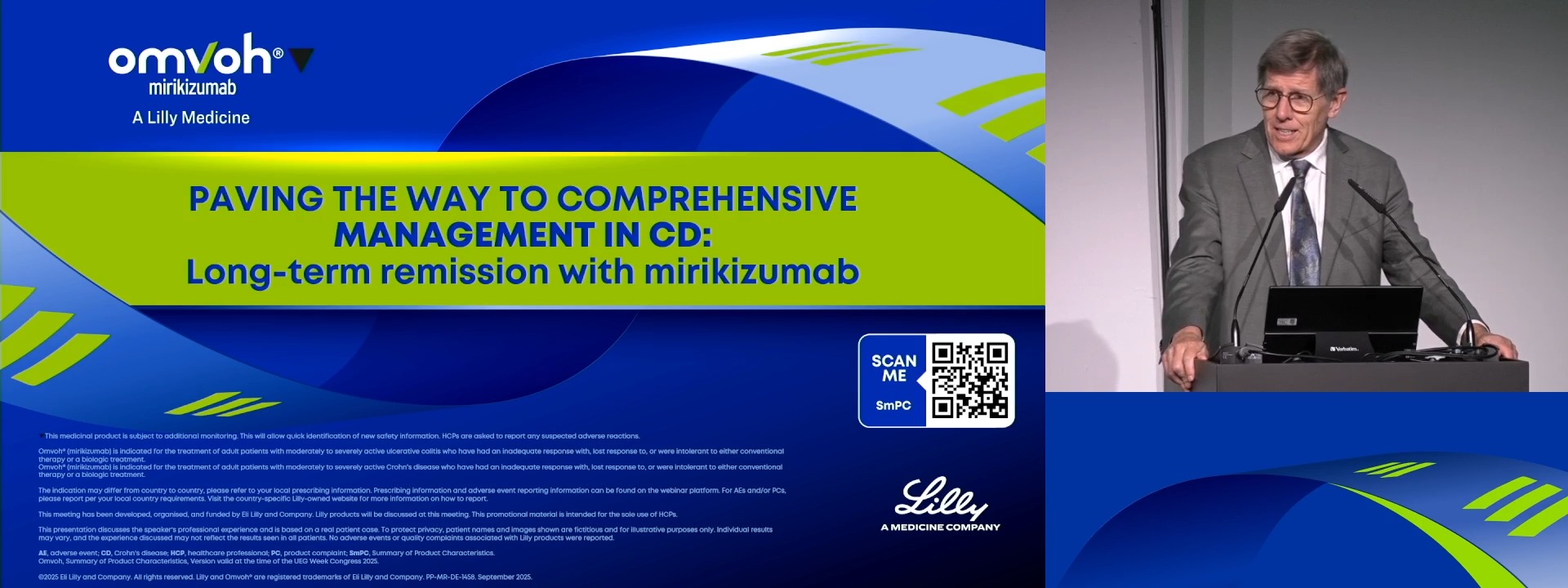
Paving the way to comprehensive management in CD: Long-term remission with mirikizumab (Eli Lilly and Company) (Complete Session)
1 Friedrich-Alexander-Universität Erlangen-Nürnberg, Erlangen, Germany
2 Amsterdam University Medical Centers, Amsterdam, Netherlands
3 University Hospitals Leuven, Leuven, Belgium
Publisher
Event
Citation
Published
Log in to access this content.
Free for all myUEG account holders. Your access level is set automatically based on your occupation. Medical professionals get full access to all content. If you are a non-medical user, you can only access UEG Week content from congresses you attended.
Not sure what you can access? Learn more about account types.
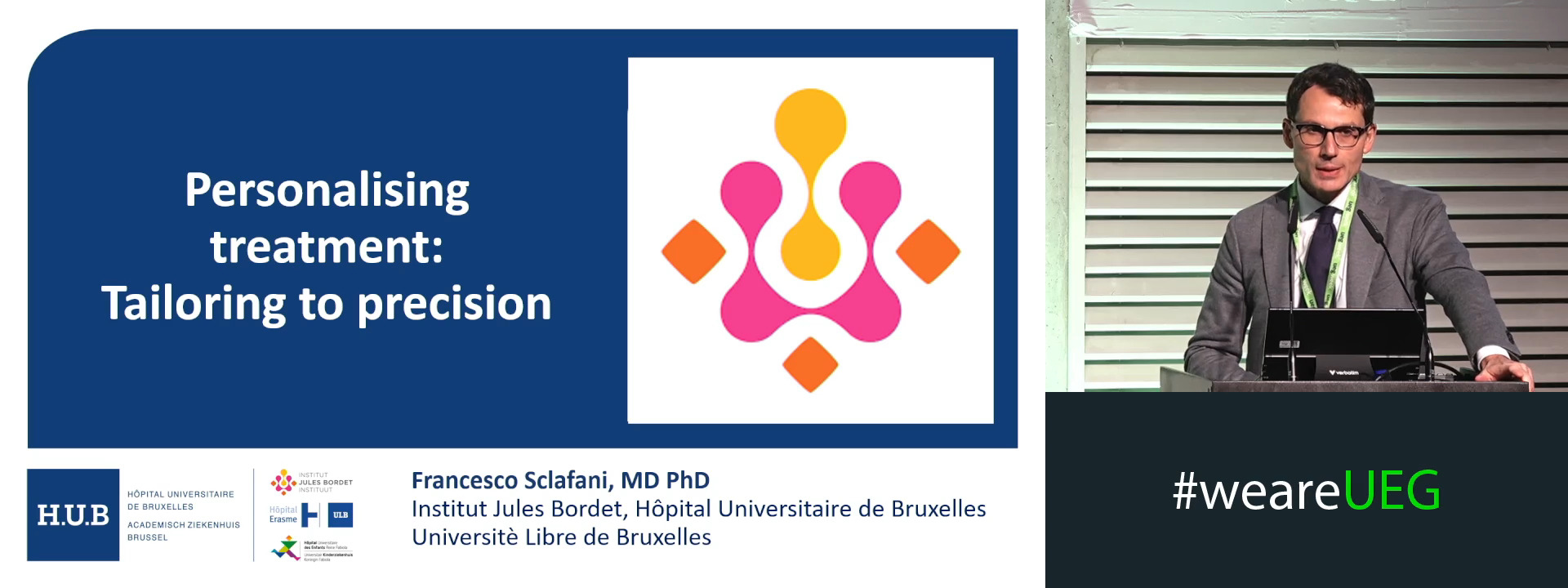
Personalising treatment: Tailoring to precision
1 Université libre de Bruxelles, Bruxelles, Belgium
Event
Citation
Published
Log in to access this content.
Free for all myUEG account holders. Your access level is set automatically based on your occupation. Medical professionals get full access to all content. If you are a non-medical user, you can only access UEG Week content from congresses you attended.
Not sure what you can access? Learn more about account types.
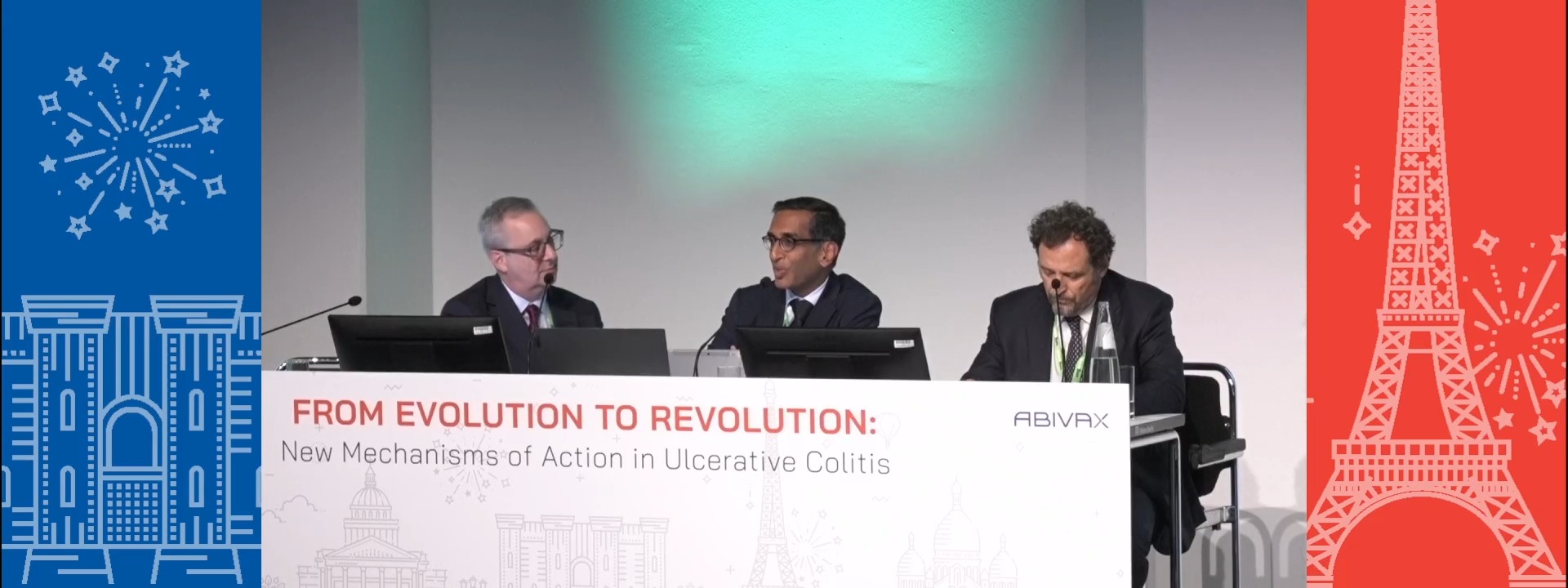
From Evolution to Revolution: New Mechanisms of Action in Ulcerative Colitis (Abivax) (Complete Session)
1 Friedrich-Alexander-Universität Erlangen-Nürnberg, Erlangen, Germany
2 Vita-Salute San Raffaele University - IRCCS San Raffaele Scientific Institute, Milan, Italy
3 Icahn School of Medicine at Mount Sinai, New York, United States of America
Publisher
Event
Citation
Published
Log in to access this content.
Free for all myUEG account holders. Your access level is set automatically based on your occupation. Medical professionals get full access to all content. If you are a non-medical user, you can only access UEG Week content from congresses you attended.
Not sure what you can access? Learn more about account types.
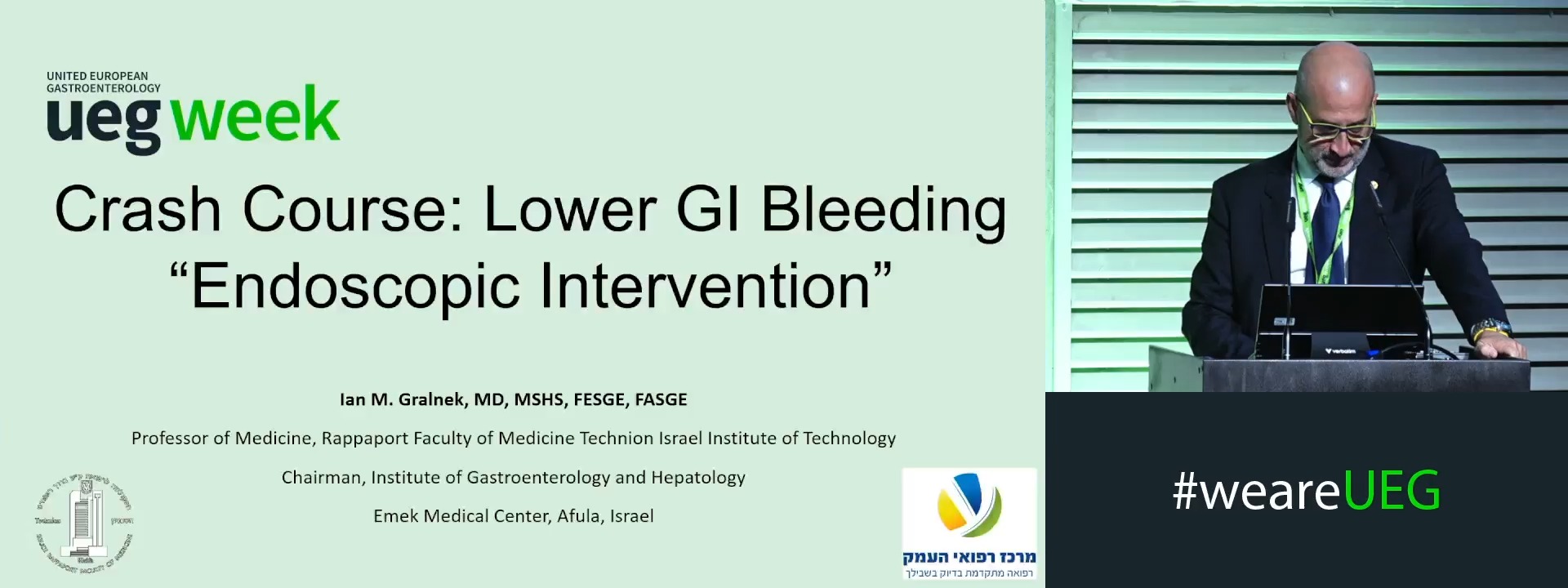
Endoscopic intervention
1 Ha'Emek Medical Center, Haifa, Israel
Event
Topics
Session
Citation
Published
Log in to access this content.
Free for all myUEG account holders. Your access level is set automatically based on your occupation. Medical professionals get full access to all content. If you are a non-medical user, you can only access UEG Week content from congresses you attended.
Not sure what you can access? Learn more about account types.
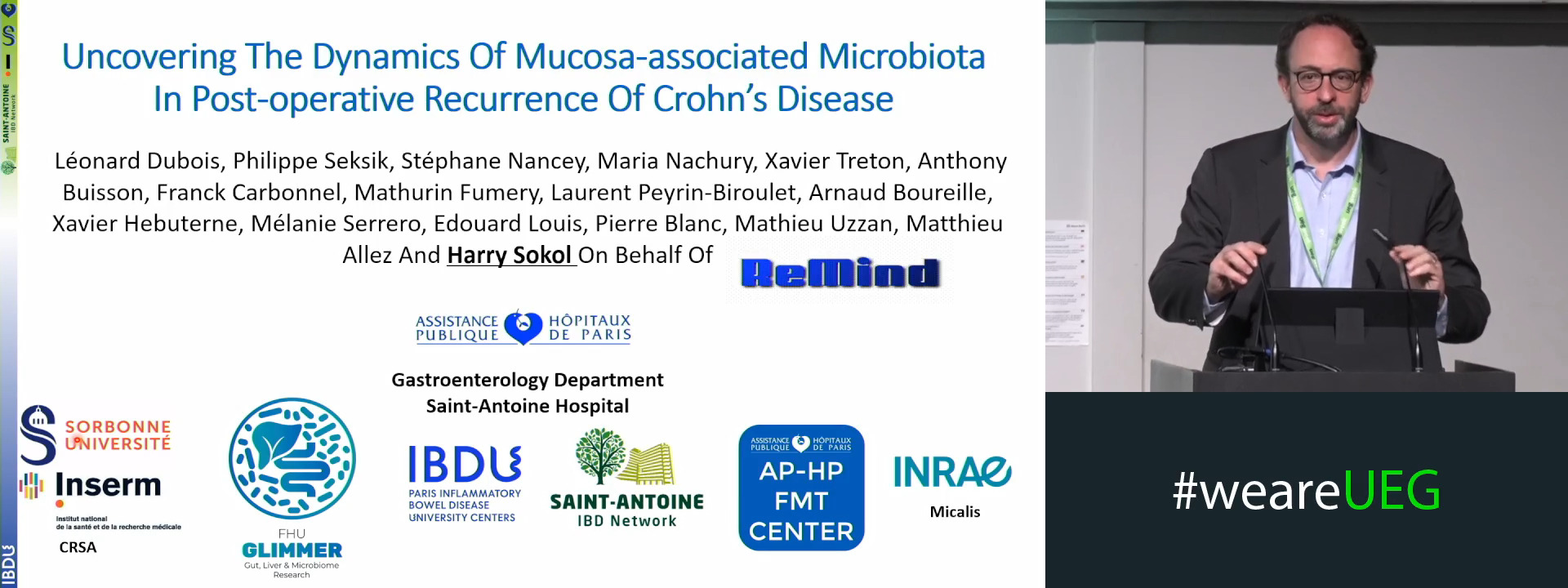
UNCOVERING THE DYNAMICS OF MUCOSA-ASSOCIATED MICROBIOTA IN POST-OPERATIVE RECURRENCE OF CROHN’S DISEASE
Leonard Dubois 1, Philippe Seksik 2, Stephane NANCEY 3, Maria Nachury 4, Xavier Treton 5, Anthony Buisson 6, Franck Carbonnel 7, Mathurin Fumery 8, Laurent Peyrin-Biroulet 9, Arnaud Bourreille 10, Xavier Hebuterne 11, Mélanie Serrero 12, Edouard Louis 13, pierre Blanc 14, Loic Brot 1, nathalie Rolhion 15, Severine Vermeire 16, Chaysavanh Manichanch 17, Reidar Fossmark 18, Madeleine Bezault 19, Mathieu Uzzan 20, Matthieu Allez 21, Harry Sokol 22
1 Sorbonne Université, Paris, France
2 Gastroenterology & Nutrition Department, Paris, France
3 HCL, Pierre Benite, France
4 CHRU Lille, Courbevoie Cedex, France
5 Groupe Hospitalier Ambroise Paré-Hartmann, Neuilly, France
6 CHU Estaing Clermont-Ferrand, Clermont-ferrand, France
7 CHU Bicetre - Dept. de Hepato-Gastroenterologie, CHU Bicetre; Le Kremlin Bicetre/FR - Dept. de Hepat, Le Kremlin Bicetre, France
8 Amiens University Hospital, Amiens, France
9 Inserm U1256, Nancy University Hospital, Vandoeuvre-les-Nancy, France
10 Hopital Hotel Dieu Et Hme - Hge Aile Sud, Nantes Cedex 1, France
11 Hospital Archet 2, Nice, Nice, France
12 Hopital Nord, Marseille, France
13 CHU Liège and Liège University, Liège, Belgium
14 Hopital Saint Eloi, Montpellier, France
15 INSERM, Paris, France
16 University Hospital Leuven, Leuven, Belgium
17 Vall d'Hebron Research Institute, Barcelona, Spain
18 Norwegian University of Science and Technology, Trondheim, Norway
19 REMIND, Paris, France
20 Hôpital Mondor, Paris, France
21 Hopital Saint-Louis APHP, Université Denis Diderot Paris 7, Paris, France
22 Saint-Antoine Hospital, Paris, France
Event
Topics
Submission format
Citation
Published
Log in to access this content.
Free for all myUEG account holders. Your access level is set automatically based on your occupation. Medical professionals get full access to all content. If you are a non-medical user, you can only access UEG Week content from congresses you attended.
Not sure what you can access? Learn more about account types.
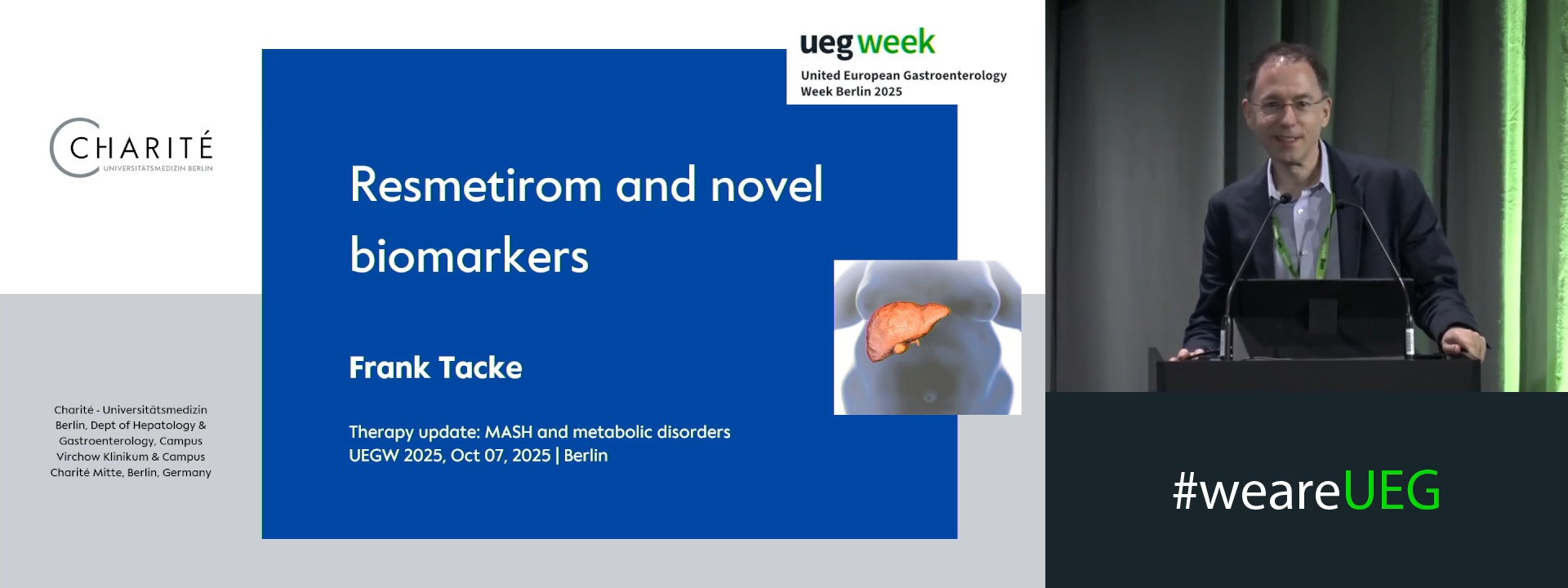
Resmetirom and novel biomarkers
1 Charité Universitaetsmedizin Berlin, Dept of Hepatology & Gastroenterology, Berlin, Germany