UEG's educational platform for gastroenterology education bringing recordings, courses, guidelines, and more together in one place.
Most popular content
Rate for better recommendations!
Your feedback helps us show you more of what you like and less of what you dislike!
Log in to access this content.
Free for all myUEG account holders. Your access level is set automatically based on your occupation. Medical professionals get full access to all content. If you are a non-medical user, you can only access UEG Week content from congresses you attended.
Not sure what you can access? Learn more about account types.

THE IMPACT OF THE RAPID-RESPONSE PATHWAY FOR THE EMERGENCY MANAGEMENT OF HIGH-RISK UPPER GASTROINTESTINAL BLEEDING ON CLINICAL OUTCOMES IN PATIENTS WITH CIRRHOSIS AND ACUTE VARICEAL BLEEDING
1 Westchina Hospital, Chengdu, China
2 Sichuan University, chengdu, China
Conference
Topics
Submission format
Session
Citation
Published
Log in to access this content.
Free for all myUEG account holders. Your access level is set automatically based on your occupation. Medical professionals get full access to all content. If you are a non-medical user, you can only access UEG Week content from congresses you attended.
Not sure what you can access? Learn more about account types.
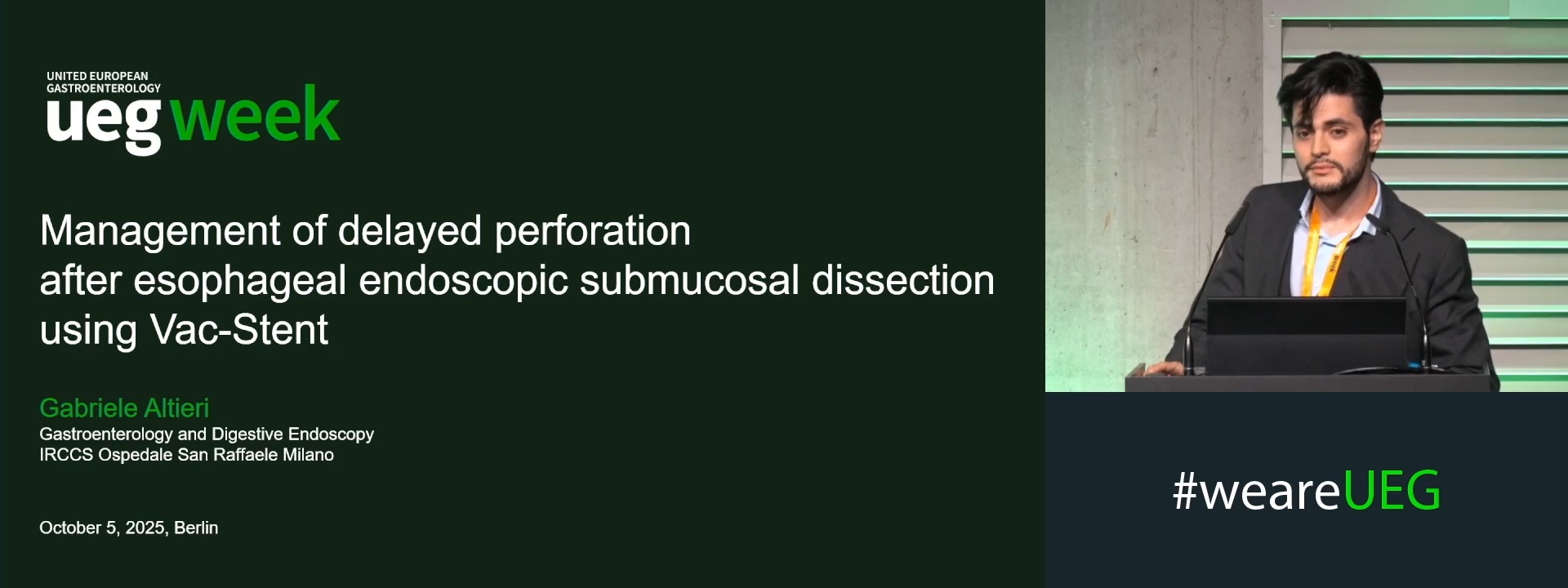
MANAGEMENT OF DELAYED PERFORATION AFTER ESOPHAGEAL ENDOSCOPIC SUBMUCOSAL DISSECTION USING VAC-STENT
Francesco Vito Mandarino 1, Gabriele Altieri 1, Giuseppe Dell'Anna 2, Alberto Barchi 1, Ernesto Fasulo 1, Francesco Azzolini 1, Silvio Danese 1, Edi Viale 1
1 IRCCS San Raffaele Institute, Milan, Italy|||Vita-Salute San Raffaele University, Milan, Italy
2 IRCCS San Raffaele Institute, Milan, Italy|||IRCCS Policlinico san Donato, Milan, Italy
Event
Submission format
Citation
Published
Log in to access this content.
Free for all myUEG account holders. Your access level is set automatically based on your occupation. Medical professionals get full access to all content. If you are a non-medical user, you can only access UEG Week content from congresses you attended.
Not sure what you can access? Learn more about account types.
Introduction
Patients with acute-on-chronic liver failure (ACLF) have traditionally been considered with a tendecy for bleeding however, they frequently display a paradoxical prothrombotic state. ACLF is characterized systemic inflammation and an increased risk of both bleeding and thrombosis. Bleeding arises from decreased pro-coagulation factors and platelet sequestration due to portal hypertension, while thrombosis is exacerbated by endothelial dysfunction and elevated heparinoids, thrombomodulin, or von Willebrand factor.
Aims & Methods
The aim of this study was to evaluate platelet aggregation pattern in patients with ACLF compared to acute decompensated (AD) liver cirrhosis.
The study took place in between the 1st of July 2024- 31st of January 2025 and we prospectively included cirrhotic patients, divided in two groups: ACLF group and AD group. The exclusion criteria were people with compensated liver cirrhosis, antiaggregant or anticoagulant treatment and patients with hepatocellular carcinoma or other malignancies. We investigated platelet aggregability in whole blood, by using multiplate aggregometry. For analysis, platelet aggregometry was performed induced by: adenosine diphosphate (ADP), arachidonic acid (ASPI), prostaglandin E2 (PGE2) and thrombin receptor-activated peptide (TRAP-6) as agonist were determined. TRAP‑6 is a peptide that stimulates protease-activated receptor 1 (PAR1) on platelet membrane.
Results
In this study we included 52 patients – 25 patients with ACLF and 27 patients with AD. There were no differences regarding demographic parameters and liver disease etiology between the two study groups. Compared to AD group, patients with ACLF showed an enhanced maximal platelet aggregation with TRAP-6 (AUC 85±12 U vs 45±10 U, p<0.0001). In contrast, we did not detect any differences in platelet aggregation between the two groups after ADP, ASPI or PGE2 activations. We observe that PAR-1 stimulation induces the highest aggregation curve and area under the curve in patients with ACLF and AD, but ACLF patients show the strongest response, highlighting that the degree of liver decompensation influences aggregation results. Severe decompensation correlates with a stronger TRAP response, suggesting that there are more PAR-1 receptors on platelets of this patients.
Conclusion
Our results indirectly indicate that platelet reactivity is higher in patients with ACLF likely due to enhanced PAR-1 receptor activity. Severe decompensation correlates with a stronger TRAP response, suggesting that there are more PAR-1 receptors on platelets of this patients.
References
1. EASL Clinical Practice Guidelines on acute on liver failure; J. Hepatol. 2023
2. Napolitano et al. European Journal of Internal Medicine 2017
3. Tripodi et al. Hepatology 2006
4. Lisman et al. Hepatology 2006
5. Nassar et al. BIOMEDICINES 2023
6. Rogalski et al. Scandinavian Journal of Gastroenterology 2019
7. Zanetto et al. Liver International 2022
8. Vecerzan et al. Cureus 2024
ENHANCED PLATELET AGGREGATION WITH TRAP-6 IN PLATELET AGGREGOMETRY IN PATIENTS WITH ACUTE-ON CHRONIC LIVER FAILURE
Irina Girleanu 1, Corugă Ioana 1, Cristina Maria Muzica 1, Laura Huiban 1, Sebastian Zenovia 1, Ana Maria Singeap 1, Raluca Avram 1, Lavinia Oloeru 1, Oancea Georgeta 1, Fominov Anastasia 1, Iulian Buzincu 2, Tarniceriu Cristina 2, Cimpoesu Diana 2, Anca-Victorita Trifan 1
1 Institute of Gastroenterology and Hepatology, Iasi, Romania
2 Grigore T. Popa” University of Medicine and Pharmacy, Iasi, Romania
Conference
Topics
Submission format
Session
Citation
Published
Log in to access this content.
Free for all myUEG account holders. Your access level is set automatically based on your occupation. Medical professionals get full access to all content. If you are a non-medical user, you can only access UEG Week content from congresses you attended.
Not sure what you can access? Learn more about account types.
PREDICTING POOR PROGNOSIS IN LIVER CIRRHOSIS: THE ACCURACY OF MELD-NA IN DISCRIMINATING BAVENO STAGES
Raluca Avram 1, Laura Huiban 1, Ioana Roxana Damian 1, Cristina Maria Muzica 1, Horia-Octav Minea 1, Sebastian Zenovia 1, Remus Stafie 1, Adrian Rotaru 2, Stratina Ermina 1, Robert Nastasa 1, Ana Maria Singeap 1, Anca-Victorita Trifan 1
1 "Grigore T. Popa" University of Medicine and Pharmacy Iași, Iasi, Romania|||Institute of Gastroenterology and Hepatology, Iasi, Romania
2 Institute of Gastroenterology and Hepatology, Iasi, Romania|||"Grigore T. Popa" University of Medicine and Pharmacy Iași, Iasi, Romania
Conference
Topics
Submission format
Session
Citation
Published
Log in to access this content.
Free for all myUEG account holders. Your access level is set automatically based on your occupation. Medical professionals get full access to all content. If you are a non-medical user, you can only access UEG Week content from congresses you attended.
Not sure what you can access? Learn more about account types.
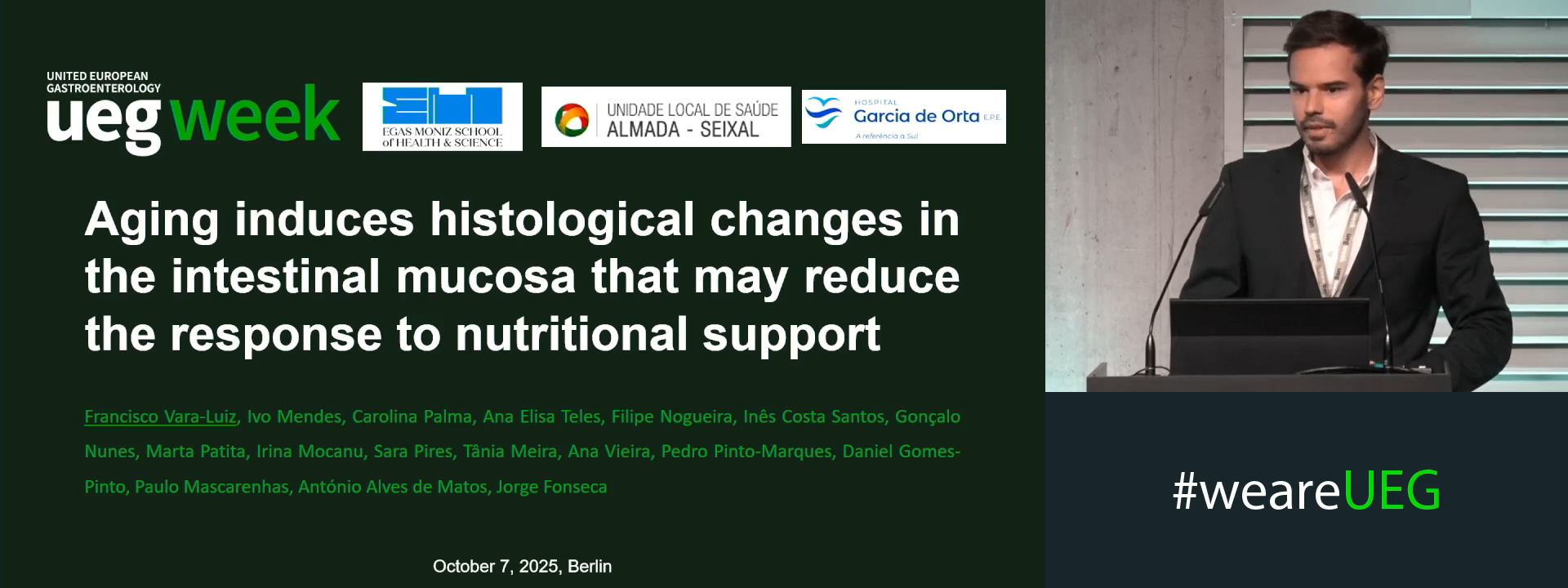
AGING INDUCES HISTOLOGICAL CHANGES IN THE INTESTINAL MUCOSA THAT MAY REDUCE THE RESPONSE TO NUTRITIONAL SUPPORT
Francisco Vara-Luiz 1, Ivo Mendes 1, Carolina Palma 1, Margarida Rajão Saraiva 2, Ana Elisa Teles 3, Filipe Nogueira 3, Inês Costa Santos 3, Gonçalo Nunes 4, Marta Patita 3, Irina Mocanu 3, Sara Isabel Ramos Pires 3, Tania Meira 3, Ana Isabel Vieira 3, Unknown Unknown 3, Daniel Gomes-Pinto 3, Paulo Mascarenhas 5, Jorge Fonseca 1
1 Hospital Garcia de Orta, Almada, Portugal|||Egas Moniz Center for Interdisciplinary Research (CiiEM), Egas Moniz School of Health and Science, Almada, Portugal
2 Instituto Português de Oncologia de Lisboa Francisco Gentil, Lisboa, Portugal
3 Hospital Garcia de Orta, Almada, Portugal
4 Egas Moniz Center for Interdisciplinary Research (CiiEM), Egas Moniz School of Health and Science, Almada, Portugal|||Hospital Garcia de Orta, Almada, Portugal
5 Egas Moniz Center for Interdisciplinary Research (CiiEM), Egas Moniz School of Health and Science, Almada, Portugal
Event
Submission format
Citation
Published
Log in to access this content.
Free for all myUEG account holders. Your access level is set automatically based on your occupation. Medical professionals get full access to all content. If you are a non-medical user, you can only access UEG Week content from congresses you attended.
Not sure what you can access? Learn more about account types.
CMV INFECTION IN ULCERATIVE COLITIS: FOCUS ON TISSUE PCR AND IMMUNOHISTOCHEMISTRY
Raffaella Rima 1, Chiara Maria Penati 2, Francesco Maria Stalla 3, Mariabeatrice Rita Daniela Principi 4, Stefano Okolicsanyi 2
1 Umberto Parini Hospital, Aosta, Italy|||Azienda Ospedaliero Universitaria Consorziale Policlinico, Bari, Italy
2 Umberto Parini Hospital, Aosta, Italy
3 Mauriziano Hospital, Turin, Italy
4 Azienda Ospedaliero Universitaria Consorziale Policlinico, Bari, Italy
Conference
Topics
Submission format
Citation
Published
Log in to access this content.
Free for all myUEG account holders. Your access level is set automatically based on your occupation. Medical professionals get full access to all content. If you are a non-medical user, you can only access UEG Week content from congresses you attended.
Not sure what you can access? Learn more about account types.
CYTOMEGALOVIRUS COLITIS IN SEVERE INFLAMMATORY BOWEL DISEASE FLARES: PREVALENCE AND ASSOCIATED FACTORS
Feriel Sahbani 1, Emna Belhadj Mabrouk 2, Mensi Asma 3, Shema Ayadi 4, Leila Mouelhi 5, Radhouane Debbeche 6
1 University Hospital Rabta, Tunis, Tunisia
2 Charles Nicole Hospital, Ezzahra, Tunisia
3 Hospital La Rabta, Ben Arous, Tunisia
4 Charles Nicolle Hospital, Tunis, Tunisia
5 Hopital Charles Nicolle, Bab Saadoun Tunis, Tunisia
6 Charles Nicole Hospital, Tunis, Tunisia
Conference
Topics
Submission format
Session