UEG's content platform for gastroenterology education bringing recordings, courses, guidelines, and more together in one place.
Trending on Gutflix
Rate for better recommendations!
Your feedback helps us show you more of what you like and less of what you dislike!
Log in to continue.
This content is part of Gutflix. Log in with your myUEG account, or create one free, to watch it.
Not sure what you can access? Learn more about account types.
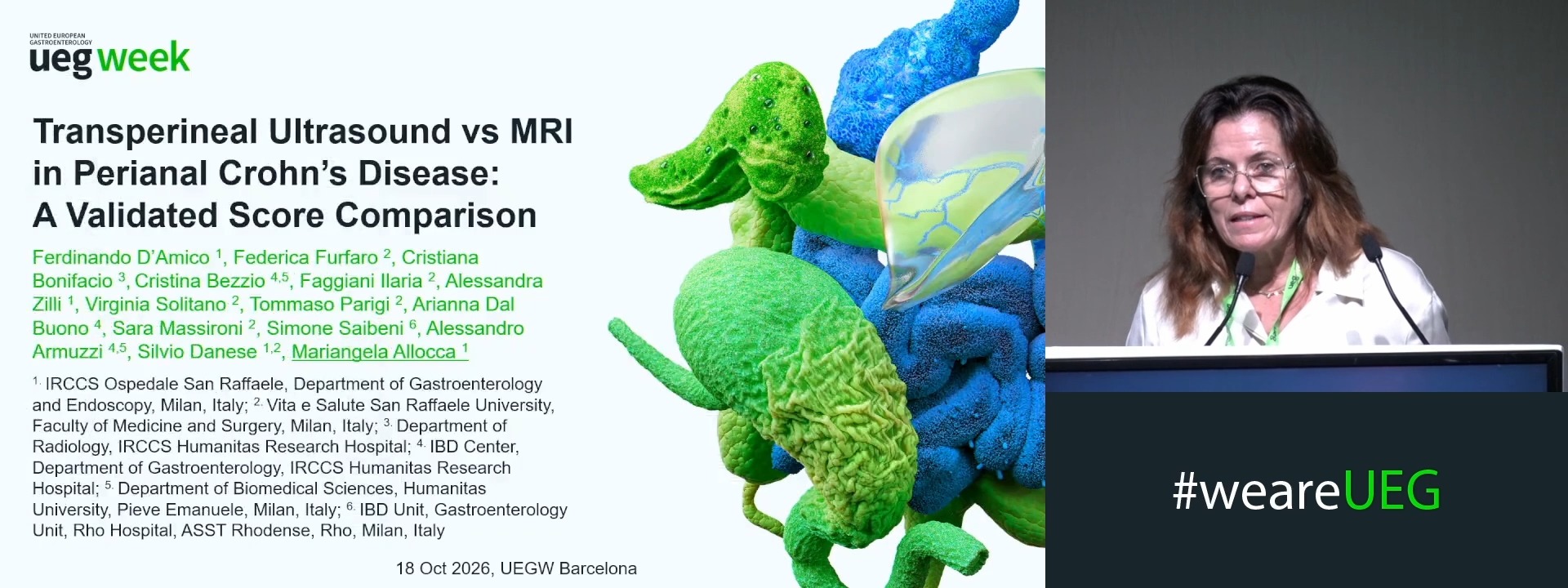
TRANSPERINEAL ULTRASOUND VS MRI IN PERIANAL CROHN’S DISEASE: A VALIDATED SCORE COMPARISON
Ferdinando D'Amico 1, Federica Furfaro 1, Cristiana Bonifacio 2, Cristina Bezzio 2, Ilaria Faggiani 1, Alessandra Zilli 1, Virginia Solitano 1, Tommaso Lorenzo Parigi 1, Arianna Dal Buono 2, Sara Massironi 1, Simone Saibeni 3, Alessandro Armuzzi 2, Silvio Danese 1, Mariangela Allocca 1
Affiliations
1 IRCCS Hospital San Raffaele and University Vita-Salute San Raffaele, Milano, Italy
2 IRCCS Humanitas Research Hospital, Rozzano, Milan, Italy
3 ASST Rhodense, Rho, Italy
Log in to continue.
This content is part of Gutflix. Log in with your myUEG account, or create one free, to watch it.
Not sure what you can access? Learn more about account types.
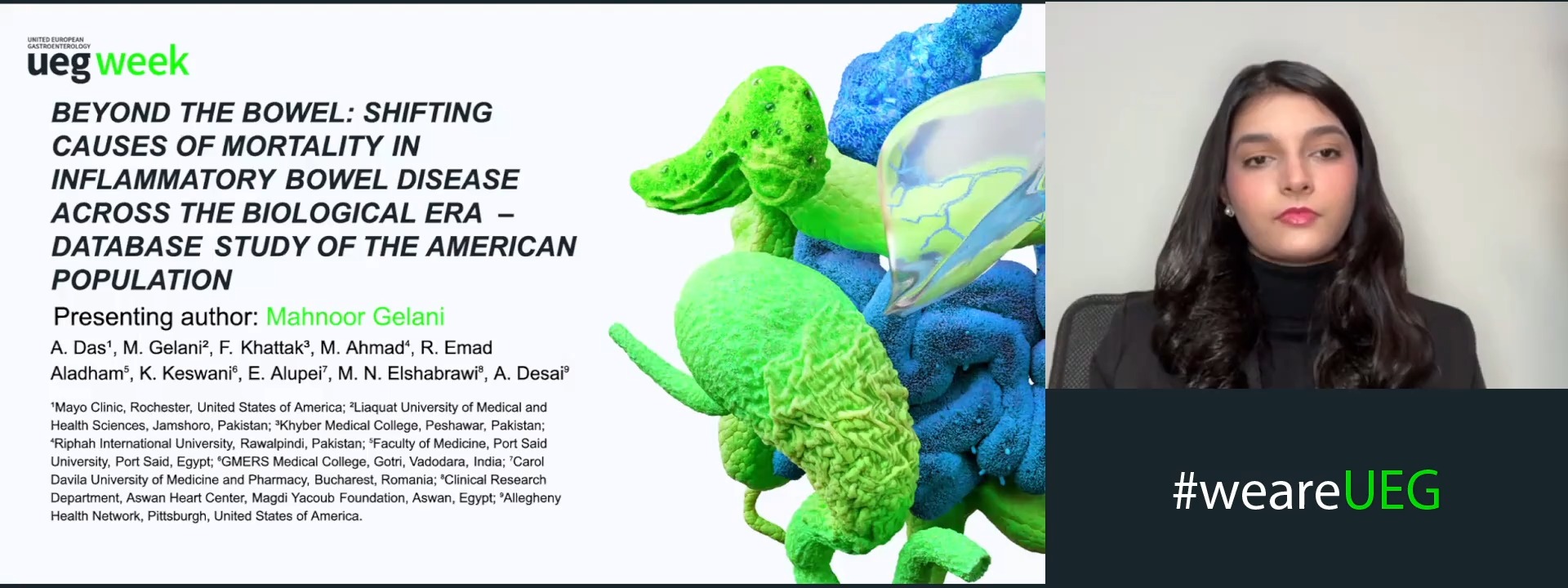
BEYOND THE BOWEL: SHIFTING CAUSES OF MORTALITY IN INFLAMMATORY BOWEL DISEASE ACROSS THE BIOLOGIC ERA - DATABASE STUDY OF AMERICAN POPULATION (1990–2025)
Ashesh Das 1, Mahnoor Gelani 2, Fazia Khattak 3, Mahad Ahmad 4, Rovan Emad Aladham 5, Krish Keswani 6, Elena Alupei 7, Mohamed Nasser Elshabrawi 8, Aakash Desai 9
Affiliations
1 Mayo Clinic, Rochester, United States
2 Liaquat University of Medical and Health Science, Jamshoro, Pakistan
3 Khyber Medical College, Peshawar, Pakistan
4 Riphah International University, Rawalpindi, Pakistan
5 Faculty of Medicine Port Said University, Port Said, Pakistan
6 GMERS Medical College, Gotri, Vadodara, India
7 Carol Davila University of Medicine and Pharmacy, Bucharest, Romania
8 Clinical Research Department, Aswan Heart Center, Magdi Yaqoup Foundation, Aswan, Egypt
9 Allegheny Health Network, Pittsburgh, United States
Log in to continue.
This content is part of Gutflix. Log in with your myUEG account, or create one free, to watch it.
Not sure what you can access? Learn more about account types.
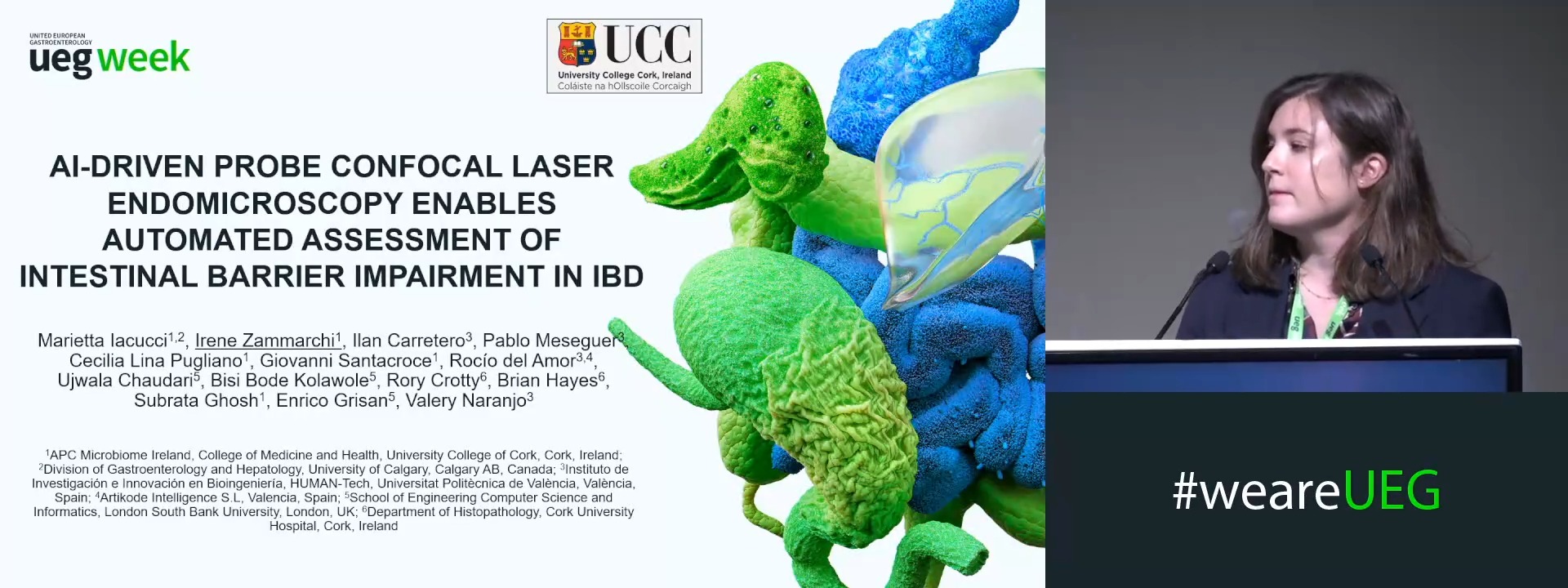
AI-DRIVEN PROBE CONFOCAL LASER ENDOMICROSCOPY ENABLES AUTOMATED ASSESSMENT OF INTESTINAL BARRIER IMPAIRMENT IN IBD
Marietta Iacucci 1,2, Irene Zammarchi 1, Ilan Carretero 3, Pablo Meseguer 3, Cecilia Lina Pugliano 1, Giovanni Santacroce 1, Rocio Del Amor 3,4, Ujwala Chaudhari 5, Bisi Bode Kolawole 5, Rory Crotty 6, Brian Hayes 6, Subrata Ghosh 1, Enrico Grisan 5, Valery Naranjo 3,4
Affiliations
1 University College Cork, Cork, Ireland
2 University of Calgary, Calgary, Canada
3 Universitat Politècnica de València, Valencia, Spain
4 Artikode Intelligence S.L., Valencia, Spain
5 London South Bank University, London, United Kingdom
6 Cork University Hospital, Cork, Ireland