UEG's educational platform for gastroenterology education bringing recordings, courses, guidelines, and more together in one place.
Most popular content
Rate for better recommendations!
Your feedback helps us show you more of what you like and less of what you dislike!
Log in to continue.
This content is part of Gutflix. Log in with your myUEG account, or create one free, to watch it.
Not sure what you can access? Learn more about account types.
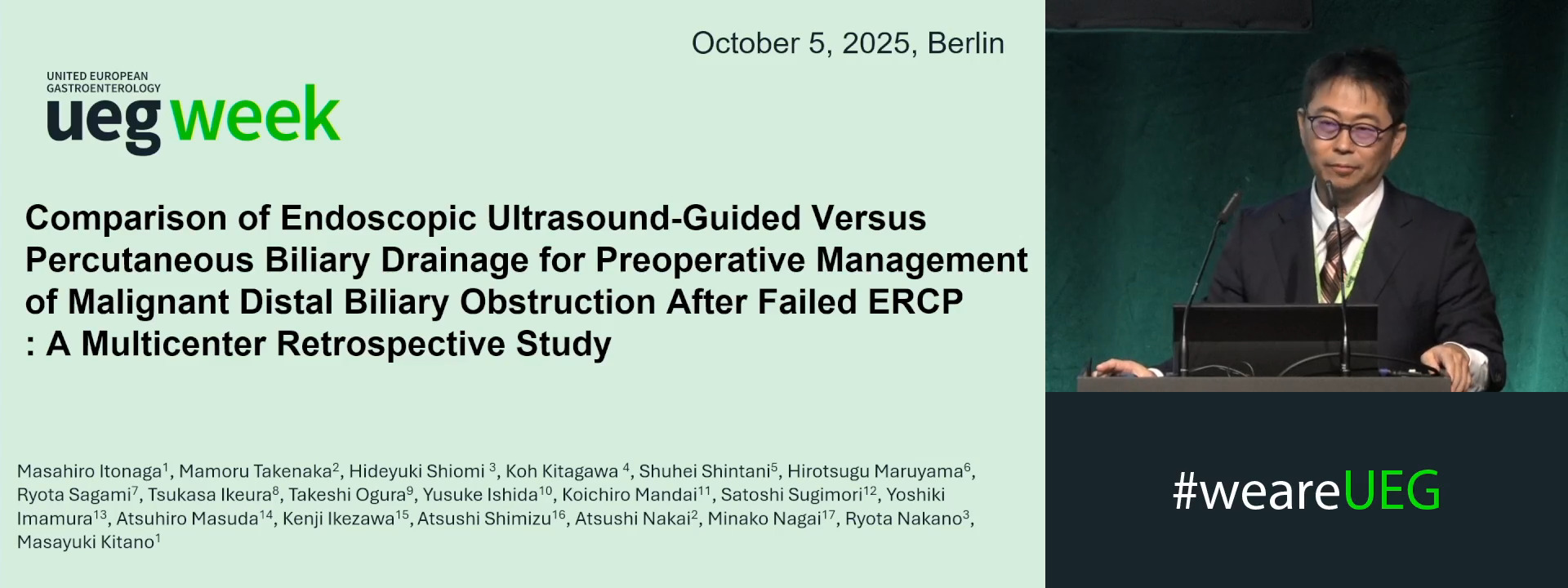
COMPARISON OF ENDOSCOPIC ULTRASOUND-GUIDED VERSUS PERCUTANEOUS BILIARY DRAINAGE FOR PREOPERATIVE MANAGEMENT OF MALIGNANT DISTAL BILIARY OBSTRUCTION AFTER FAILED ERCP: A MULTICENTER RETROSPECTIVE STUDY
Itonaga Masahiro 1, Mamoru Takenaka 2, Hideyuki Shiomi 3, Koh Kitagawa 4, Shuhei Shintani 5, Hirotsugu Maruyama 6, Ryota Sagami 7, Tsukasa Ikeura 8, Takeshi Ogura 9, Yusuke Ishida 10, Koichiro Mandai 11, Satoshi Sugimori 12, Yoshiki Imamura 13, Atsuhiro Masuda 14, Kenji Ikezawa 15, Atsushi Shimizu 16, Misako Nagai 4, Atsushi Nakai 2, Ryota Nakano 3, Masayuki Kitano 16
Affiliations
1 Wakayama Medical University, Wakayama City, Japan
2 Kindai University Faculty of Medicine, Osaka, Japan
3 Hyogo Medical University, Hyogo, Japan
4 Nara Medical University, Nara, Japan
5 Shiga University of Medical Science, Otsu, Japan
6 Osaka City University Graduate School of Medicine, Osaka, Japan
7 Oita University, Yufu, Japan
8 Kansai Medical University, Hirakata, Japan
9 Osaka Medical and Pharmaceutical University Hospital, Takatsuki, Japan
10 Fukuoka University Faculty of Medicine, Fukuoka, Japan
11 Kyoto Second Red Cross Hospital, Kyoto, Japan
12 Osaka City Genaral Hospital, Osaka, Japan
13 Ehime University Graduate School of Medicine, Ehime, Japan
14 Kobe graduate school of medicine, Kobe, Japan
15 Osaka International Cancer Institute, Osaka, Japan
16 Wakayama Medical University, Wakayama, Japan
Log in to continue.
This content is part of Gutflix. Log in with your myUEG account, or create one free, to watch it.
Not sure what you can access? Learn more about account types.
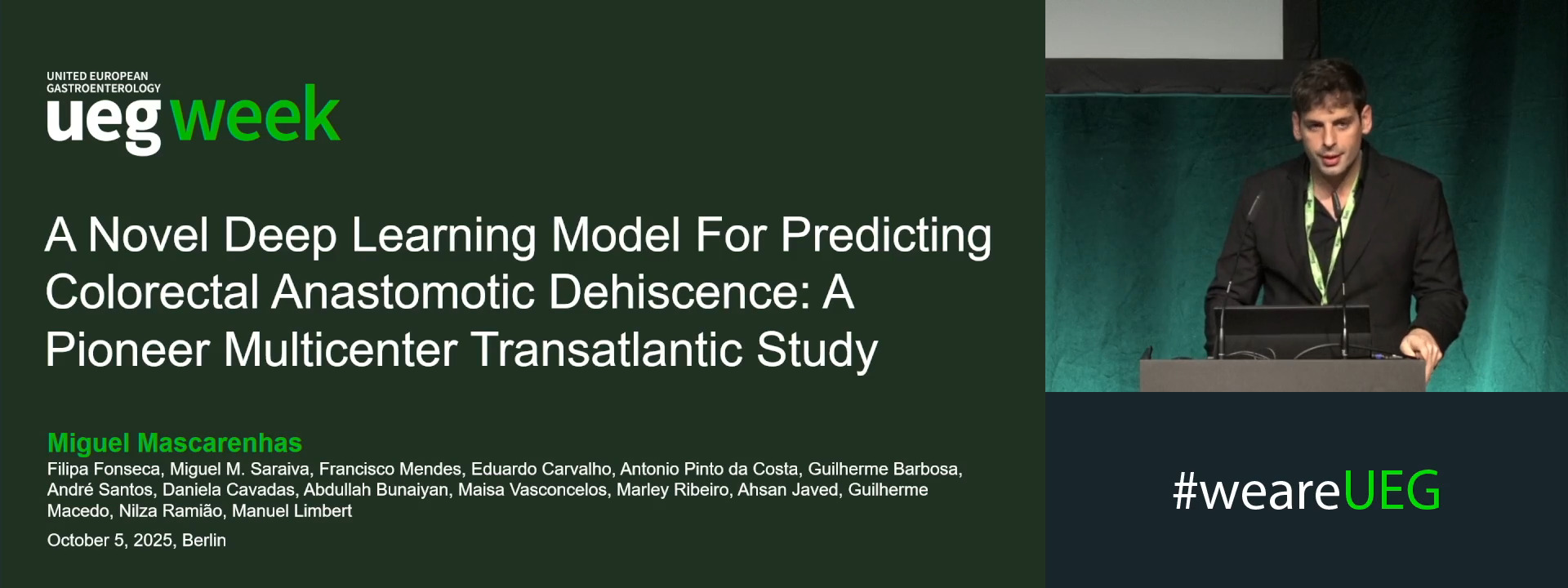
A NOVEL DEEP LEARNING MODEL FOR PREDICTING COLORECTAL ANASTOMOTIC DEHISCENCE: A PIONEER MULTICENTER TRANSATLANTIC STUDY
Miguel Mascarenhas-Saraiva 1, Francisco Mendes 1, André Martins dos Santos 2, António Miguel Martins Pinto da Costa 3, Filipa Fonseca 4, Eduardo Carvalho 5, Nilza Ramião 5, Guilherme Barbosa 5, Maisa Vasconcellos 6, Abdullah Bunaiyan 7, Maria Almeida 1, Joana Mota 1, Tiago Ribeiro 1, Miguel Martins 1, João Afonso 1, Pedro Cardoso 1, Francisca Pinheiro 2, Matheus Carvalho 3, Marcos Eduardo Lera dos Santos 3, Eduardo De Moura 3, Marley Feitosa 6, Ahsan Javed 7, Guilherme Macedo 1, Manuel Limbert 4
Affiliations
1 Centro Hospitalar Universitário de São João, Porto, Portugal
2 Faculdade de Medicina da Universidade do Porto, Porto, Portugal
3 Hospital das Clínicas da Faculdade de Medicina da USP, São Paulo, Brazil
4 Instituto Português de Oncologia IPO, Lisboa, Portugal
5 INEGI – Institute of Science and Innovation in Mechanical and Industrial Engineering, Porto, Portugal
6 Hospital das Clínicas da Faculdade de Medicina de USP - Ribeirão Preto, São Paulo, Brazil
7 Liverpool University Hospitals NHS Foundation Trust, Liverpool, United Kingdom
Log in to continue.
This content is part of Gutflix. Log in with your myUEG account, or create one free, to watch it.
Not sure what you can access? Learn more about account types.
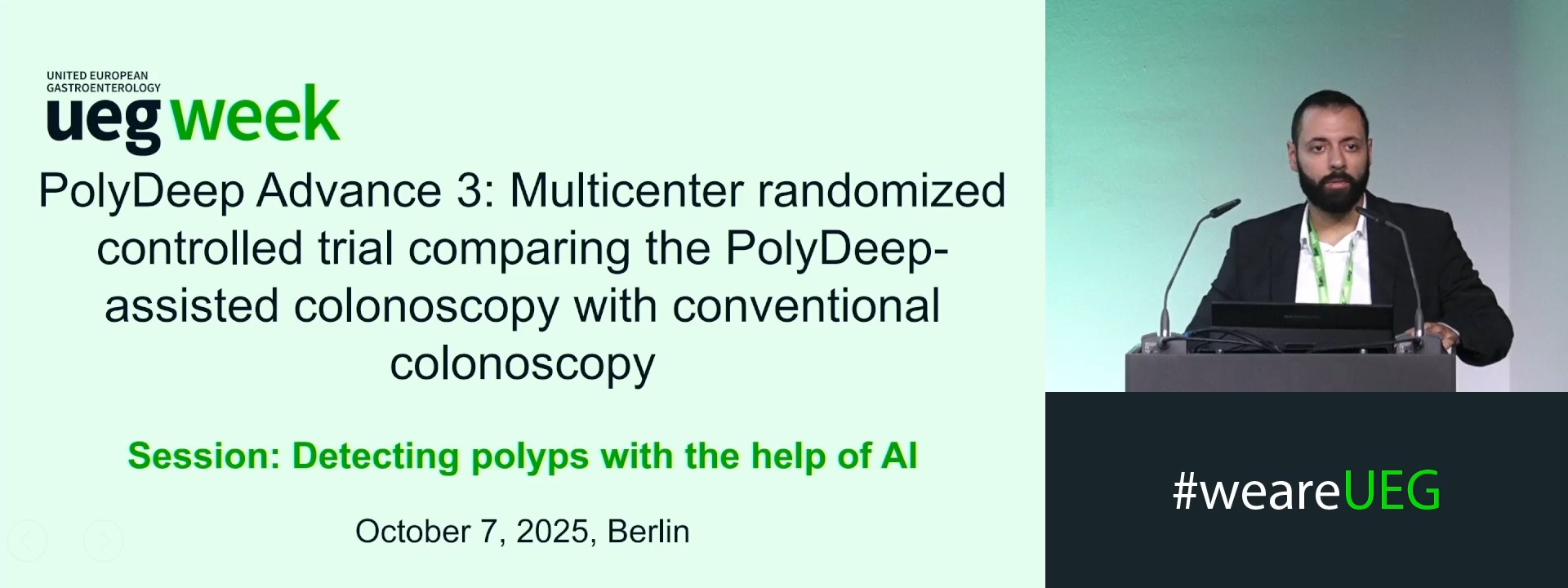
POLYDEEP ADVANCE 3: MULTICENTRE RANDOMIZED CONTROLLED TRIAL COMPARING THE POLYDEEP-ASSISTED COLONOSCOPY WITH CONVENTIONAL COLONOSCOPY
Pedro Davila-Piñón 1, Astrid Irene Díez Martín 1, Cristina Regueiro Expósito 1, Alba Nogueira-Rodríguez 2, Florentino Fdez-Riverola 2, Miguel Reboiro-Jato 2, Daniel Glez-Peña 2, Rubén Domínguez-Carbajales 3, Luisa De Castro Parga 4, Jesús Daniel Fernández de Castro 5, Pablo Vega 5, Miguel Telmo Galovart Araguas 4, Santiago Soto 5, Sara Alonso Lorenzo 4, Alfonso Martinez Turnes 4, Noel Pin Vieito 5, Sara Zarraquiños Martínez 5, David Remedios 5, Cristina Alejandra Sánchez Gómez 5, Raquel Souto Rodríguez 6, Franco Baiocchi 5, María José Iglesias-Varela 5, Coral Tejido Sandoval 5, Alejandro Ledo 6, Laura Rivas Moral 5, Natalia Garcia Morales 4, Antonio Rodríguez 4, Manuel Puga 5, María Belén Castiñeira-Domínguez 6, Nereida Fernández Fernández 4, Arantxa Germade-Martínez 4, Enrique González 6, Indhira Miosotis 6, Romina Fernández Poceiro 4, Eloy Sanchez Hernandez 5, Hugo López-Fernández 2, Joaquín Cubiella 7
Affiliations
1 Research Group in Gastrointestinal Oncology, Ourense, Spain|||Galicia-Sur Public Biomedical Foundation, Ourense, Spain
2 Universidade de Vigo, Ourense, Spain|||SING Research Group, Ourense, Spain
3 Complexo Hospitalario Universitario de Ourense, Ourense, Spain
4 Hospital Álvaro Cunqueiro de Vigo - CHUVI, Vigo, Spain
5 Hospital Universitario de Ourense, Ourense, Spain
6 Hospital Montecelo - CHUP, Pontevedra, Spain
7 Research Group in Gastrointestinal Oncology, Ourense, Spain|||Hospital Universitario de Ourense, Ourense, Spain
Log in to continue.
This content is part of Gutflix. Log in with your myUEG account, or create one free, to watch it.
Not sure what you can access? Learn more about account types.
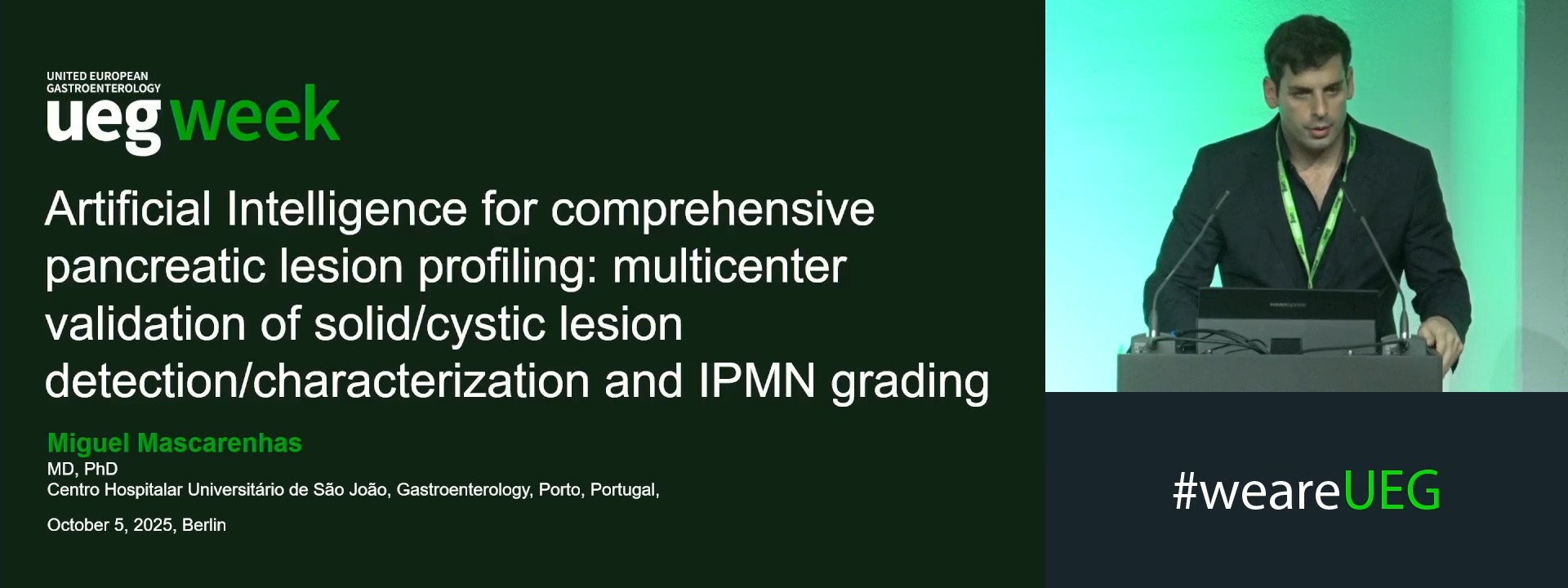
ARTIFICIAL INTELLIGENCE FOR COMPREHENSIVE PANCREATIC LESION PROFILING: MULTICENTER VALIDATION OF SOLID/CYSTIC LESION DETECTION/CHARACTERIZATION AND IPMN GRADING
Miguel Mascarenhas-Saraiva 1, António Miguel Martins Pinto da Costa 2, Belén Agudo Castillo 2, Francisco Mendes 1, Jessica Widmer 3, Uzma D. Siddiqui 4, Tiago Ribeiro 1, Miguel Martins 1, Pedro Cardoso 1, Joana Mota 1, Maria Almeida 1, João Afonso 1, Grace E. Kim 4, Daniel De la Iglesia-García 2, Ana Pérez González 2, Carlos Esteban Fernández-Zarza 2, Ana Garcia Garcia de Paredes 5, Maria Moris 6, Matheus Ferreira de Carvalho 7, Marcos Eduardo Lera dos Santos 8, João Ferreira 9, Khoon Sheng Kok 10, Tamas Gonda 11, Joan B. Gornals 12, Mason Adams 13, Jack Di Palma 13, André Martins Dos Santos 14, Filipe Vilas-Boas 1, Pedro Moutinho-Ribeiro 1, Susana Lopes 1, Mariano Ganzalez- Haba Ruiz 2, Eduardo Guimarães Hourneaux de Moura 7, Guilherme Macedo 1
Affiliations
1 Centro Hospitalar Universitário de São João, Porto, Portugal
2 Hospital Universitario Puerta de Hierro Majadahonda, Madrid, Spain
3 NYU Langone Health, New York, United States
4 Center for Endoscopic Research and Therapeutics (CERT) and Advanced Endoscopy Training, University of Chicago, Chicago, United States
5 Hospital Universitario Ramon y Cajal, Madrid, Spain
6 Hospital Universitario Marqués de Valdecilla, Santander, Spain
7 Hospital das Clínicas da Faculdade de Medicina da USP, São Paulo, Brazil
8 Hospital das Clínicas da Faculdade de Medicina da USP, São Paulo, Brazil|||Hospital São Luiz Jabaquara, São Paulo, Brazil
9 Faculty of Engineering of the University of Porto, Porto, Portugal
10 Royal Liverpool Hospital, Liverpool, United Kingdom
11 Columbia University, New York, United States
12 Hospital Universitari De Bellvitge, Bellvitge Biomedical Research Institute (idibell), Barcelona, Spain
13 University of South Alabama, Mobile, United States
14 Faculdade de Medicina da Universidade do Porto, Porto, Portugal
Log in to continue.
This content is part of Gutflix. Log in with your myUEG account, or create one free, to watch it.
Not sure what you can access? Learn more about account types.
Words of welcome
Affiliations
1 Klinikum der LMU München-Grosshadern, München, Germany
Log in to continue.
This content is part of Gutflix. Log in with your myUEG account, or create one free, to watch it.
Not sure what you can access? Learn more about account types.
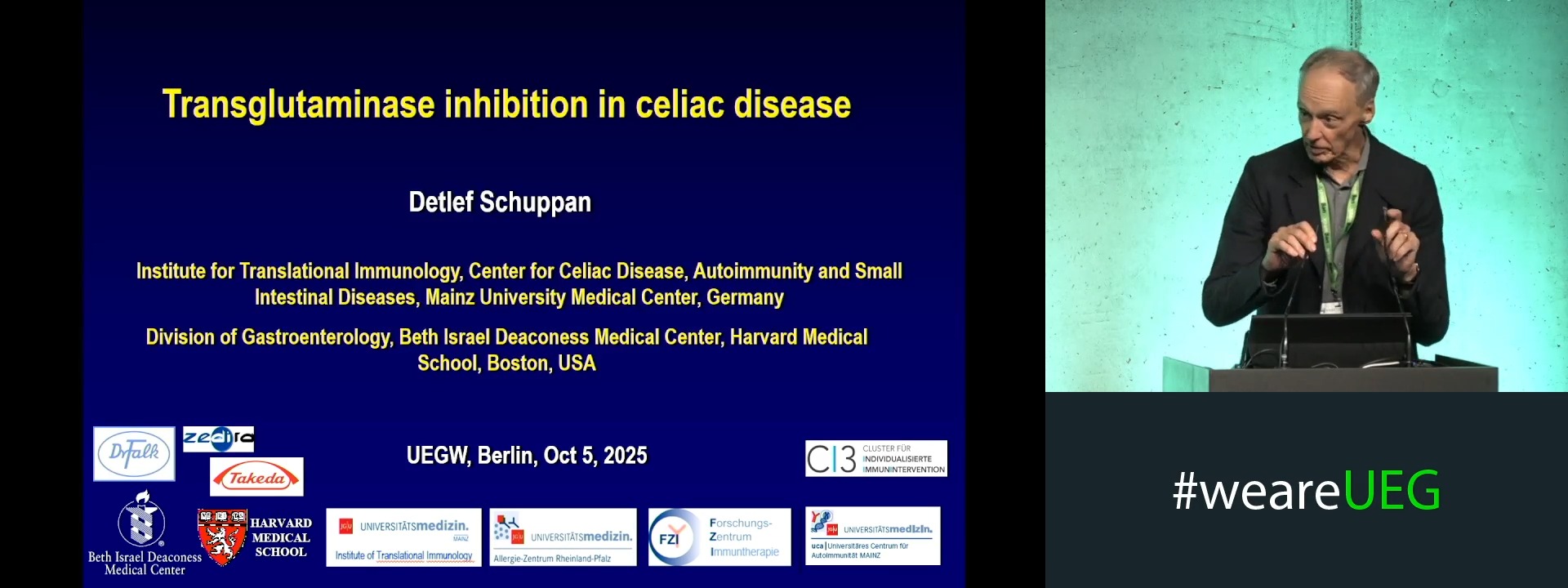
Transglutaminase inhibition in CeD
Affiliations
1 Medical University Mainz - Institute of Translational Immunology, Medical University Mainz ; Mainz/D, Mainz, Germany