UEG's educational platform for gastroenterology education bringing recordings, courses, guidelines, and more together in one place.
Most popular content
Rate for better recommendations!
Your feedback helps us show you more of what you like and less of what you dislike!
Log in to access this content.
Free for all myUEG account holders. Your access level is set automatically based on your occupation. Medical professionals get full access to all content. If you are a non-medical user, you can only access UEG Week content from congresses you attended.
Not sure what you can access? Learn more about account types.
UNBURDENING THE PILL LOAD: REAL-WORLD EVIDENCE OF MEDICATION REDUCTION AFTER ENDOSCOPIC SLEEVE GASTROPLASTY
Yan Ling Ong 1, Michael Chu 1, Sushmitha C 1, Charlene Tan 1, Tian Yu Qiu 1, Carlos Paolo Francisco 2, Rajesh R 3, Ravishankar Asokkumar 4
1 Singapore General Hospital, Singapore, Singapore
2 St. Luke's Medical Center - Global City, Taguig City, Philippines
3 Duke-NUS Graduate Medical School, Singapore, Singapore|||Singapore General Hospital, Singapore, Singapore
4 Singapore General Hospital, Singapore, Singapore|||Duke-NUS Graduate Medical School, Singapore, Singapore
Conference
Topics
Submission format
Citation
Published
Log in to access this content.
Free for all myUEG account holders. Your access level is set automatically based on your occupation. Medical professionals get full access to all content. If you are a non-medical user, you can only access UEG Week content from congresses you attended.
Not sure what you can access? Learn more about account types.
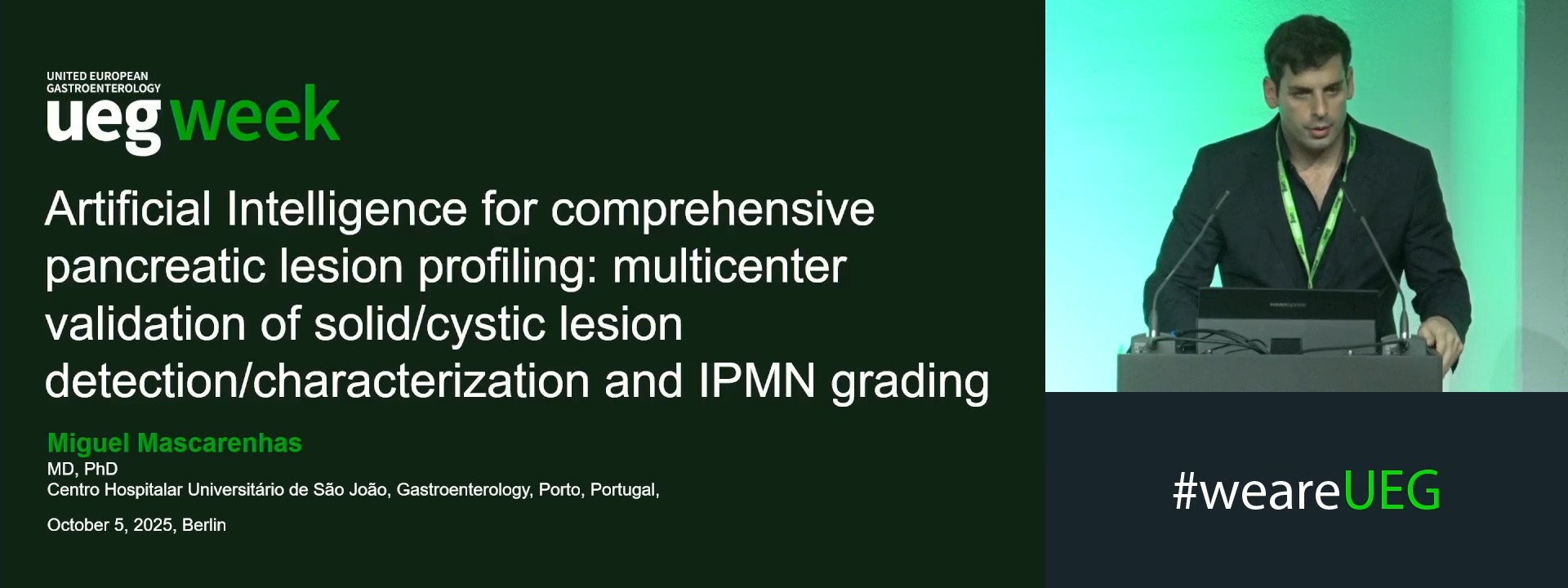
ARTIFICIAL INTELLIGENCE FOR COMPREHENSIVE PANCREATIC LESION PROFILING: MULTICENTER VALIDATION OF SOLID/CYSTIC LESION DETECTION/CHARACTERIZATION AND IPMN GRADING
Miguel Mascarenhas-Saraiva 1, António Miguel Martins Pinto da Costa 2, Belén Agudo Castillo 2, Francisco Mendes 1, Jessica Widmer 3, Uzma D. Siddiqui 4, Tiago Ribeiro 1, Miguel Martins 1, Pedro Cardoso 1, Joana Mota 1, Maria Almeida 1, João Afonso 1, Grace E. Kim 4, Daniel De la Iglesia-García 2, Ana Pérez González 2, Carlos Esteban Fernández-Zarza 2, Ana Garcia Garcia de Paredes 5, Maria Moris 6, Matheus Ferreira de Carvalho 7, Marcos Eduardo Lera dos Santos 8, João Ferreira 9, Khoon Sheng Kok 10, Tamas Gonda 11, Joan B. Gornals 12, Mason Adams 13, Jack Di Palma 13, André Martins Dos Santos 14, Filipe Vilas-Boas 1, Pedro Moutinho-Ribeiro 1, Susana Lopes 1, Mariano Ganzalez- Haba Ruiz 2, Eduardo Guimarães Hourneaux de Moura 7, Guilherme Macedo 1
1 Centro Hospitalar Universitário de São João, Porto, Portugal
2 Hospital Universitario Puerta de Hierro Majadahonda, Madrid, Spain
3 NYU Langone Health, New York, United States
4 Center for Endoscopic Research and Therapeutics (CERT) and Advanced Endoscopy Training, University of Chicago, Chicago, United States
5 Hospital Universitario Ramon y Cajal, Madrid, Spain
6 Hospital Universitario Marqués de Valdecilla, Santander, Spain
7 Hospital das Clínicas da Faculdade de Medicina da USP, São Paulo, Brazil
8 Hospital das Clínicas da Faculdade de Medicina da USP, São Paulo, Brazil|||Hospital São Luiz Jabaquara, São Paulo, Brazil
9 Faculty of Engineering of the University of Porto, Porto, Portugal
10 Royal Liverpool Hospital, Liverpool, United Kingdom
11 Columbia University, New York, United States
12 Hospital Universitari De Bellvitge, Bellvitge Biomedical Research Institute (idibell), Barcelona, Spain
13 University of South Alabama, Mobile, United States
14 Faculdade de Medicina da Universidade do Porto, Porto, Portugal
Event
Topics
Submission format
Citation
Published
Log in to access this content.
Free for all myUEG account holders. Your access level is set automatically based on your occupation. Medical professionals get full access to all content. If you are a non-medical user, you can only access UEG Week content from congresses you attended.
Not sure what you can access? Learn more about account types.
Panel discussion: Post-OP complications
Event
Topics
Citation
Published
Log in to access this content.
Free for all myUEG account holders. Your access level is set automatically based on your occupation. Medical professionals get full access to all content. If you are a non-medical user, you can only access UEG Week content from congresses you attended.
Not sure what you can access? Learn more about account types.
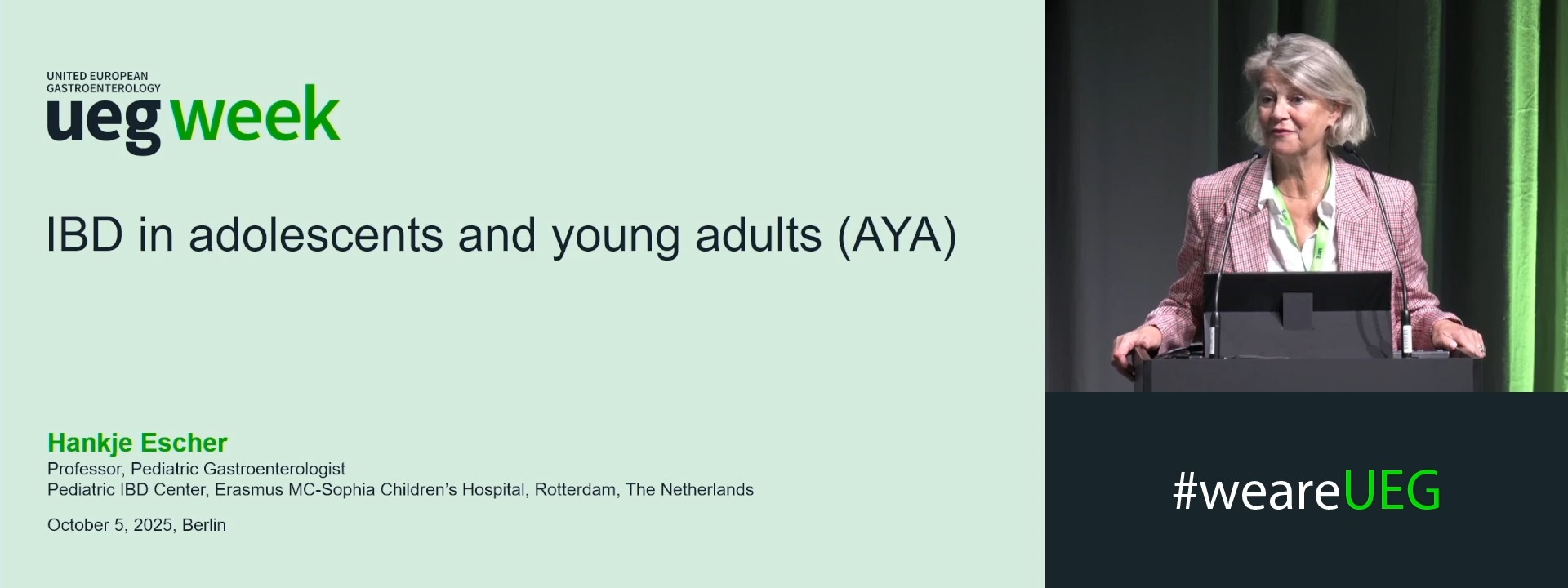
AYA: Adolescents and young adults
1 Erasmus Medical Center, Rotterdam, Netherlands
Event
Topics
Session
Citation
Published
Log in to access this content.
Free for all myUEG account holders. Your access level is set automatically based on your occupation. Medical professionals get full access to all content. If you are a non-medical user, you can only access UEG Week content from congresses you attended.
Not sure what you can access? Learn more about account types.
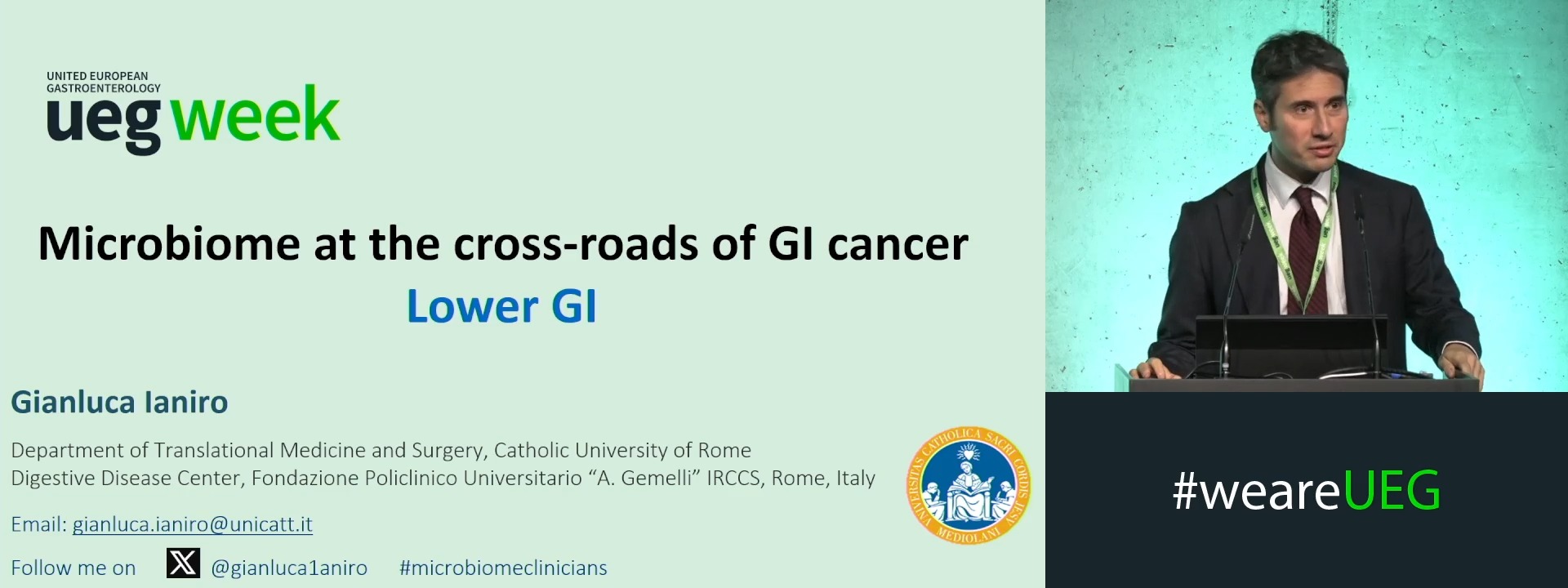
Lower-GI cancer
1 Fondazione Policlinico Universitario "A. Gemelli" IRCCS, Catholic University of Rome, Rome, Italy
Event
Citation
Published
Log in to access this content.
Free for all myUEG account holders. Your access level is set automatically based on your occupation. Medical professionals get full access to all content. If you are a non-medical user, you can only access UEG Week content from congresses you attended.
Not sure what you can access? Learn more about account types.
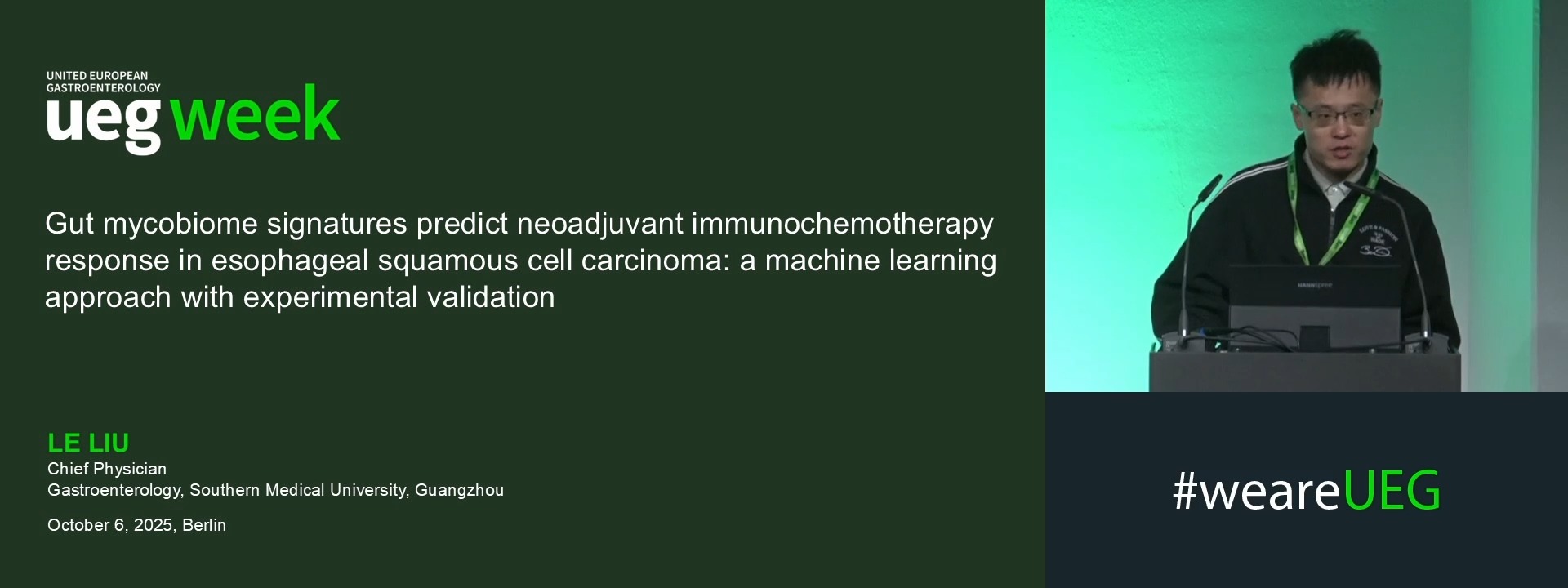
GUT MYCOBIOME SIGNATURES PREDICT NEOADJUVANT IMMUNOCHEMOTHERAPY RESPONSE IN ESOPHAGEAL SQUAMOUS CELL CARCINOMA: A MACHINE LEARNING APPROACH WITH EXPERIMENTAL VALIDATION
1 Zhujiang Hospital, Southern Medical University, Guangzhou, China
2 Guangzhou First People's Hospital, Guangzhou, China
3 Nanfang Hospital, Southern Medical University, Guangzhou, China
Event
Submission format
Session
Citation
Published
Log in to access this content.
Free for all myUEG account holders. Your access level is set automatically based on your occupation. Medical professionals get full access to all content. If you are a non-medical user, you can only access UEG Week content from congresses you attended.
Not sure what you can access? Learn more about account types.
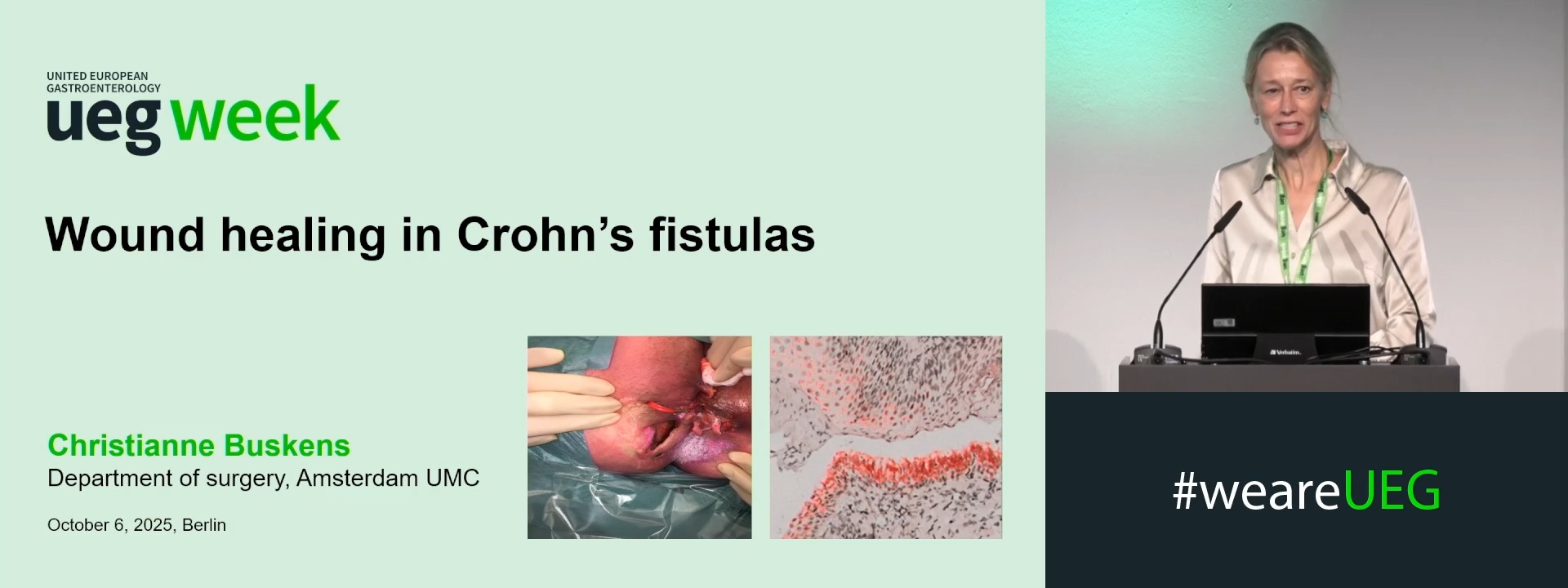
Wound healing in fistula and surgical wounds
1 Academic Medical Center, Amsterdam, Netherlands
Event
Topics