UEG's educational platform for gastroenterology education bringing recordings, courses, guidelines, and more together in one place.
Most popular content
Rate for better recommendations!
Your feedback helps us show you more of what you like and less of what you dislike!
Log in to access this content.
Free for all myUEG account holders. Your access level is set automatically based on your occupation. Medical professionals get full access to all content. If you are a non-medical user, you can only access UEG Week content from congresses you attended.
Not sure what you can access? Learn more about account types.

INTRODUCING MINI INTRON1 IN SPINK1 GENE ELEVATED SPINK1 EXPRESSION AND IMPROVED GENE THERAPY FOR PANCREATITIS IN MICE
1 Changhai Hospital, Shanghai, China
Conference
Topics
Submission format
Session
Citation
Published
Log in to access this content.
Free for all myUEG account holders. Your access level is set automatically based on your occupation. Medical professionals get full access to all content. If you are a non-medical user, you can only access UEG Week content from congresses you attended.
Not sure what you can access? Learn more about account types.
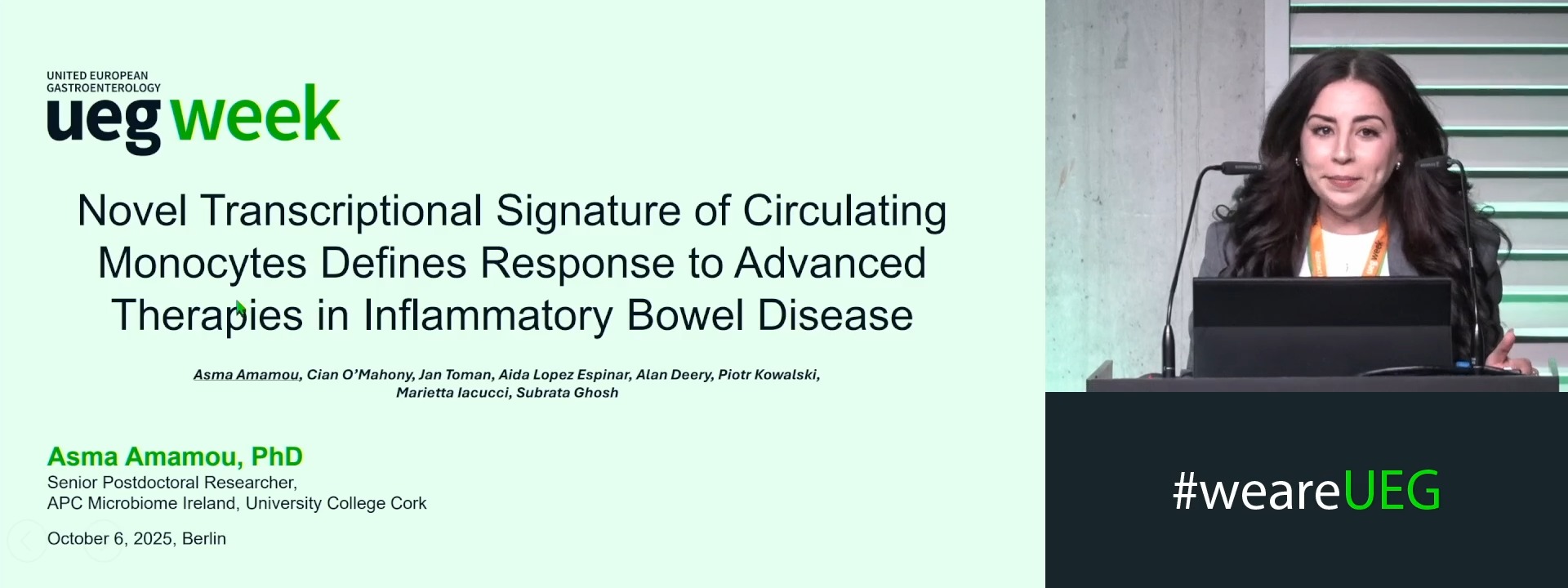
NOVEL TRANSCRIPTIONAL SIGNATURE OF CIRCULATING MONOCYTES DEFINES RESPONSE TO ADVANCED THERAPIES IN INFLAMMATORY BOWEL DISEASE
Asma Amamou 1, Cian O'Mahony 1, Jan Toman 1, Aida Lopez Espinar 2, Alan Deery 1, Piotr Kowalski 3, Marietta Iacucci 1, Subrata Ghosh 1
1 APC Microbiome Ireland, College of Medicine and Health, University College Cork, Cork, Ireland
2 School of Pharmacy, University College Cork, Cork, Ireland
3 APC Microbiome Ireland, College of Medicine and Health, University College Cork, Cork, Ireland|||School of Pharmacy, University College Cork, Cork, Ireland
Event
Submission format
Citation
Published
Log in to access this content.
Free for all myUEG account holders. Your access level is set automatically based on your occupation. Medical professionals get full access to all content. If you are a non-medical user, you can only access UEG Week content from congresses you attended.
Not sure what you can access? Learn more about account types.
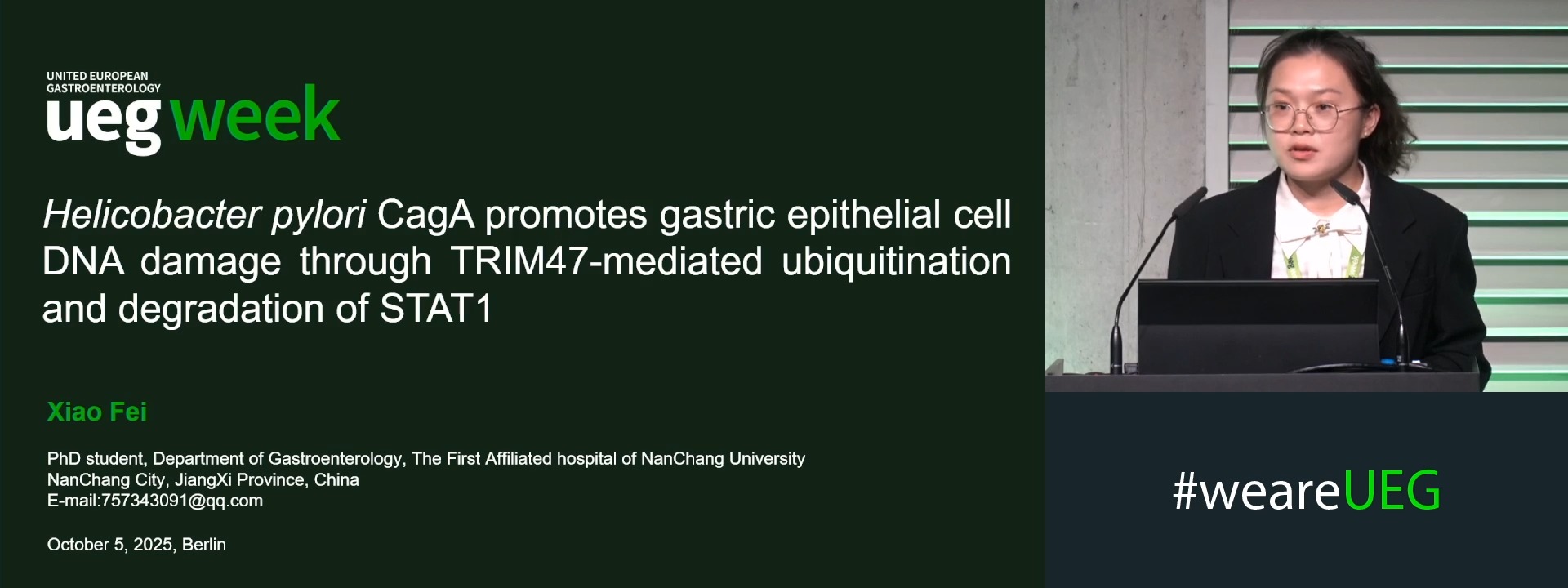
HELICOBACTER PYLORI CAGA PROMOTES GASTRIC EPITHELIAL CELL DNA DAMAGE THROUGH TRIM47-MEDIATED UBIQUITINATION AND DEGRADATION OF STAT1
1 The First Affiliated Hospital, Jiangxi Medical College, Nanchang University, Nanchang, China
Event
Submission format
Citation
Published
Log in to access this content.
Free for all myUEG account holders. Your access level is set automatically based on your occupation. Medical professionals get full access to all content. If you are a non-medical user, you can only access UEG Week content from congresses you attended.
Not sure what you can access? Learn more about account types.
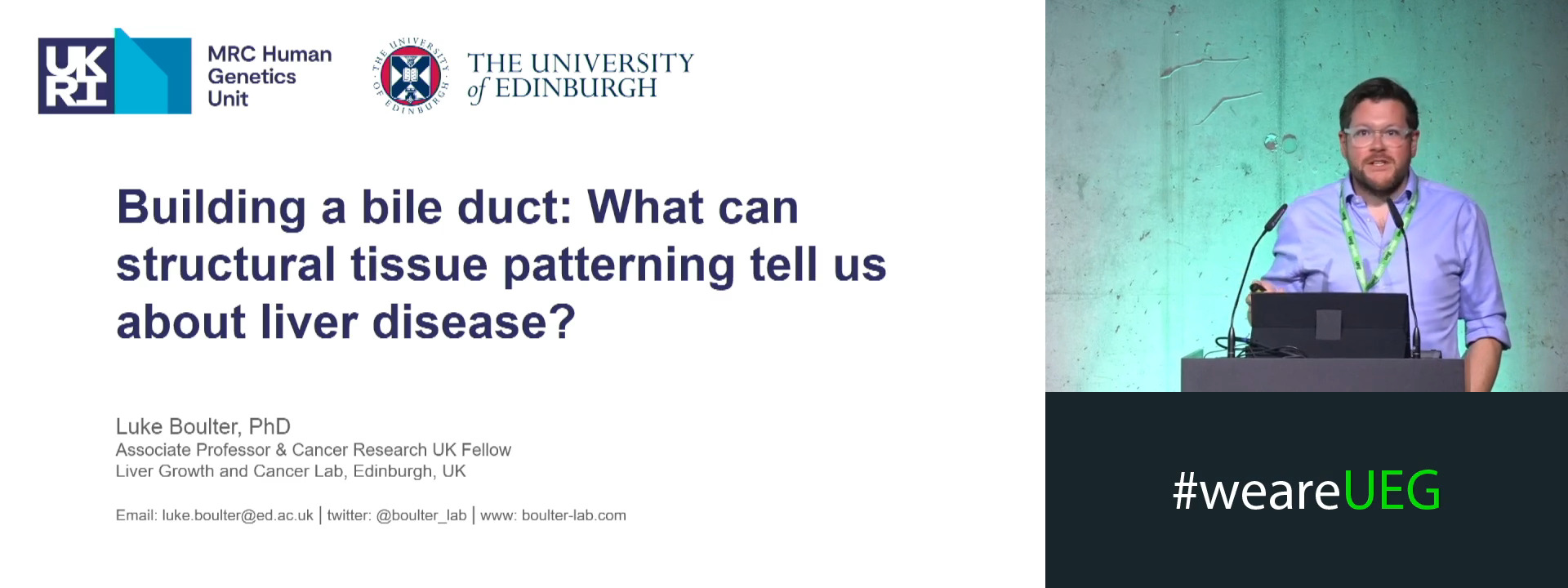
Building a bile duct: What can structural tissue patterning tell us about liver disease?
1 University of Edinburgh, Edinburgh, United Kingdom
Event
Session
Citation
Published
Log in to access this content.
Free for all myUEG account holders. Your access level is set automatically based on your occupation. Medical professionals get full access to all content. If you are a non-medical user, you can only access UEG Week content from congresses you attended.
Not sure what you can access? Learn more about account types.
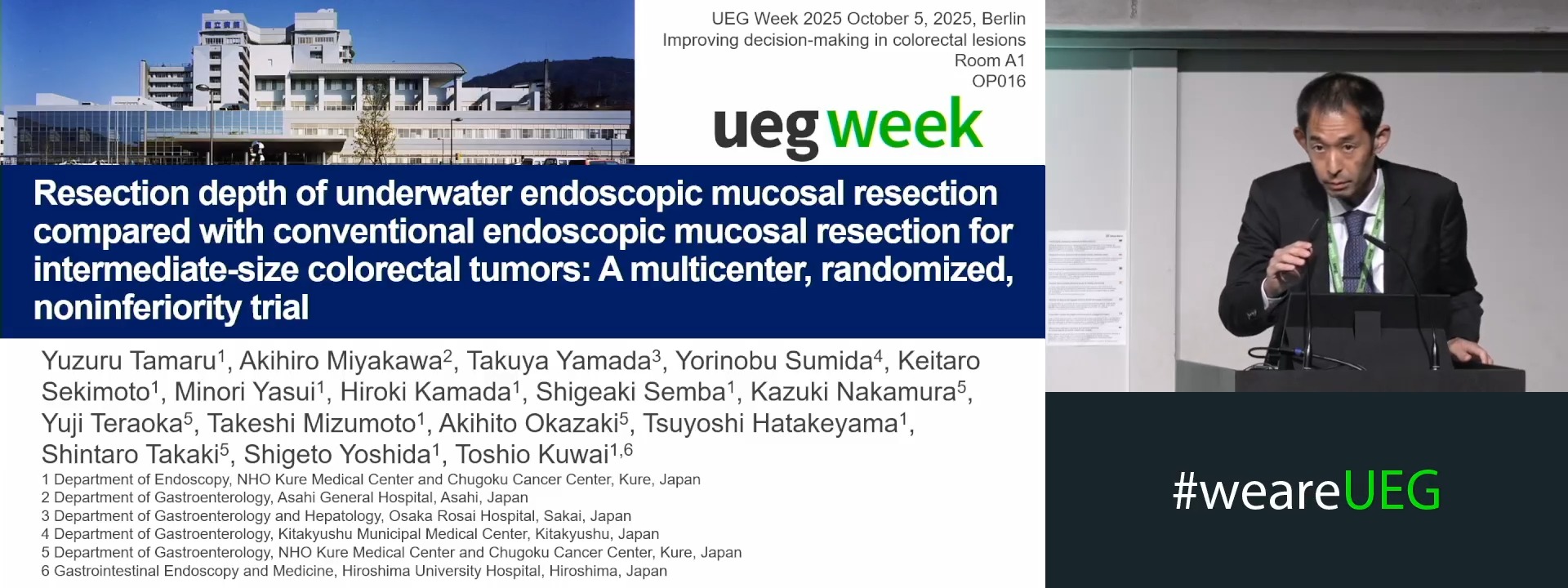
RESECTION DEPTH OF UNDERWATER ENDOSCOPIC MUCOSAL RESECTION COMPARED WITH CONVENTIONAL ENDOSCOPIC MUCOSAL RESECTION FOR INTERMEDIATE-SIZE COLORECTAL TUMORS: A MULTICENTER, RANDOMIZED, NONINFERIORITY TRIAL
Yuzuru Tamaru 1, Akihiro Miyakawa 2, Takuya Yamada 3, Yorinobu Sumida 4, Keitaro Sekimoto 1, Minori Yasui 1, Hiroki Kamada 1, Shigeaki Semba 1, Kazuki Nakamura 1, Yuji Teraoka 1, Takeshi Mizumoto 1, Akihito Okazaki 1, Tsuyoshi Hatakeyama 1, Shintaro Takaki 1, Shigeto Yoshida 1, Toshio Kuwai 5
1 NHO Kure Medical Center and Chugoku Cancer Center, Kure, Japan
2 Asahi General Hospital, Asahi, Japan
3 Osaka Rosai Hospital, Sakai, Japan
4 Kitakyushu Municipal Medical Center, Kitakyushu, Japan
5 Hiroshima University Hospital, Hiroshima, Japan
Event
Topics
Submission format
Citation
Published
Log in to access this content.
Free for all myUEG account holders. Your access level is set automatically based on your occupation. Medical professionals get full access to all content. If you are a non-medical user, you can only access UEG Week content from congresses you attended.
Not sure what you can access? Learn more about account types.
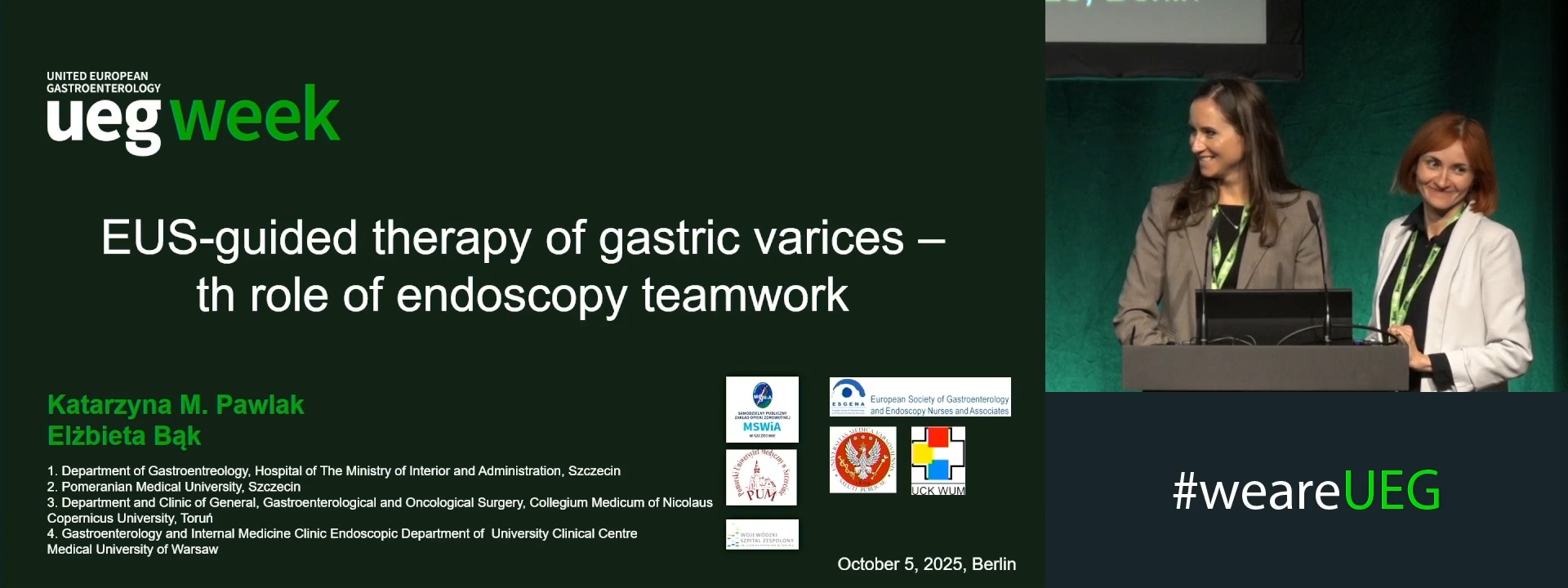
EUS-guided therapy of gastric varices: The role of endoscopic nurse-team work
1 Wojskowy Instytut Medyczny, Warsaw, Poland
2 Hospital of the Ministry of Interior and Administration, Szczecin, Poland
Event
Topics
Citation
Published
Log in to access this content.
Free for all myUEG account holders. Your access level is set automatically based on your occupation. Medical professionals get full access to all content. If you are a non-medical user, you can only access UEG Week content from congresses you attended.
Not sure what you can access? Learn more about account types.
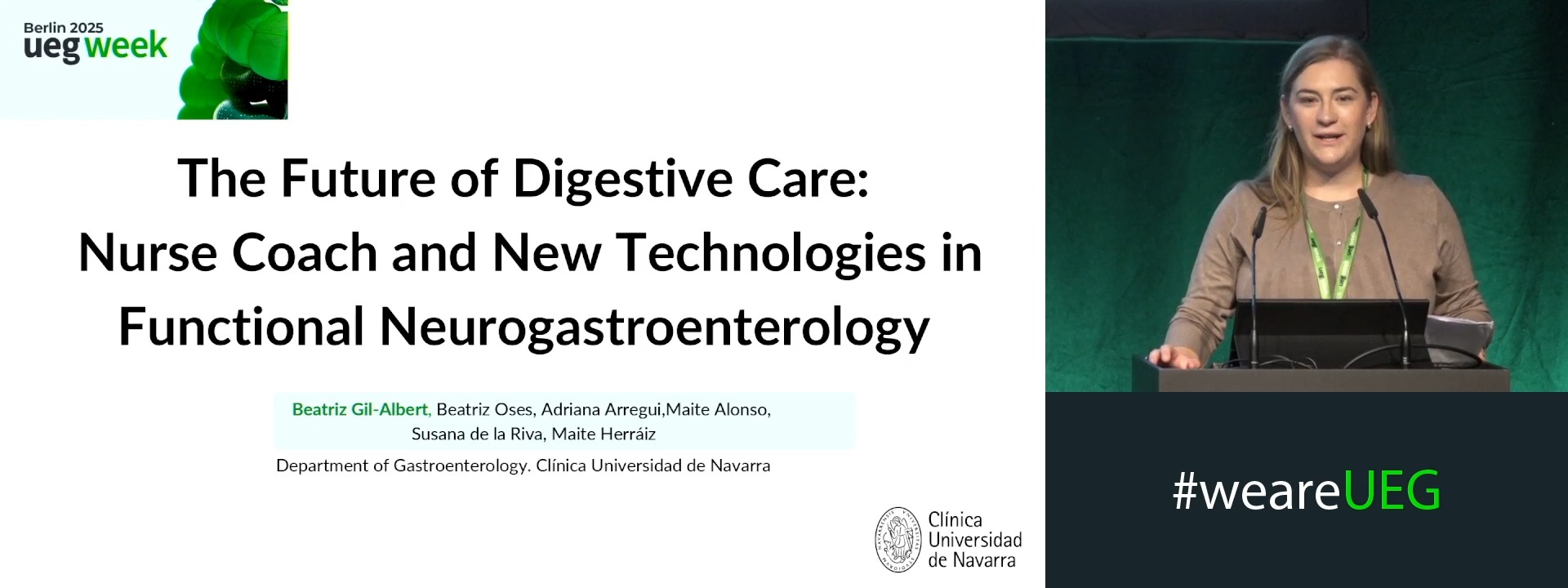
THE FUTURE OF DIGESTIVE CARE: NURSE COACH AND NEW TECHNOLOGIES IN FUNCTIONAL NEUROGASTROENTEROLOGY
Beatriz Oses 1, Adriana Arregui-Azagra 1, Beatriz Gil-Albert Sáenz de Cabezón 2, María Teresa Alonso Sierra 2, Susana de la Riva 1, Maite Herraiz Bayod 1
1 Clinica Universidad de Navarra, Pamplona, Spain
2 Clinica Universidad de Navarra, Madrid, Spain
Event
Topics