UEG's educational platform for gastroenterology education bringing recordings, courses, guidelines, and more together in one place.
Most popular content
Rate for better recommendations!
Your feedback helps us show you more of what you like and less of what you dislike!
Log in to access this content.
Free for all myUEG account holders. Your access level is set automatically based on your occupation. Medical professionals get full access to all content. If you are a non-medical user, you can only access UEG Week content from congresses you attended.
Not sure what you can access? Learn more about account types.

THE ASSOCIATION BETWEEN ENDOSCOPIC HEALING AND LONG-TERM PATIENT REPORTED OUTCOMES AND HOSPITALIZATION IN PATIENTS WITH MODERATE TO SEVERE CROHN’S DISEASE AFTER 3 YEARS OF RISANKIZUMAB MAINTENANCE TREATMENT: POST HOC ANALYSIS OF THE PHASE 3 FORTIFY TRIAL
Christopher Ma 1, Namita Joshi 2, Brian G. Feagan 3, Peter Bossuyt 4, Nidhi Shukla 2, Kristina Kligys 2, Ari Stromberg 2, Jameson Crowley 2, Vipul Jairath 5
1 University of Calgary, Calgary, Canada|||University of Calgary, Calgary, Canada
2 AbbVie, North Chicago, United States
3 Alimentiv Inc., London, Canada
4 Imelda General Hospital, Bonheiden, Belgium
5 Western University, London, Canada|||Western University, London, Canada
Conference
Topics
Submission format
Citation
Published
Log in to access this content.
Free for all myUEG account holders. Your access level is set automatically based on your occupation. Medical professionals get full access to all content. If you are a non-medical user, you can only access UEG Week content from congresses you attended.
Not sure what you can access? Learn more about account types.
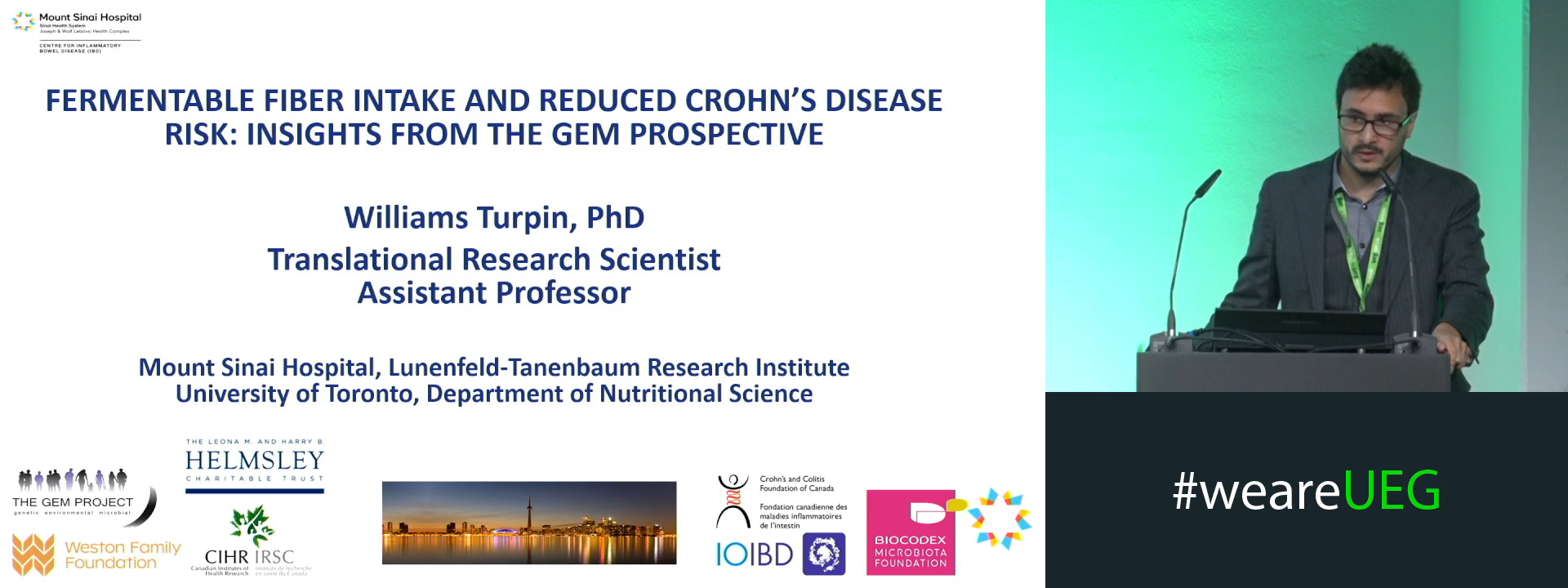
FERMENTABLE FIBER INTAKE AND REDUCED CROHN’S DISEASE RISK: INSIGHTS FROM THE GEM PROSPECTIVE COHORT
Mingyue Xue 1, Catherine Mcshane 2, Kim Jeongseok 2, Haim Leibovitzh 3, Jingcheng Shao 2, Qilong Li 2, Karen Madsen 4, Reihane Khorasaniha 2, Anne Griffiths 5, Thomas D Walters 5, Allan Hillary Steinhart 1, Mark S. Silverberg 2, Levinus Dieleman 6, Hien Huynh 6, Remo Panaccione 7, Paul Beck 7, Guy Aumais 8, Iwona Wrobel 7, Alain Bitton 9, John K. Marshall 10, Charles N. Bernstein 11, Jeffrey Hyams 12, Paul Moayyedi 13, Sun-Ho Lee 2, Heather Armstrong 6, Ken Croitoru 14, Williams Turpin 2
1 Mount Sinai Hospital Dept. of Medicine, Toronto, Canada
2 Mount Sinai Hospital, Toronto, Canada
3 Mount-Sinai Hospital, Toronto, Toronto, Canada
4 University of Alberta, Alberta, Canada
5 Hospital for Sick Children, Toronto, Canada
6 University of Alberta Division of Gastroenterology Dept. of Medicine, Edmonton, Canada
7 University of Calgary, Calgary, Canada
8 University of Montreal / Maisonneuve Hospital, Montreal, QC, Canada
9 Royal Victoria Hospital Dept. of Gastroenterology, Montreal, Canada
10 McMaster University, Burlington, Canada
11 University of Manitoba, Winnipeg, Canada
12 CT Children's, Hartford, United States
13 McMaster University Dept. of Medicine Dept. of Gastroenterology - McMaster University Dept. of Medic, Hamilton, Canada
14 Mt Sinai Hospital, Toronto, Canada
Event
Submission format
Session
Citation
Published
Log in to access this content.
Free for all myUEG account holders. Your access level is set automatically based on your occupation. Medical professionals get full access to all content. If you are a non-medical user, you can only access UEG Week content from congresses you attended.
Not sure what you can access? Learn more about account types.
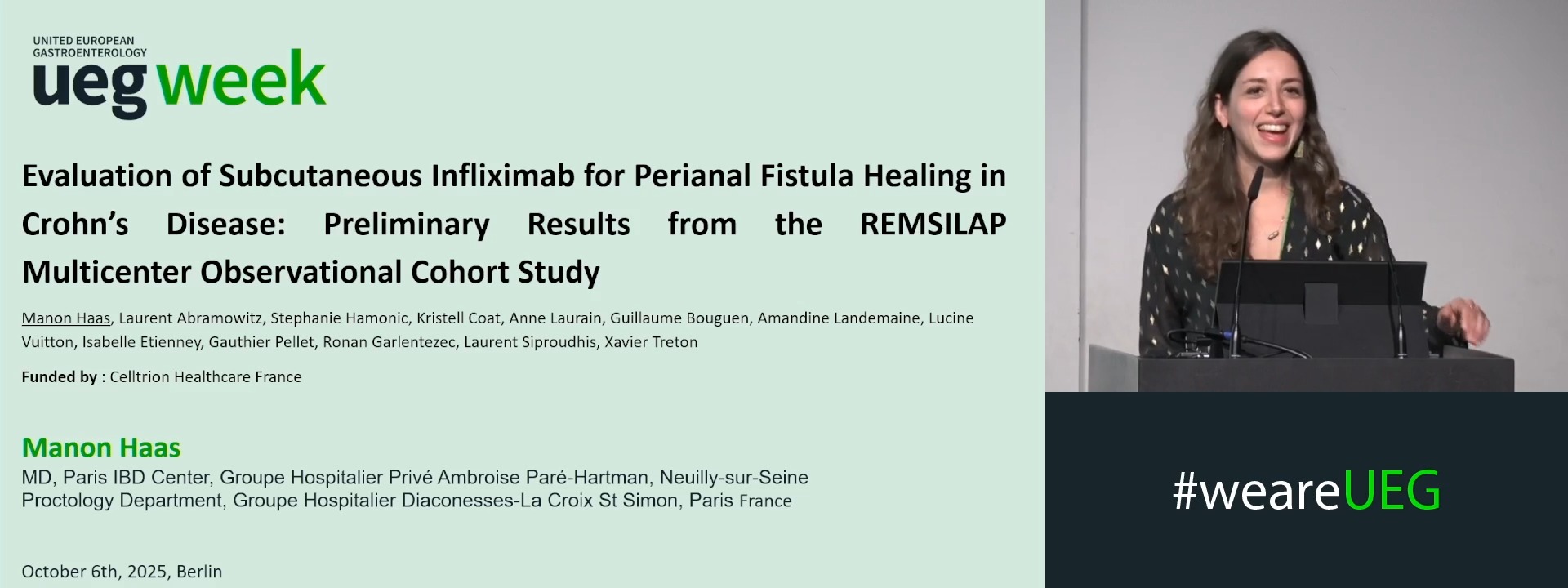
EVALUATION OF SUBCUTANEOUS INFLIXIMAB FOR PERIANAL FISTULA HEALING IN CROHN’S DISEASE: PRELIMINARY RESULTS FROM THE REMSILAP MULTICENTER OBSERVATIONAL COHORT STUDY
Manon Haas 1, Laurent Abramowitz 2, Stephanie Hamonic 3, Amandine Landemaine 3, Guillaume Bouguen 3, Anne Laurain 2, Lucine Vuitton 4, Isabelle Etienney 5, Gauthier Pellet 6, Kristell Coat 3, Ronan Garlantezec 3, Laurent Siproudhis 3, Xavier Treton 1
1 Institut des MICI - Clinique Ambroise Paré Hartmann, Neuilly sur Seine, France
2 CHU Bichat, Paris, France
3 CHU Pontchaillou, Rennes, France
4 Besançon university hospital gastroenterology, Courbevoie, France
5 Diaconesses-Croix St Simon Hospital, Paris, France
6 CHU Bordeaux, Bordeaux, France
Event
Topics
Submission format
Citation
Published
Log in to access this content.
Free for all myUEG account holders. Your access level is set automatically based on your occupation. Medical professionals get full access to all content. If you are a non-medical user, you can only access UEG Week content from congresses you attended.
Not sure what you can access? Learn more about account types.
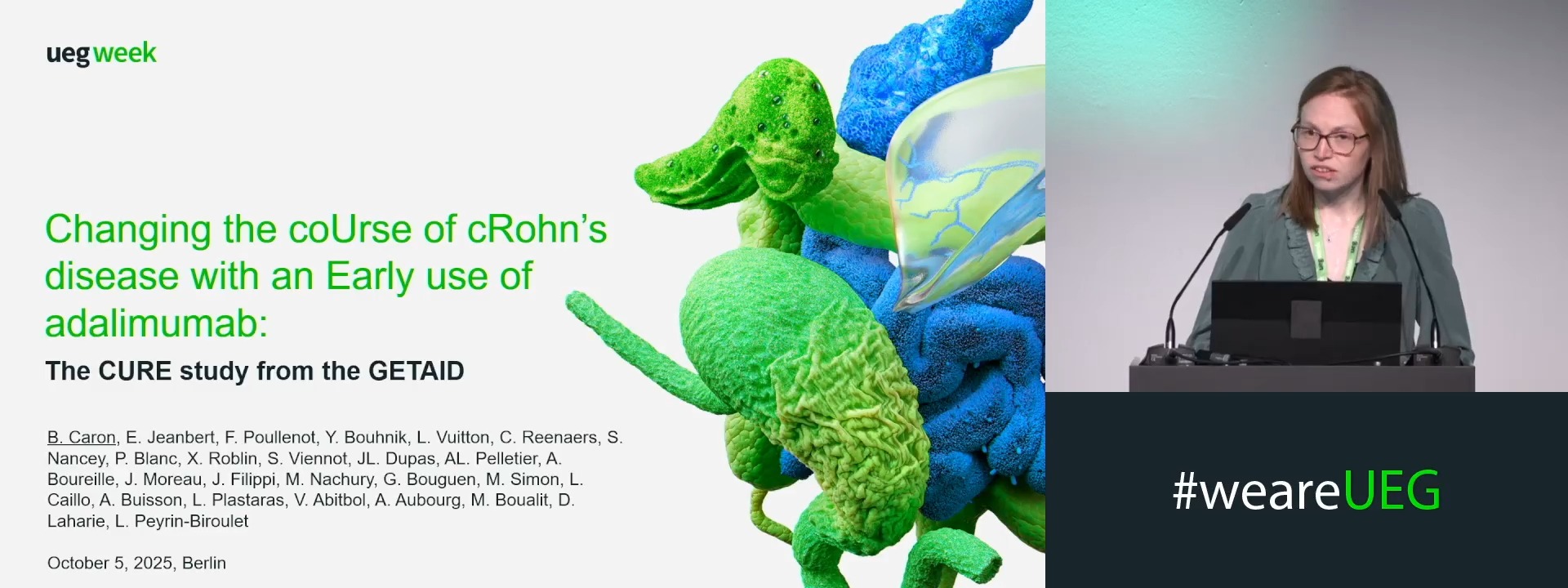
CHANGING THE COURSE OF CROHN’S DISEASE WITH AN EARLY USE OF ADALIMUMAB: THE CURE STUDY FROM THE GETAID
Bénédicte Caron 1, Elodie Jeanbert 1, Florian Poullenot 2, Yoram Bouhnik 3, Lucine Vuitton 4, Catherine Reenaers 5, Stephane NANCEY 6, pierre Blanc 7, Xavier Roblin 8, Stéphanie Viennot 9, Jean-Louis Dupas 10, Anne Laure Pelletier 11, Arnaud Bourreille 12, Jacques Moreau 13, Jerome Filippi 14, Maria Nachury 15, Guillaume Bouguen 16, Marion Simon 17, Ludovic Caillo 18, Anthony Buisson 19, Laurianne Plastaras 20, Vered Abitbol 21, Alexandre Aubourg 22, Médina Boualit 23, David Laharie 24, Laurent Peyrin-Biroulet 25
1 Nancy University Hospital, Vandoeuvre les Nancy, France
2 Bordeaux University Hospital, Bordeaux, France
3 CHU Beaujon Dept. of IBD and Nutrition, Clichy, France
4 Besançon university hospital gastroenterology, Courbevoie, France
5 Assistants en formation gastro, réseau Ulg - CHU Sart Tilman, Assistants en formation gastro, réseau, Lantremange, Belgium
6 Lyon University Hospital, Pierre Benite, France
7 Hopital Saint Eloi, Montpellier, France
8 University of St. Etienne Dept. de Gastroenterologie, Saint Etienne, France
9 CHRU de Caen HGE 19è étage, Caen Cedex, France
10 CHU Nord Amiens, Amiens, France
11 Hopital Beaujon, Paris, France
12 Hopital Hotel Dieu Et Hme - Hge Aile Sud, Nantes Cedex 1, France
13 Centre Hospitalier Universitaire de Toulouse, Hopital Rangueil, Toulouse, France
14 Hopital de lAchet Dept. de Gastroenterlogie Dept. de Nutrition Oncologie, Nice Cedex 3, France
15 CHRU Lille, Courbevoie Cedex, France
16 CHU Pontchaillou, Rennes, France
17 Institut Mutualiste Montsouris, Paris, France
18 CHU DE NIMES, Nîmes, France
19 CHU Estaing Clermont-Ferrand, Clermont-ferrand, France
20 Chu Colmar, Colmar, France
21 Hopital Cochin Gastroentérologie AP-HP, Paris Cedex 14, France
22 Cabinet Medical, Chambray Les Tours, France
23 Ch Valenciennes, Valenciennes Cedex, France
24 CHU de Bordeaux Hopital Haut-Leveque Dept. de Gastroenterologie, Pessac cedex, France
25 Inserm U1256, Nancy University Hospital, Vandoeuvre-les-Nancy, France
Event
Submission format
Session
Citation
Published
Log in to access this content.
Free for all myUEG account holders. Your access level is set automatically based on your occupation. Medical professionals get full access to all content. If you are a non-medical user, you can only access UEG Week content from congresses you attended.
Not sure what you can access? Learn more about account types.
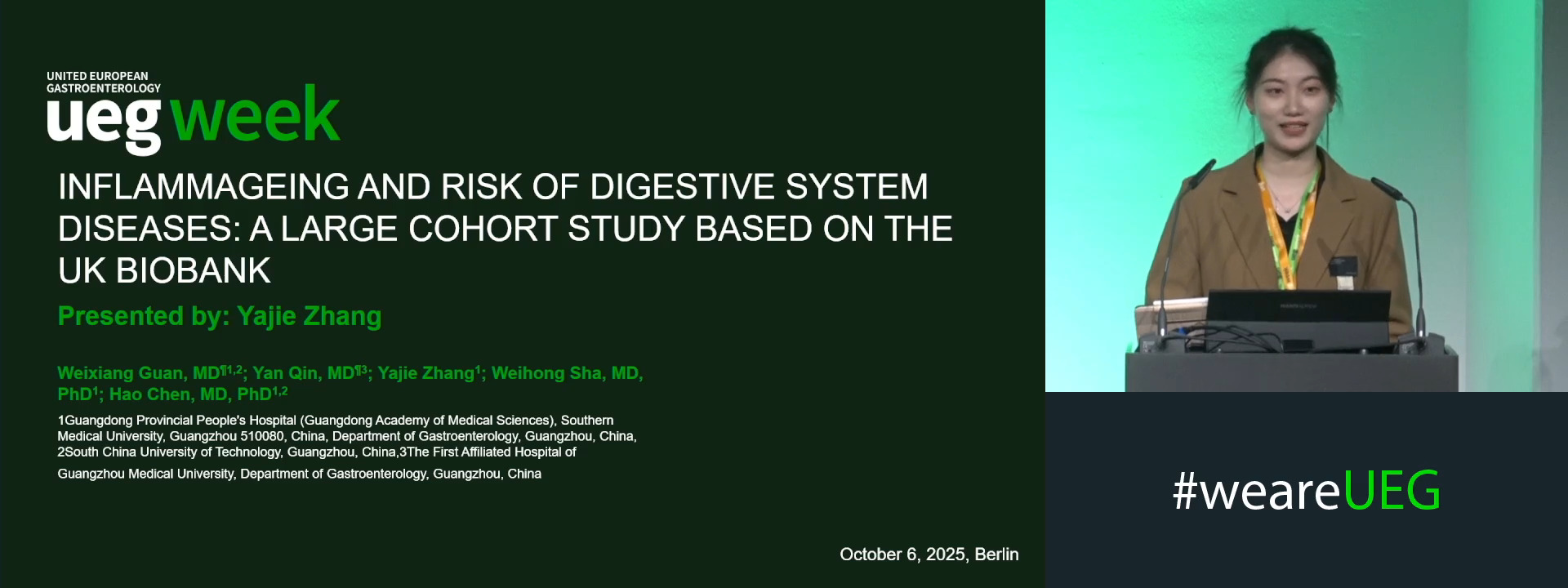
INFLAMMAGEING AND RISK OF DIGESTIVE SYSTEM DISEASES: A LARGE COHORT STUDY BASED ON THE UK BIOBANK
1 Guangdong Provincial People's Hospital (Guangdong Academy of Medical Sciences), Southern Medical University, Guangzhou 510080, China, Guangzhou, China|||South China University of Technology, Guangzhou, China
2 The First Affiliated Hospital of Guangzhou Medical University, Guangzhouchi, China
3 Guangdong Provincial People's Hospital (Guangdong Academy of Medical Sciences), Southern Medical University, Guangzhou 510080, China, Guangzhou, China
Event
Submission format
Session
Citation
Published
Log in to access this content.
Free for all myUEG account holders. Your access level is set automatically based on your occupation. Medical professionals get full access to all content. If you are a non-medical user, you can only access UEG Week content from congresses you attended.
Not sure what you can access? Learn more about account types.
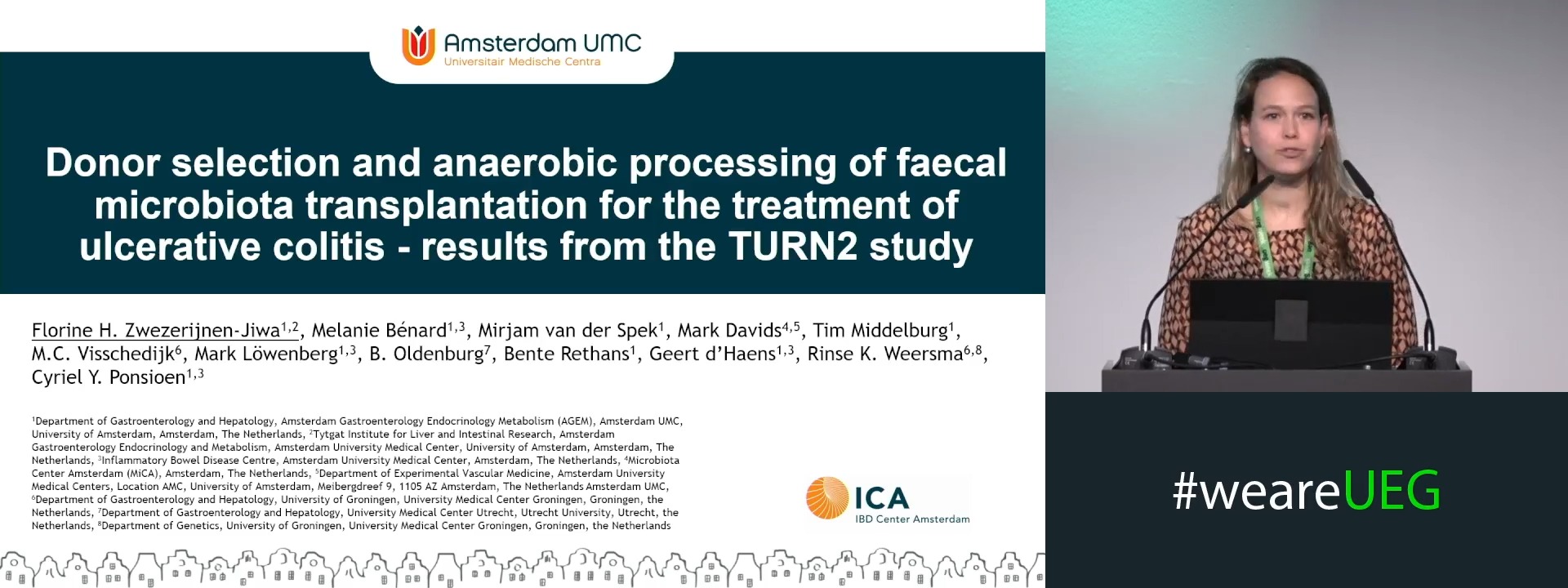
DONOR SELECTION AND ANAEROBIC PROCESSING OF FAECAL MICROBIOTA TRANSPLANTION FOR THE TREATMENT OF ULCERATIVE COLITIS: RESULTS FROM A MULTI-CENTRE RANDOMIZED CONTROLLED TRIAL (TURN2 STUDY)
Florine Zwezerijnen-Jiwa 1, Melanie Benard 2, Mirjam van der Spek 3, Mark Davids 4, Tim Middelburg 3, Marijn C. Visschedijk 5, Mark Lowenberg 6, Bas Oldenburg 7, Benthe Rethans 3, Geert R. D'Haens 8, Rinse K. Weersma 9, Cyriel Y. Ponsioen 10
1 Amsterdam UMC, Amsterdam, Netherlands|||Tytgat Institute for Liver and Intestinal Research, Amsterdam, Netherlands
2 Amsterdam UMC, Amsterdam, Netherlands|||Amsterdam University Medical Center, Amsterdam, Netherlands
3 Amsterdam UMC, Amsterdam, Netherlands
4 Microbiota Center Amsterdam (MiCA), Amsterdam, Netherlands|||Amsterdam University Medical Centers, Amsterdam, Netherlands
5 University Medical Medical Center, Groningen, Netherlands
6 Amsterdam University Medical Center, Amsterdam, Netherlands
7 University Medical Center Utrecht, Utrecht, Netherlands
8 AMC Amsterdam Inflammatory Bowel Disease Centre - Academic Medical Center, AMC Amsterdam Inflammator, Amsterdam, Netherlands|||Amsterdam UMC, Amsterdam, Netherlands
9 University Medical Center Groningen, Groningen, Netherlands
10 AMC Amsterdam Gastroenterology and Hepatology - Gastroenterology & Hepatology, AMC Amsterdam Gastroe, Amsterdam, Netherlands
Event
Submission format
Session
Citation
Published
Log in to access this content.
Free for all myUEG account holders. Your access level is set automatically based on your occupation. Medical professionals get full access to all content. If you are a non-medical user, you can only access UEG Week content from congresses you attended.
Not sure what you can access? Learn more about account types.
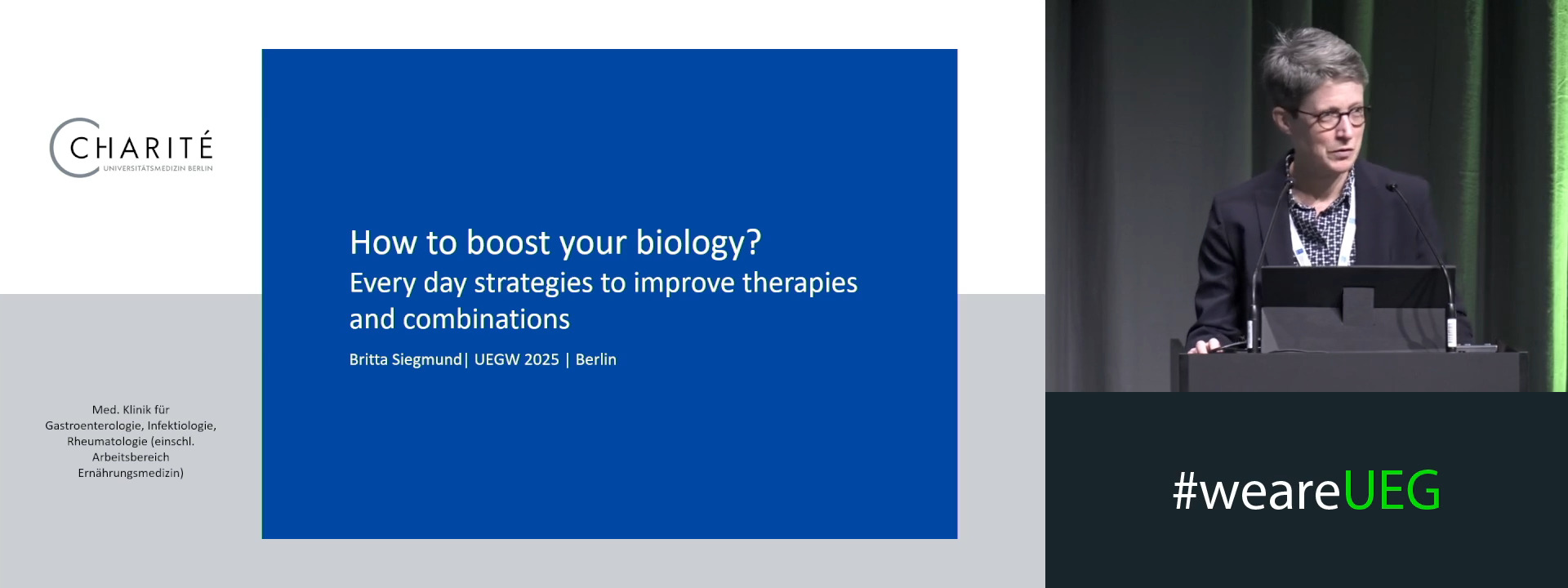
How to boost your biology? Every day strategies to improve therapies and combinations
1 Charité - Universitätsmedizin Berlin, Berlin, Germany