Introduction
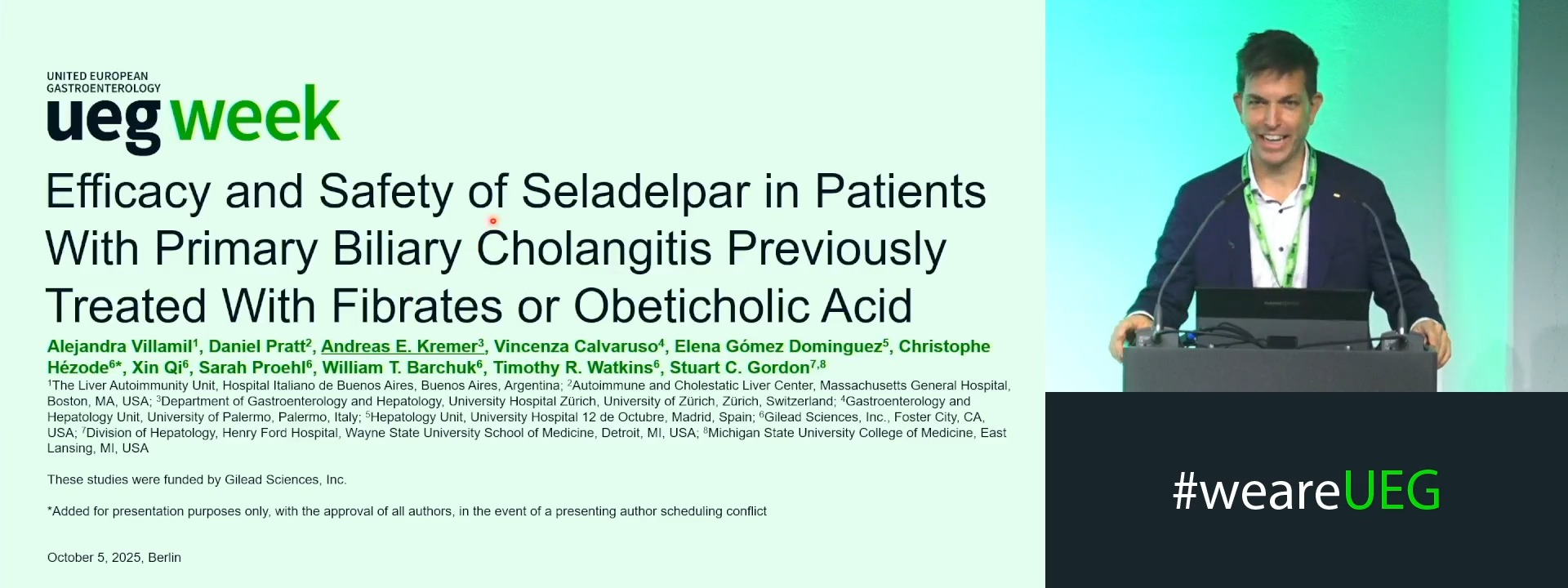
Seladelpar is a first-in-class delpar (selective PPAR-delta agonist) indicated for the treatment of primary biliary cholangitis in combination with ursodeoxycholic acid (UDCA) in patients (pts) with an inadequate response to UDCA or as monotherapy in pts unable to tolerate UDCA. RESPONSE was a Phase 3, randomised, placebo-controlled clinical trial of seladelpar in pts with inadequate response/intolerance to UDCA. Pts completing RESPONSE were eligible to roll over into ASSURE (NCT03301506), an ongoing, open-label, long-term, Phase 3 safety trial. Here, we describe data from month 18 (month 6 of ASSURE) in pts with or without prior use of fibrates or obeticholic acid (OCA) who rolled over from RESPONSE into ASSURE.
Aims & Methods
Pts received 10 mg seladelpar orally daily or placebo in RESPONSE; pts received open-label 10 mg seladelpar in ASSURE. Fibrates and OCA were prohibited during the study period and a 6-week washout was required prior to entry in RESPONSE. Data were described for pts in ASSURE with or without prior use of fibrates/OCA and based on whether they received seladelpar (continuous seladelpar pts) or placebo (crossover pts) in RESPONSE. Efficacy included the percentage of pts achieving a composite biochemical response (CBR; alkaline phosphatase [ALP] < 1.67 × upper limit of normal [ULN], ALP decrease ≥ 15%, and total bilirubin ≤ ULN). Safety assessments included adverse events (AEs) and laboratory parameters.
Results
Among pts who continued into ASSURE from RESPONSE (158), 16 continuous seladelpar and 11 crossover pts reported prior use of fibrates/OCA (total, n=27; 17%); 88 continuous seladelpar and 43 crossover pts reported no prior use of fibrates/OCA (total, n=131; 83%). At month 18, among continuous seladelpar pts, 9/15 (60%) pts with prior fibrate/OCA use achieved a CBR vs 54/87 (62%) pts without prior fibrate/OCA use. Among crossover pts, 7/11 (64%) pts with prior fibrate/OCA use vs 32/41 (78%) pts without prior fibrate/OCA use achieved a CBR at month 6 of ASSURE. From ASSURE initiation to month 6, incidence of AEs was similar across continuous seladelpar and crossover pts, regardless of prior OCA/fibrate use; no treatment-related serious AEs were reported.
Conclusion
In this interim analysis of continuous seladelpar and crossover pts from ASSURE, pts who reported prior use of fibrates/OCA achieved a similar sustained biochemical response with seladelpar compared with pts who reported no prior use. Seladelpar appeared safe and well tolerated in this subgroup.
Disclosure
AV reports receiving speaker fees from Intercept Pharmaceuticals and participation on an advisory board with Novartis. DP reports receiving consulting fees from Mediar Therapeutics. AEK reports receiving grants or contracts from Gilead Sciences, Inc., Intercept Pharmaceuticals and Roche; consulting fees from AbbVie; Advanz Pharma; Alentis Therapeutics; Alfasigma; Astellas; AstraZeneca; Attovia Therapeutics; Avior Bio; Bayer; Bristol Myers Squibb; Böhringer-Ingelheim; CymaBay Therapeutics; Escient Pharmaceuticals; Falk; Gilead Sciences, Inc.; GSK; Guidepoint; Intercept Pharmaceuticals; Ipsen; Merck Sharp & Dohme; Mirum Pharma; Novo Nordisk; Rectify Pharma; Roche; and Takeda; payment or honoraria for lectures, presentations, speakers bureaus, manuscript writing, or educational events from AbbVie; Advanz Pharma; AOP Orphan Pharmaceuticals; Bayer; Bristol Myers Squibb; CymaBay Therapeutics; Falk; Gilead Sciences, Inc.; GSK; Intercept Pharmaceuticals; Ipsen; Johnson & Johnson; Medscape; Merck Sharp & Dohme; Mirum Pharma; NewBridge Pharmaceuticals; Novartis; Roche; Vertex Pharmaceuticals; and Viofor; support for attending meetings and/or travel from Gilead Sciences, Inc.; participation on a data safety monitoring board with AbbVie; Advanz Pharma; Alentis Therapeutics; Alfasigma; AstraZeneca; Avior Bio; Bayer; Bristol Myers Squibb; CymaBay Therapeutics; Escient Pharmaceuticals; Falk; Gilead Sciences, Inc.; GSK; Guidepoint; Intercept Pharmaceuticals; Ipsen; Merck Sharp & Dohme; Mirum Pharma; Novo Nordisk; Roche; and Takeda; and a leadership or fiduciary role in other board, society, committee, or advocacy groups (paid or unpaid) with PBC Foundation, Swiss Association for the Study of the Liver (SASL), Swiss Gastroenterology Society (SGG), Swiss Hepa, and Swiss Transplant Society (STS). VC reports receiving speaker fees from AbbVie; Advanz Pharma; Echosens; Gilead Sciences, Inc.; Ipsen; and Roche; and participation on an advisory board with Advanz Pharma; Gilead Sciences, Inc.; Ipsen; and Roche. EGD reports receiving consulting fees from Ipsen; payment or honoraria for lectures, presentations, speakers bureaus, manuscript writing, or educational events from Ipsen; support for attending meetings and/or travel from Advanz Pharma; and participation on a data safety monitoring board or advisory board for GSK. CH, XQ, SP, WTB, and TRW are employees of Gilead Sciences, Inc., and may own stock in Gilead Sciences, Inc. SCG reports receiving grants or contracts from AbbVie, Arbutus Biopharma, CymaBay Therapeutics, GSK, Ipsen, and Mirum Pharma; and participation on a data safety monitoring board or advisory board with CymaBay Therapeutics, GSK, and Ipsen.