Introduction
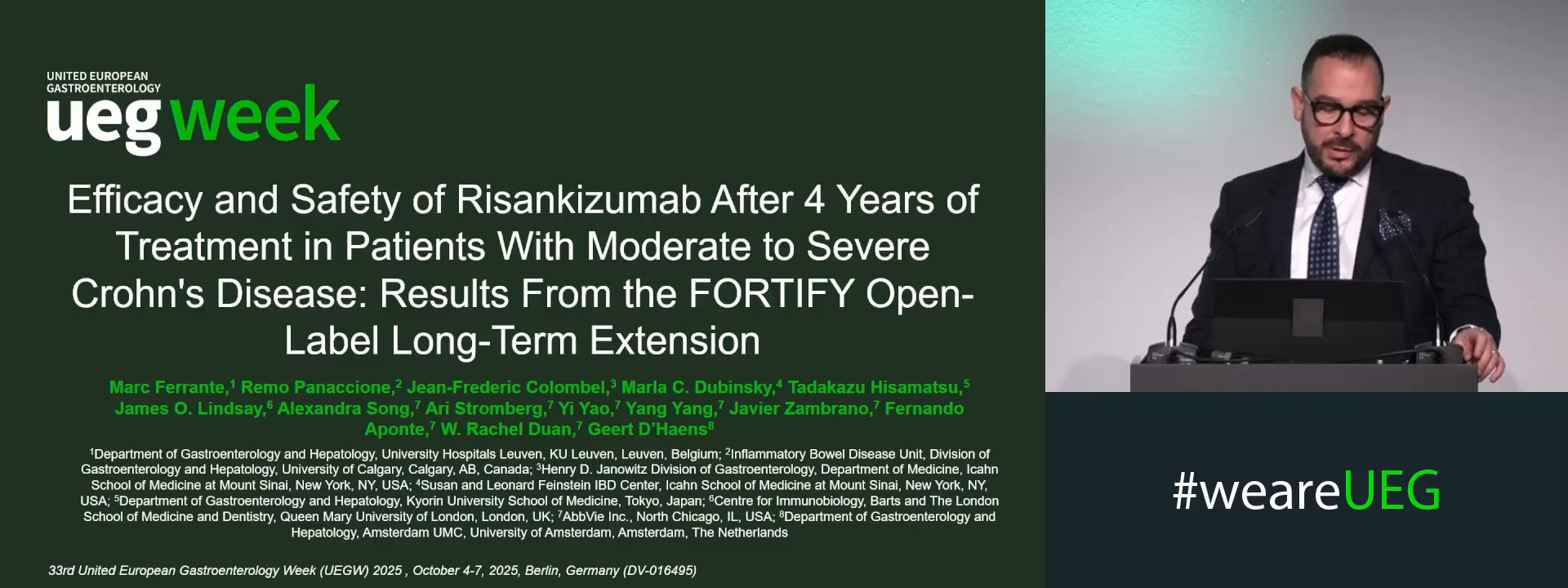
Risankizumab (RZB) is a highly specific humanized monoclonal antibody that targets the p19 subunit of interleukin-23 and was designed to have low immunogenicity and high bioavailability, allowing for less-frequent dosing, although the clinical implications of these modifications have not been studied. The FORTIFY maintenance open label extension (OLE) is an ongoing phase 3 substudy evaluating the long-term efficacy and safety of RZB in pts with moderate to severe Crohn’s disease (CD). Here, we report interim efficacy and safety results from the FORTIFY OLE following up to 4 years (yrs) of RZB treatment.
Aims & Methods
The FORTIFY (NCT03105102) OLE enrolled pts who completed 52 weeks (wks) of RZB maintenance.1,2 Pts received subcutaneous (SC) RZB 180mg every 8wks (Q8w) starting at wk56, except for pts who received rescue therapy prior to or during the OLE; these pts received SC RZB 360mg Q8w (see Table footnote for rescue therapy details). Pooled data (180mg+360mg) were analyzed through wk144 of the OLE (wk200 of cumulative RZB treatment) using as observed (AO) and modified nonresponder imputation (mNRI, pts were considered nonresponders for visits after premature discontinuation of RZB due to the primary reason of lack of efficacy or adverse event limited to Crohn’s disease only, as well as initiation of rescue, while other missing data were handled by multiple imputation [MI]) methods (‘All Patients [No Rescue or Prior to Rescue]’ group in Table). For pts who received rescue therapy, only their data obtained prior to receiving rescue were included in the aforementioned AO and mNRI analyses (‘All Patients [No Rescue]’ group in Table). Data from pts on the day of or after rescue were analyzed separately and reported AO starting at the initiation of rescue (defined as the last nonmissing value prior to or on initiation of rescue) and every 24 wks post-rescue (‘Rescue’ group in Table). Safety was evaluated in all pts receiving any RZB treatment in the OLE. Treatment-emergent adverse events (TEAEs) reported on/after the first dose in the OLE were summarized (cutoff date: 30DEC2024).
Results
A total of 1112 pts (excluding 36 pts who received RZB rescue at entry to OLE) received ≥1 dose of RZB 180mg or 360mg in the OLE. Efficacy rates (per mNRI analysis) were stable from OLE wk0 to wk144 for clinical remission per stool frequency/abdominal pain score (SF/APS, 64.5% to 75.8%) and per CD Activity Index (CDAI, 68.6% to 82.8%), endoscopic response (55.1% to 73.8%), and endoscopic remission (39.0% to 58.8%) (Table). Pts who received rescue therapy in the OLE demonstrated clinical and endoscopic improvements over time. The profiles of TEAEs and AEs of special interest were consistent with the known safety profile of RZB.3,4
Week in OLEa
| All Patients (No Rescue or Prior to Rescue), Pooledb
| Initiation of Rescue (Week 0) and Every 24 Weeks Post-Rescuee
| Rescuec, Pooledd
|
AO
n/N (%) [95% CI]
| mNRI
n/N (%) [95% CI]
| AO
n/N (%) [95% CI]
|
SF/APS
Clinical Remissionf
Week 0
Week 24
Week 48
Week 72
Week 96
Week 120
Week 144
CDAI
Clinical Remissiong
Week 0
Week 24
Week 48
Week 72
Week 96
Week 120
Week 144
Endoscopic
Responseh
Week 0
Week 96
Endoscopic
Remissioni
Week 0
Week 96
|
717/1112
(64.5) [61.7, 67.3]
665/1000
(66.5) [63.6, 69.4]
587/844
(69.5) [66.4, 72.7]
574/798
(71.9) [68.8, 75.0]
523/723
(72.3) [69.1, 75.6]
494/669
(73.8) [70.5, 77.2]
483/637
(75.8) [72.5, 79.1]
763/1112
(68.6) [65.9, 71.3]
693/933
(74.3) [71.5, 77.1]
609/797
(76.4) [73.5, 79.4]
591/755
(78.3) [75.3, 81.2]
547/689
(79.4) [76.4, 82.4]
503/628
(80.1) [77.0, 83.2]
496/599
(82.8) [79.8, 85.8]
588/1068
(55.1) [52.1, 58.0]
573/776
(73.8) [70.7, 76.9]
417/1068
(39.0) [36.1, 42.0]
456/776
(58.8) [55.3, 62.2]
|
717/1112
(64.5) [61.7, 67.3]
707/1112
(63.6) [60.7, 66.5]
667/1112
(60.0) [57.0, 63.0]
651/1112
(58.5) [55.5, 61.5]
624/1112
(56.1) [53.0, 59.1]
599/1112
(53.8) [50.7, 57.0]
605/1112
(54.4) [51.2, 57.5]
763/1112
(68.6) [65.9, 71.3]
783/1112
(70.4) [67.6, 73.2]
745/1112
(67.0) [64.0, 70.0]
729/1112
(65.5) [62.5, 68.5]
701/1112
(63.0) [60.0, 66.0]
675/1112
(60.7) [57.5, 63.9]
689/1112
(62.0) [58.9, 65.1]
602/1112
(54.1) [51.2, 57.1]
648/1112
(58.3) [55.2, 61.4]
419/1112
(37.7) [34.8, 40.5]
491/1112
(44.2) [41.0, 47.4]
| SF/APS
Clinical Remissionf
At initiation of rescue
24 weeks post-rescue
48 weeks post-rescue
72 weeks post-rescue
96 weeks post-rescue
120 weeks post-rescue
144 weeks post-rescue
CDAI
Clinical Remissiong
At initiation of rescue
Week 24 post-rescue
Week 48 post-rescue
Week 72 post-rescue
Week 96 post-rescue
Week 120 post-rescue
Week 144 post-rescue
Endoscopic
Responseh
At initiation of rescue
Week 96 post-rescue
Endoscopic
Remissioni
At initiation of rescue
Week 96 post-rescue
|
3/278
(1.1) [0.4, 3.1]
101/251
(40.2) [34.4, 46.4]
98/185
(53.0) [45.8, 60.0]
74/154
(48.1) [40.3, 55.9]
65/125
(52.0) [43.3, 60.6]
50/92
(54.3) [44.2, 64.1]
38/64
(59.4) [47.1, 70.5]
39/278
(14.0) [10.4, 18.6]
108/226
(47.8) [41.4, 54.3]
99/164
(60.4) [52.7, 67.5]
80/138
(58.0) [49.6, 65.9]
69/111
(62.2) [52.9, 70.6]
55/80
(68.8) [57.9, 77.8]
39/54
(72.2) [59.1, 82.4]
95/265
(35.8) [30.3, 41.8]
102/189
(54.0) [46.9, 60.9]
46/265
(17.4) [13.3, 22.4]
68/189
(36.0) [29.5, 43.0]
|
Adverse Events
Events (E/100PYs)
| (N=1112)
(PYs=3160.2)
|
| (N=278)
(PYs=543.9) |
|
All TEAEs
Investigator-defined drug-related AE
Severe AE
Serious AE
AEs leading to study drug discontinuation
Death
Adverse Events of Special Interestj
Adjudicated MACE
Adjudicated anaphylactic reaction
Serious infections
Opportunistic infections excluding tuberculosis and herpes zoster
Herpes zoster
Malignant tumors
Non-melanoma skin cancer
Malignancies excluding NMSC
Hypersensitivity
Hepatic events
Injection site reactions
| 5067 (160.3)
610 (19.3)
263 (8.3)
385 (12.2)
47 (1.5)
3 (<0.1)
5 (0.2)
0
68 (2.2)
5 (0.2)
22 (0.7)
23 (0.7)
8 (0.3)
15 (0.5)
142 (4.5)
83 (2.6)
141 (4.5)
|
| 1187 (218.2)
114 (21.0)
86 (15.8)
109 (20.0)
25 (4.6)
0
2 (0.4)
0
12 (2.2)
4 (0.7)
5 (0.9)
5 (0.9)
2 (0.4)
3 (0.6)
22 (4.0)
24 (4.4)
17 (3.1)
|
|
AO, as observed; AE, adverse event; APS, abdominal pain score; CDAI, Crohn’s disease activity index; E, events; OLE, open-label extension; NMSC, nonmelanoma skin cancer; mNRI, modified nonresponder imputation; Q8w, every 8 weeks; MACE, major adverse cardiovascular event; PY, patient years; RZB, risankizumab; SC, subcutaneous; SES-CD, simple endoscopic score for Crohn’s disease; SF, stool frequency; TEAE, treatment-emergent AE; Wk, week.
The study population included all patients who received at least one dose of study drug in the FORTIFY OLE. For AO analysis, data were used as is, except for data collected on or after rescue, which were excluded. For mNRI, patients were categorized as nonresponders for visits after premature discontinuation of study drug due to the primary reason of lack of efficacy and initiation of rescue therapy while other missing data were handled by multiple imputation. Patients who received rescue before receiving RZB 180 mg/360 mg treatment at week 0 of the OLE were not included in efficacy analysis.
For patients who received rescue during the OLE, data on or after receiving risankizumab rescue therapy are presented as observed.
aFor patients not receiving rescue, the week denotes the week of the OLE.
bData for the 180mg + 360mg RZB treatment groups were pooled. Data through wk144 of the OLE were included in the analysis, unless the patient received rescue, in which case only data obtained prior to rescue were included. Data on or after initiation of rescue were excluded from this analysis and are shown in the far-right column (“Rescue, Pooled”).
cRescue therapy consisted of a single 1200mg intravenous RZB dose, then 360mg SC Q8w, and was given in the case of inadequate response (as determined by increased symptoms plus an objective marker of inflammation).
dRescue data was pooled, meaning patients may have received either 180mg or 360mg RZB prior to rescue.
eInitiation of rescue was the last non-missing value prior to or on the initiation of risankizumab rescue therapy in the FORTIFY OLE. Subsequent timepoints are defined as the number of weeks post-rescue.
fSF/APS clinical remission is defined as average daily SF ≤ 2.8 and not worse than baseline of the induction study and average daily AP score ≤ 1 and not worse than baseline of the induction study.
gCDAI clinical remission is defined as CDAI < 150.
hEndoscopic response is defined as decrease in SES-CD > 50% from baseline of the induction study (or for patients with isolated ileal disease and a baseline SES-CD = 4, at least a 2-point reduction from baseline of the induction study).
iEndoscopic remission is defined as SES-CD ≤ 4 and at least a 2-point reduction versus baseline of the induction study and no subscore > 1 in any individual variable
jThere were no events of active tuberculosis or serious hypersensitivity.
|
Conclusion
Durable clinical and endoscopic efficacy was observed in pts with moderate to severe CD who completed up to 4 yrs of RZB maintenance therapy in the FORTIFY OLE. Pts who received rescue therapy in the OLE also showed clinical and endoscopic improvements by wk144. No new safety risks for RZB were identified, supporting its long-term use in treating CD.
References
1. Ferrante M, et al. J Crohns Colitis. 2021;15(12):2001-2010.
2. Ferrante M, et al. Lancet. 2022; 399(10340):2031–46.
3. Papp KA, et al. J. Am. Acad. Dermatol. 2023; 89(6):1149–58.
4. Ferrante M, et al. J Crohns Colitis. 2024;18(Supplement_1):i168–70.
Disclosure
Marc Ferrante
Research grants from AbbVie, EG Pharma, Janssen, Pfizer, Takeda and Viatris. Consultancy fees from AbbVie, AgomAb Therapeutics, Boehringer Ingelheim, Celgene, Celltrion, Eli Lilly, Janssen-Cilag, MRM Health, Merck Sharp and Dohme, Pfizer, Takeda and ThermoFisher. Speakers’ fees from AbbVie, Biogen, Boehringer Ingelheim, Dr Falk Pharma, Ferring, Janssen-Cilag, Merck Sharp and Dohme, Pfizer, Takeda, Truvion Healthcare and Viatris
Remo Panaccione
Consulting fees from AbbVie, Abbott, Alimentiv, Amgen, Arena, AstraZeneca, Bristol Myers Squibb, Boehringer Ingelheim, Celgene, Celltrion, Cosmos Pharmaceuticals, Eisai, Elan, Ferring, Galapagos, Genentech, Gilead Sciences, GlaxoSmithKline, Janssen, Lilly, Merck, Mylan, Oppilan Pharma, Pandion Pharma, Pfizer, Progenity, Protagonist Therapeutics, Roche, Sandoz, Satisfai Health, Schering-Plough, Shire, Sublimity Therapeutics, Theravance, UCB, and Takeda; speaker fees from AbbVie, Arena, Celgene, Ferring, Gilead Sciences, Janssen, Lilly, Merck, Pfizer, Roche, Sandoz, Shire, and Takeda; and research/educational support from AbbVie, Ferring, Janssen, Pfizer, and Takeda. He has served on an advisory board for AbbVie, Amgen, Arena, Bristol Myers Squibb, Celgene, Celltrion, Ferring, Galapagos, Genentech, Gilead Sciences, GlaxoSmithKline, Janssen, Lilly, Merck, Mylan, Oppilan Pharma, Pandion Pharma, Pfizer, Sandoz, Shire, Sublimity Therapeutics, Takeda, and Theravance
Jean-Frederic Colombel
Research grants from AbbVie, Janssen Pharmaceuticals, and Takeda; payment for lectures from AbbVie, Allergan, Amgen, Ferring Pharmaceuticals, Shire, and Takeda; consulting fees from AbbVie, Amgen, Arena Pharmaceuticals, Boehringer Ingelheim, Bristol Myers Squibb, Celgene Corporation, Ferring Pharmaceuticals, Galmed Research, Genentech, GlaxoSmithKline, Imedex, Immunic, Iterative Scopes, Janssen Pharmaceuticals, Kaleido Biosciences, Lilly, Merck, Microbia, Novartis, PBM Capital, Pfizer, Protagonist Therapeutics, Sanofi, Takeda, TiGenix, and Vifor; and holds stock options in Intestinal Biotech Development.
Marla Dubinsky
Consulting fees from AbbVie, Arena, Bristol Myers Squibb, Celgene, Eli Lilly, Genentech, Gilead, Janssen, Pfizer, Prometheus Labs, and Takeda; and is founder and a shareholder of Trellus Health
Tadakazu Hisamatsu
Grant support from AbbVie, Daiichi-Sankyo, EA Pharma Co, Ltd. JIMRO, Mitsubishi Tanabe Pharma Corporation, Mochida Pharmaceutical Co., Ltd., Nippon Kayaku Co., Ltd., Pfizer Inc., Takeda Pharmaceutical Co., Ltd. Consulting fees from EA Pharma Co, Ltd., Janssen Research & Development, LLC., Gilead Sciences, Eli Lilly, Bristol Myers Squibb. Lecture fees from AbbVie, EA Pharma Co, Ltd, Mitsubishi Tanabe Pharma Corporation, Takeda Pharmaceutical Co., Ltd., Mochida Pharmaceutical Co., Ltd., Kissei Pharmaceutical Co, Ltd.
James O. Lindsay
Consultant and an advisory board participant for AbbVie, Atlantic Healthcare, Bristol Myers Squibb, Celgene, Celltrion, Eli Lilly, Ferring Pharmaceuticals, Galapagos, Gilead, GSK, Janssen, MSD, Napp, Pfizer, Shire, Takeda, and Vifor Pharma; has received speaker fees and sponsorship for academic meetings from AbbVie, Ferring Pharmaceuticals, Janssen, MSD, Napp, Norgine, Pfizer, Shire, Tillotts Pharma, and Takeda; and has received investigator-led research grants from AbbVie, Gilead, Pfizer, Shire and Takeda.
Geert D’Haens
Consultant for AbbVie, AgomAb, AstraZeneca, AM Pharma, AMT, Bristol Myers Squibb, Boehringer Ingelheim, Celltrion, Eli Lilly, Exeliom Biosciences, Exo Biologics, Galapagos, Index Pharmaceuticals,, GSK, Pfizer, Immunic, J&J, Origo, Polpharma, Procise Diagnostics, Prometheus Laboratories, Prometheus Biosciences, Progenity, Protagonist and Ventyx; and has received speakers bureau fees from AbbVie, Arena Pharmaceuticals, Galapagos, Gilead, Pfizer, Bristol Myers Squibb, and Takeda
Alexandra Song, Yi Yao, Yang Yang, Javier Zambrano, Fernando Aponte, and W. Rachel Duan are full-time employees of AbbVie and may own AbbVie stock or options.
Funding
AbbVie funded this study and participated in the study design, research, analysis, data collection, interpretation of data, reviewing, and approval of the abstract. All authors had access to relevant data and participated in the drafting, review, and approval of this abstract. No honoraria or payments were made for authorship. AbbVie and authors thank all the trial investigators and the patients who participated in this clinical trial.
Medical writing support was provided by Stephanie Parsons, PhD, an employee of AbbVie.