UEG's educational platform for gastroenterology education bringing recordings, courses, guidelines, and more together in one place.
Most popular content
Rate for better recommendations!
Your feedback helps us show you more of what you like and less of what you dislike!
Log in to access this content.
Free for all myUEG account holders. Your access level is set automatically based on your occupation. Medical professionals get full access to all content. If you are a non-medical user, you can only access UEG Week content from congresses you attended.
Not sure what you can access? Learn more about account types.

MUCOSAL HEALING IN ULCERATIVE COLITIS: DEFINITION, TREATMENT TARGET AND CLINICAL ENDPOINTS
Autumn Jones 1, Russell Bailey McBride 2, Stephen Laroux 3, Noam Harpaz 2, Christina Jayson 4, Tara A. Altepeter 5, Sabyasachi Bhattacharya 6, Jacqueline Brosnan-Cashman 4, Kevin Clare 2, Lani Clinton 4, Wallace Crandall 7, Chong Duan 8, Jeremy Gale 8, Michael Griffin 4, Vandana Gupta 9, Helene Haarmann 10, Andrea Hooper 11, Julie Horowitz 11, Andres Hurtado-Lorenzo 12, Bader Hussaini 9, Vipul Jairath 13, Ben Kostiuk 12, Anjli Kukreja 14, Trevor Lissoos 7, Qingqing Liu 2, Anil Nayyar 5, Mark T. Osterman 15, Pratik Panchal 9, Darren Ruane 16, Chintan Shah 4, Barbara Shaikh 16, John Shamshoian 4, Geetika Singh 4, Aryeh Stock 2, Kathleen Sucipto 4, Waleed Tahir 4, Paresh Thakker 9, Simon Travis 17, Laura Wilson 18
1 Foundation for the National Institutes of Health, North Bethesda, United States
2 Icahn School of Medicine at Mount Sinai, New York, United States
3 AbbVie Bioresearch Center, Worcester, United States
4 PathAI Inc, Boston, United States
5 US Food and Drug Administration, Silver Spring, United States
6 AbbVie Bay Area, South San Francisco, United States
7 Eli Lilly and Company, Indianapolis, United States
8 Pfizer Research Technology Center, Cambridge, United States
9 Takeda Pharmaceuticals America Inc, Cambridge, United States
10 Takeda Pharmaceuticals International AG, Zurich, Switzerland
11 Regeneron Pharmaceuticals Inc, Tarrytown, United States
12 Crohn's and Colitis Foundation, New York, United States
13 Western University Faculty of Health Sciences, London, Canada
14 Boehringer Ingelheim Corp USA, Ridgefield, United States
15 Bristol Myers Squibb Co, Princeton, United States
16 Janssen Research & Development LLC, Raritan, United States
17 John Radcliffe Hospital, Oxford, United Kingdom
18 Kenneth Rainin Foundation, Oakland, United States
Conference
Topics
Submission format
Citation
Published
Log in to access this content.
Free for all myUEG account holders. Your access level is set automatically based on your occupation. Medical professionals get full access to all content. If you are a non-medical user, you can only access UEG Week content from congresses you attended.
Not sure what you can access? Learn more about account types.
AFIMKIBART (ANTI-TL1A) IS EFFECTIVE IN THE BLOCKADE OF CELLULAR SIGNALING INDUCED BY ACTIVE TL1A
Domagoj Vucic 1, Franklin Fuh 2, Allen Nguyen 1, Eugene Varfolomeev 1, Angela Oh 1, Geil Merana 1, Xiao Tao 1, David Place 1, Karen Lasch 3, Daniela Bojic 4, Pascal Espie 4, Maggie Neighbors 1, Jacqueline McBride 1, Vishnu Mohanan 1
1 Genentech-Roche, South San Francisco, United States
2 Genentech-Roche, South San Francisco, United States|||Genentech-Roche, South San Francisco, United States
3 Roche, South San Francisco, United States
4 F.Hoffman-La Roche Ltd, Basel, Switzerland
Conference
Topics
Submission format
Session
Citation
Published
Log in to access this content.
Free for all myUEG account holders. Your access level is set automatically based on your occupation. Medical professionals get full access to all content. If you are a non-medical user, you can only access UEG Week content from congresses you attended.
Not sure what you can access? Learn more about account types.
FIB-6 OVER FIB-4: SCORING HIGHER IN LIVER FIBROSIS EVALUATION IN MASLD: EVIDENCE FROM A PORTUGUESE COHORT
Ana Catarina Garcia 1, Patrícia Pires 1, Mónica Francisco 1, Sofia Bragança 1, Mariana Cardoso 1, Joana Carvalho e Branco 1, Mariana Nuno Costa 1, Rita Carvalho 1, Alexandra Martins 1, Gonçalo Alexandrino 1
1 Unidade Local de Saúde Amadora/Sintra, Lisbon, Portugal
Conference
Topics
Submission format
Session
Citation
Published
Log in to access this content.
Free for all myUEG account holders. Your access level is set automatically based on your occupation. Medical professionals get full access to all content. If you are a non-medical user, you can only access UEG Week content from congresses you attended.
Not sure what you can access? Learn more about account types.
URSODEOXYCHOLIC ACID THERAPY IN PATIENTS WITH PRIMARY BILIARY CHOLANGITIS: PREDICTORS FOR INCOMPLETE RESPONSE
BASMA AABDI 1, Ouiam Elmqaddem 2, Hajar Koulali 2, Zazour Abdelkrim 3, Ghizlane Kharrasse 1, Zahi Ismaili 1
1 Mohammed VI University Hospital Center, Oujda, Morocco
2 Mohammed First University, Faculty of Medicine, Oujda, Morocco
3 Mohammed First University, Mohammed VI University Hospital, Oujda, Morocco
Conference
Topics
Submission format
Session
Citation
Published
Log in to access this content.
Free for all myUEG account holders. Your access level is set automatically based on your occupation. Medical professionals get full access to all content. If you are a non-medical user, you can only access UEG Week content from congresses you attended.
Not sure what you can access? Learn more about account types.
DEVELOPMENT AND CHARACTERIZATION OF SIM0709, A NOVEL HALF-LIFE EXTENDED BI-SPECIFIC ANTIBODY SIMULTANEOUSLY TARGETING TL1A AND IL-23P19 FOR THE TREATMENT OF IBD AND BEYOND
Xiaofeng Zhao 1, Xiaoqing Liu 1, Yuxi Yan 1, Yong Fu 1, Yiming Kou 1, Shihui Huang 1, Zhaojie Li 1, Fudong Wang 1, Wenlong Zhu 1, Yingying Hu 1, Shunwei Zhu 1
1 Jiangsu Simcere Pharmaceutical Co., Ltd, Nanjing, China|||State Key Laboratory of Neurology and Oncology Drug Development, Nanjing, China
Conference
Topics
Submission format
Citation
Published
Log in to access this content.
Free for all myUEG account holders. Your access level is set automatically based on your occupation. Medical professionals get full access to all content. If you are a non-medical user, you can only access UEG Week content from congresses you attended.
Not sure what you can access? Learn more about account types.
TIMING OF EMERGENCY GASTROSCOPY IN UPPER GASTROINTESTINAL BLEEDING: A RETROSPECTIVE COHORT ANALYSIS IN A TERTIARY CENTER
Bálint Tibor Kovács 1, Fruzsina Vilmos 1, Mark Daniel Kozma 1, Aliz Morar 1, Bernadett Kinga Csókay 1, Kata Lalák 1, Zsolt Mártonfalvi 1, Norbert Solymosi 2, Veronika Papp 1, Miklós Horváth 1, Krisztina Hagymási 1, Katalin Müllner 1, Zoltán Péter 1, Székely Hajnal 1, Judit Imecz 1, Bánk Gábor Fenyves 1, Csaba Varga 1, Szijarto Attila 1, Pal Miheller 1, István Hritz 1, Árpád V. Patai 1
1 Semmelweis University, Budapest, Hungary
2 University of Veterinary Medicine, Budapest, Hungary|||Eötvös Lóránd University, Budapesthunga, Hungary
Conference
Topics
Submission format
Citation
Published
Log in to access this content.
Free for all myUEG account holders. Your access level is set automatically based on your occupation. Medical professionals get full access to all content. If you are a non-medical user, you can only access UEG Week content from congresses you attended.
Not sure what you can access? Learn more about account types.
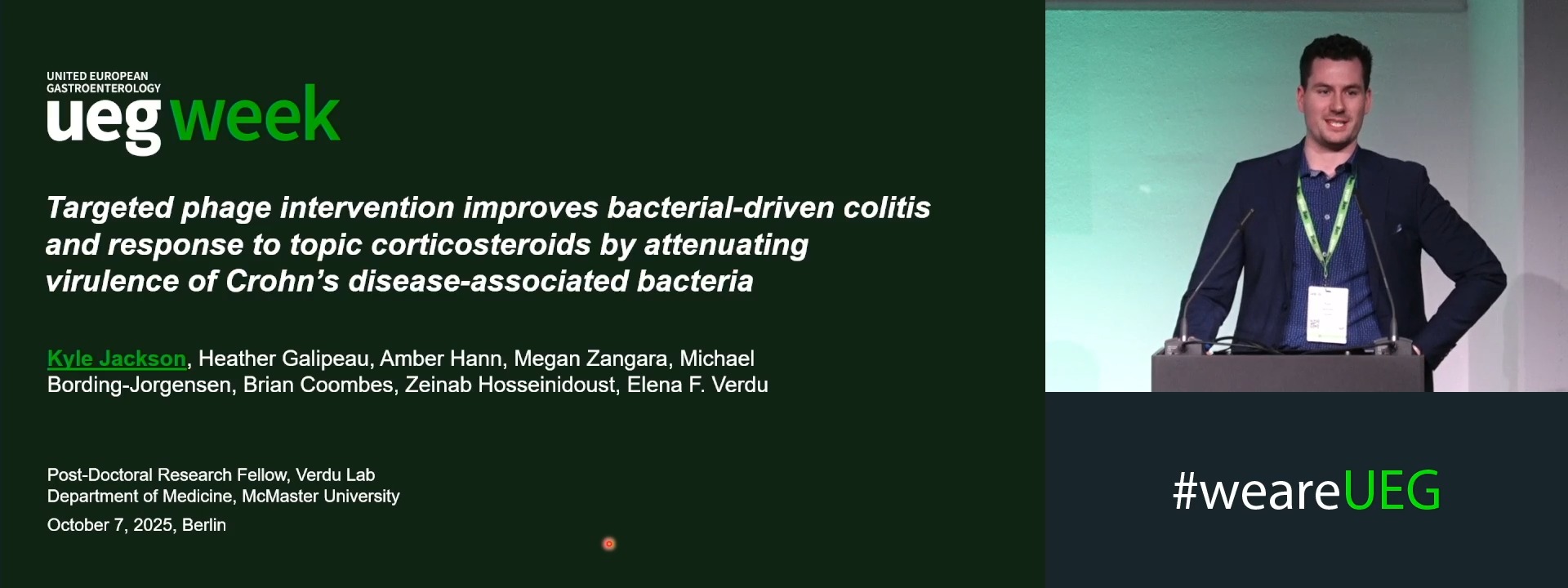
TARGETED PHAGE INTERVENTION IMPROVES BACTERIAL-DRIVEN COLITIS AND RESPONSE TO TOPICAL CORTICOSTEROIDS BY ATTENUATING VIRULENCE OF CROHN’S DISEASE-ASSOCIATED BACTERIA
Kyle Jackson 1, Heather Galipeau 2, Amber Hann 2, Marco Constante 2, Megan Zangara 3, Alexandra Fuentas 2, Chiko Shimbori 2, Premysl Bercik 2, Brian Coombes 3, Zeinab Hosseinidoust 1, Elena Verdu 2
1 McMaster University, Hamilton, Canada|||Farncombe Family Digestive Health Research Institute, Hamilton, Canada
2 Farncombe Family Digestive Health Research Institute, Hamilton, Canada
3 McMaster University, Hamilton, Canada
Event
Topics