UEG's educational platform for gastroenterology education bringing recordings, courses, guidelines, and more together in one place.
Most popular content
Rate for better recommendations!
Your feedback helps us show you more of what you like and less of what you dislike!
Log in to access this content.
Free for all myUEG account holders. Your access level is set automatically based on your occupation. Medical professionals get full access to all content. If you are a non-medical user, you can only access UEG Week content from congresses you attended.
Not sure what you can access? Learn more about account types.

EUS-GUIDED BILIARY DRAINAGE IN THE MANAGEMENT OF MALIGNANT BILIARY OBSTRUCTION: EXPERIENCE AND LEARNING CURVE IN ALGERIAN TERTIARY CENTER
Khellaf Amalou 1, Hana Chetroub 1, Fateh Bouaouina 1, Farid Belghanem 1, Mohamed Medkour 1, Nadjib Benboudiaf 1, Khadidja Saidani 1, Samia Gassem 1
1 HCA, Algiers, Algeria
Conference
Topics
Submission format
Citation
Published
Log in to access this content.
Free for all myUEG account holders. Your access level is set automatically based on your occupation. Medical professionals get full access to all content. If you are a non-medical user, you can only access UEG Week content from congresses you attended.
Not sure what you can access? Learn more about account types.
MRI ASSESSMENT OF ACUTE COLONIC VOLUME RESPONSES TO OPIOIDS AND NALOXEGOL IN HEALTHY SUBJECTS: INTERIM RESULTS FROM A RANDOMISED, DOUBLE-BLIND CROSSOVER STUDY
Annelies Verheyden 1, Živa Makovec 2, Amy Saliën 1, Esben Bolvig Mark 3, Iyad Naim 4, Alex Menys 5, Jan Tack 6
1 KU Leuven, University Hospital Gasthuisberg, Leuven, Belgium
2 University clinical centre Ljubljana, Ljubljana, Slovenia
3 Aalborg University Hospital, Aalborg, Denmark
4 Centre for Medical Imaging, University College London, London, United Kingdom
5 UCL, London, United Kingdom
6 University of Leuven, University Hospital Gasthuisberg, Leuven, Belgium
Conference
Topics
Submission format
Session
Citation
Published
Log in to access this content.
Free for all myUEG account holders. Your access level is set automatically based on your occupation. Medical professionals get full access to all content. If you are a non-medical user, you can only access UEG Week content from congresses you attended.
Not sure what you can access? Learn more about account types.
CHARACTERIZATION OF ABNORMAL GASTRIC CONTRACTILE FREQUENCY AND AMPLITUDE PARAMETERS USING ATMO CAPSULE IN RELATION TO GASTRIC EMPTYING AND GI SYMPTOMS
William Hasler 1, William Chey 2, Thomas Abell 3, Ashok Attaluri 4, Michael Cline 5, Vincent Ho 6, Allen Lee 2, Anthony Lembo 5, Amir Masoud 7, Richard W McCallum 8, Baharak Moshiree 9, Eamonn Quigley 10, Satish Rao 11, Abigal Stocker 3, Mayra Sanchez 7, Irene Sarosiek 8, Brian Surjanhata 12, Jerry Zhou 6, Braden Kuo 12
1 Mayo Clinic, Scottsdale, United States
2 University of Michigan, Ann Arbor, United States
3 University of Louisville, Louisville, United States
4 Olathe Medical Centre, Olathe, United States
5 Cleveland Clinic, Cleveland, United States
6 Western Sydney University, Campbelltown, Australia
7 Hartford Healthcare, Fairfield, United States|||Connecticut GI PC, Rocky Hill, United States
8 Texas Tech University Health Sciences Center, El Paso, United States
9 Wake Forest University, Charlotte, United States
10 Houston Methodist Hospital and Weill Cornell Medical College, Houston, United States
11 Augusta University, Augusta, United States
12 Massachusetts General Hospital, Boston, United States
Conference
Topics
Submission format
Session
Citation
Published
Log in to access this content.
Free for all myUEG account holders. Your access level is set automatically based on your occupation. Medical professionals get full access to all content. If you are a non-medical user, you can only access UEG Week content from congresses you attended.
Not sure what you can access? Learn more about account types.
IMMUNOREACT 19: IN RECTAL CANCER PATIENTS, PREVIOUS APPENDECTOMY IS ASSOCIATED TO AN ALTERED ANTIGEN PRESENTATION IN THE NORMAL MUCOSA
Anna Matteazzi 1, Melania Scarpa 2, Andromachi Kotsafti 3, Astghik Stepanyan 4, Gaia Tussardi 1, Antonio Rosato 2, Ottavia De Simoni 2, Francesca Bergamo 2, Valerio Pellegrini 5, Ivana Cataldo 5, Ceccon Carlotta 5, Anna Pozza 5, Roberta Salmaso 6, Federico Scognamiglio 4, Cesare Ruffolo 1, Silvia Negro 4, Isacco Maretto 1, Imerio Angriman 6, Chiara Vignotto 1, Luca Facci 1, Giorgio Rivella 1, Quoc Riccardo Bao 1, Andrea Baldo 1, Giulia Pozza 1, Marco Agostini 1, Maurizio Zizzo 7, Beatrice Salmaso 8, Dario Parini 8, GiovannI Pirozzolo 9, Giovanni Bordignon 10, Roberto Merenda 10, Laurino Licia 10, Isabella Mondi 10, Silvio Guerriero 11, Giuseppe Portale 12, Lavinia Ceccarini 12, Michele Antoniutti 12, Laura Marinelli 13, Mattia Barbareschi 13, Giovanni Bertalot 13, Alberto Brolese 13, Giulia Noaro 9, Giulia Becherucci 14, Andrea Porzionato 6, Francesco Cavallin 15, Barbara Di Camillo 6, Gaya Spolverato 1, Ignazio CASTAGLIUOLO 1, Matteo Fassan 5, Marco Scarpa 1
1 Azienda Ospedaliera Universitaria di Padova, Padova, Italy
2 Veneto Institute of Oncology IOV-IRCCS, Padova, Italy
3 Veneto Institute of Oncology (IOV-IRCCS), Padova, Italy
4 Azienda Ospedaliera Universitaria di Padova, Yerevan, Italy
5 Azienda ULSS n 2 Marca Trevigiana, Treviso, Italy
6 University of Padova, Padova, Italy
7 Arcispedale Santa Maria Nuova IRCCS, Reggio Emilia, Italy
8 Azienda ULSS n 5 Polesana, Rovigo, Italy
9 Azienda ULSS n 6 Euganea, Padova, Italy
10 Azienda ULSS n 3 Serenissima, Venezia, Italy
11 Ospedale di Fermo, ASUR 4, Fermo, Italy
12 Azienda ULSS n 7 Pedemontana, Bassano del Grappa, Italy
13 Azienda Provinciale per i Servizi Sanitari, Trento, Italy
14 Azienda ULSS n 1 Dolomiti, Belluno, Italy
15 Independent Statistician, Solagna, Italy
Conference
Topics
Submission format
Citation
Published
Log in to access this content.
Free for all myUEG account holders. Your access level is set automatically based on your occupation. Medical professionals get full access to all content. If you are a non-medical user, you can only access UEG Week content from congresses you attended.
Not sure what you can access? Learn more about account types.
SWALLOWABLE TECH: ADVANCING DISEASE MONITORING WITH INGESTIBLE SENSORS
Aniek Even 1, Roseanne Minderhoud 2, Lotte Hazeleger 3, Tom Torfs 4, Francesca Leonardi 1, Arjan van Heusden 1, Ria Sijabat 1, Dimitrios Firfilionis 1, Ivan Dario Castro Miller 4, Ramzy Rammouz 4, Tobias Teichmann 1, Ruben van Bergen 1, Günter Vermeeren 5, Edoardo Capuano 6, Rachel Armstrong 1, Klaus Mathwig 1, Sonja de Vries 6, Marjolijn Duijvestein 7, Annelies Goris 1, Nick Van Helleputte 4, Guido Hooiveld 6, Chris Van Hoof 8
1 OnePlanet Research Center, Wageningen, Netherlands|||imec, Wageningen, Netherlands
2 OnePlanet Research Center, Wageningen, Netherlands|||Wageningen University & Research, Wageningen, Netherlands
3 Radboud University Medical Centre, Nijmegen, Netherlands|||OnePlanet Research Center, Wageningen, Netherlands
4 imec, Leuven, Belgium
5 Ghent University, Ghent, Belgium
6 Wageningen University & Research, Wageningen, Netherlands|||OnePlanet Research Center, Wageningen, Netherlands
7 OnePlanet Research Center, Wageningen, Netherlands|||Radboud University Medical Centre, Nijmegen, Netherlands
8 OnePlanet Research Center, Wageningen, Netherlands|||imec, Wageningen, Netherlands|||imec, Leuven, Belgium
Conference
Topics
Submission format
Session
Citation
Published
Log in to access this content.
Free for all myUEG account holders. Your access level is set automatically based on your occupation. Medical professionals get full access to all content. If you are a non-medical user, you can only access UEG Week content from congresses you attended.
Not sure what you can access? Learn more about account types.
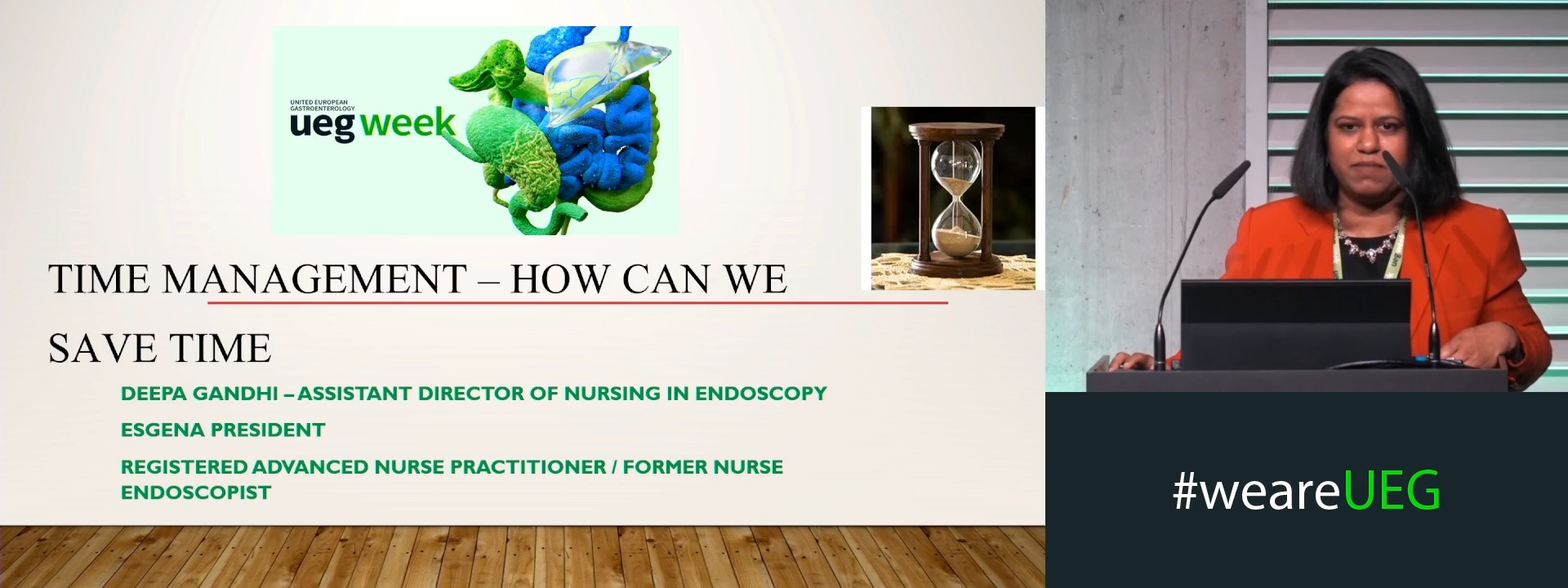
Time management: How can we save time?
1 Mater Misericordiae University Hospital, Dublin, Ireland
Event
Topics
Session
Citation
Published
Log in to access this content.
Free for all myUEG account holders. Your access level is set automatically based on your occupation. Medical professionals get full access to all content. If you are a non-medical user, you can only access UEG Week content from congresses you attended.
Not sure what you can access? Learn more about account types.
ANTITHROMBOTIC THERAPY AND UPPER GI HEMORRHAGE: RISKY BUSINESS?
Amine Achemlal 1, Samir Mrabti 1, Salma Azammam 1, Sakina Oualaalou 1, Meriem Amine 1, Imane KARAM 1, Firdaouss Ait iken 1, Sara HDIYE 1, Ahlame Benhamdane 1, Tarik Addajou 1, Reda Berraida 1, elkoti ilham 1, Rouibaa Fedoua 1, Hassan Seddik 1
1 Mohamed V Military Training Hospital, Rabat, Morocco, Rabat, Morocco
Conference
Topics