UEG's educational platform for gastroenterology education bringing recordings, courses, guidelines, and more together in one place.
Most popular content
Rate for better recommendations!
Your feedback helps us show you more of what you like and less of what you dislike!
Log in to access this content.
Free for all myUEG account holders. Your access level is set automatically based on your occupation. Medical professionals get full access to all content. If you are a non-medical user, you can only access UEG Week content from congresses you attended.
Not sure what you can access? Learn more about account types.
Best of UEG Week 2024 with Thomas Seufferlein on "Oncology for Gastroenterologists"
Topics
Published
Log in to access this content.
Free for all myUEG account holders. Your access level is set automatically based on your occupation. Medical professionals get full access to all content. If you are a non-medical user, you can only access UEG Week content from congresses you attended.
Not sure what you can access? Learn more about account types.
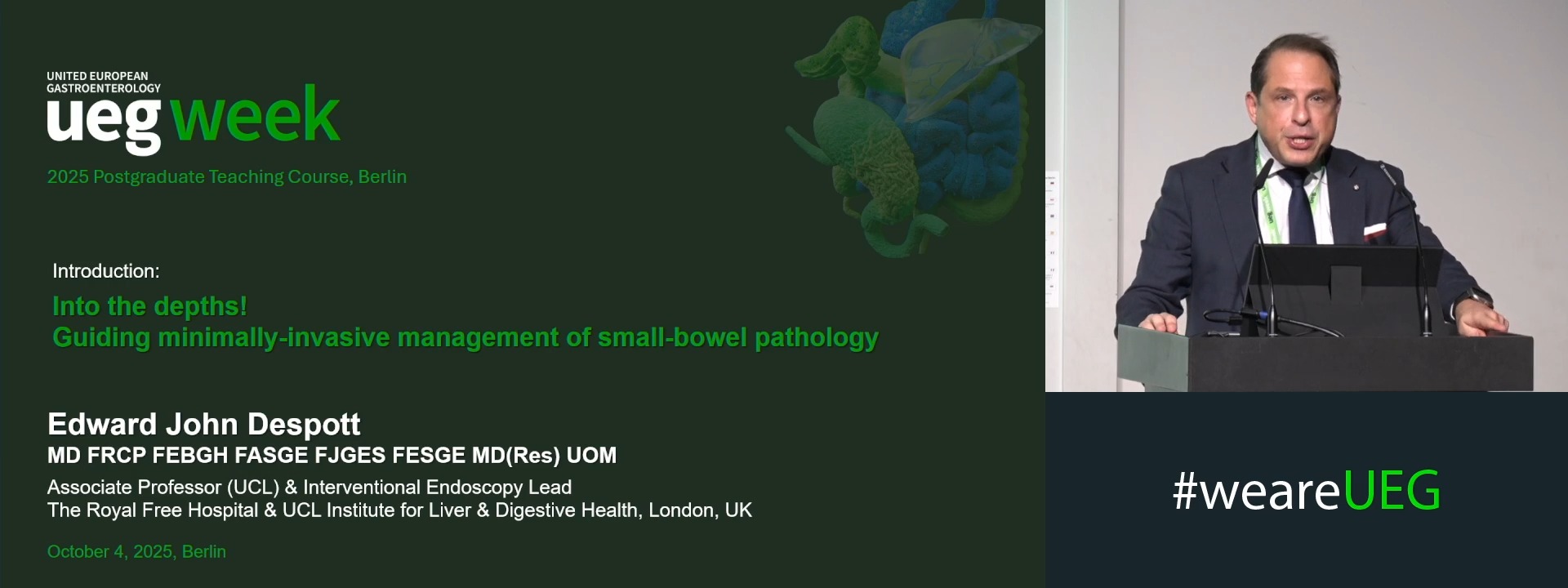
Introduction: Into the depths! Guiding minimally-invasive management of small-bowel pathology
1 Royal Free Hospital & UCL School of Medicine, London, United Kingdom
Event
Citation
Published
Log in to access this content.
Free for all myUEG account holders. Your access level is set automatically based on your occupation. Medical professionals get full access to all content. If you are a non-medical user, you can only access UEG Week content from congresses you attended.
Not sure what you can access? Learn more about account types.
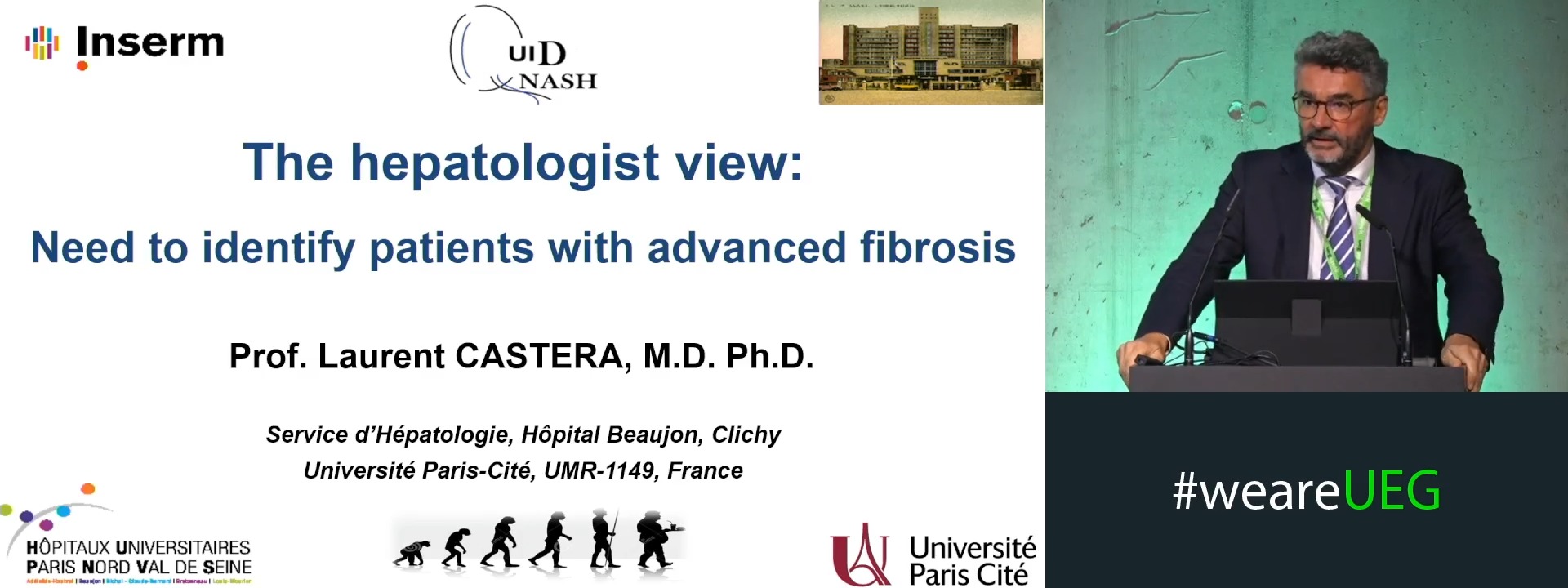
The hepatologist view: Need to identify patients with advanced fibrosis
1 Hôpital Beaujon - Service d’Hépatologie, Hôpital Beaujon; Clichy/FR, Clichy, France
Event
Session
Citation
Published
Log in to access this content.
Free for all myUEG account holders. Your access level is set automatically based on your occupation. Medical professionals get full access to all content. If you are a non-medical user, you can only access UEG Week content from congresses you attended.
Not sure what you can access? Learn more about account types.

CHRONIC INFLAMMATORY BOWEL DISEASES AND CANCERS
Meryem Ahamam 1, Nawal Lagdali 1, FATIMA-ZAHRA CHABIB 1, Maryeme Kadiri 1, Mohamed Borahma 1, Fatima Zahra Ajana 1
1 Ibn Sina University Hospital, Faculty Of Medicine And Pharmacy Of Rabat, Mohammed V University Rabat, Rabat, Morocco
Conference
Topics
Submission format
Session
Citation
Published
Log in to access this content.
Free for all myUEG account holders. Your access level is set automatically based on your occupation. Medical professionals get full access to all content. If you are a non-medical user, you can only access UEG Week content from congresses you attended.
Not sure what you can access? Learn more about account types.
RETROSPECTIVE REVIEW OF THE ROLE OF BOTOX INJECTION AND SPHINCETROTOMY IN THE MANAGEMENT OF FUNCTIONAL HEPATOBILLARY PAIN
1 Sheffield Teaching Hospitals, Sheffield, United Kingdom
Conference
Topics
Submission format
Session
Citation
Published
Log in to access this content.
Free for all myUEG account holders. Your access level is set automatically based on your occupation. Medical professionals get full access to all content. If you are a non-medical user, you can only access UEG Week content from congresses you attended.
Not sure what you can access? Learn more about account types.
Panel Discussion: Diabetes in GI disorders
Event
Session
Citation
Published
Log in to access this content.
Free for all myUEG account holders. Your access level is set automatically based on your occupation. Medical professionals get full access to all content. If you are a non-medical user, you can only access UEG Week content from congresses you attended.
Not sure what you can access? Learn more about account types.
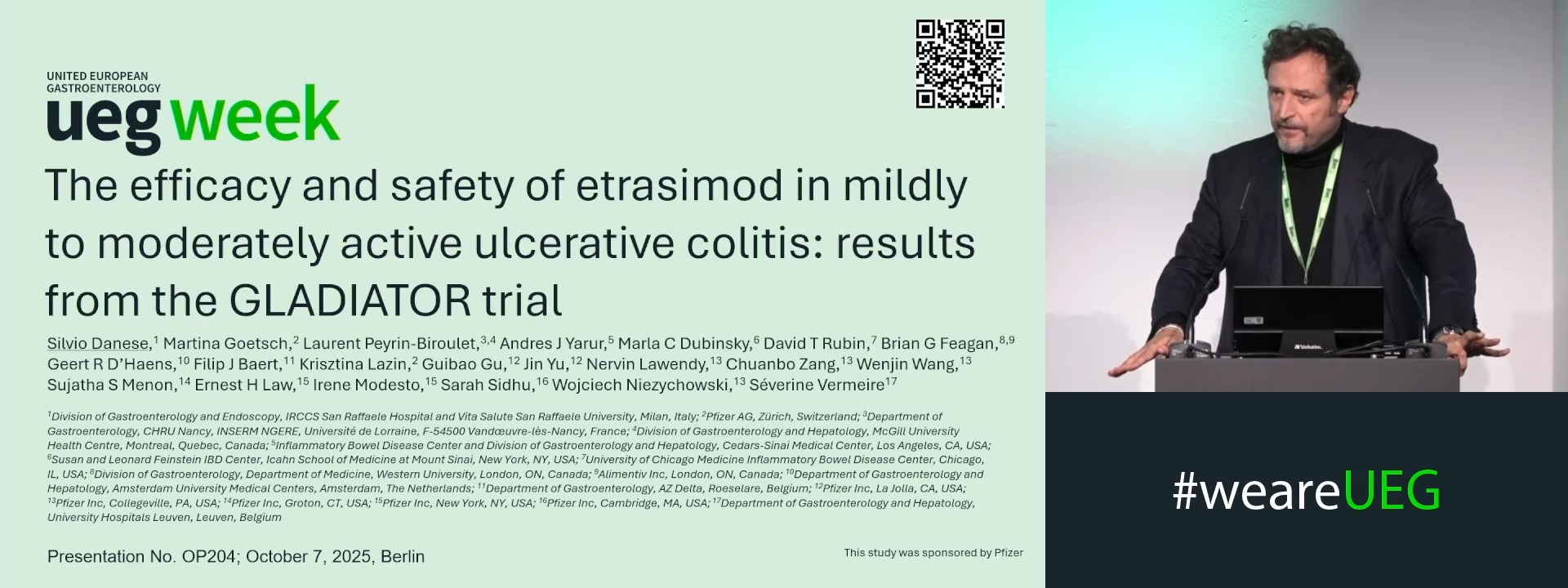
THE EFFICACY AND SAFETY OF ETRASIMOD IN MILDLY TO MODERATELY ACTIVE ULCERATIVE COLITIS: RESULTS FROM THE GLADIATOR TRIAL
Silvio Danese 1, Martina Goestch 2, Laurent Peyrin-Biroulet 3, Andres Yarur 4, Marla C. Dubinsky 5, David T. Rubin 6, Brian G. Feagan 7, Geert R. D'Haens 8, Filip Baert 9, Krisztina Lazin 2, Guibao Gu 10, Jin Yu 10, Nervin Lawendy 11, Chuanbo Zang 11, Wenjin Wang 11, Sujatha S. Menon 12, Ernest Law 13, Irene Modesto 13, Sarah Sidhu 13, Wojciech Niezychowski 11, Severine Vermeire 14
1 Division of Gastroenterology and Endoscopy, IRCCS San Raffaele Hospital and Vita Salute San Raffaele University, Milan, Italy
2 Pfizer AG, Zürich, Switzerland
3 Department of Gastroenterology, CHRU Nancy, INSERM NGERE, Université de Lorraine, Vandœuvre-lès-Nancy, France
4 Inflammatory Bowel Disease Center and Division of Gastroenterology and Hepatology, Cedars-Sinai Medical Center, Los Angeles, CA, United States
5 Susan and Leonard Feinstein IBD Center, Icahn School of Medicine, Mount Sinai, New York, NY, United States
6 University of Chicago Medicine Inflammatory Bowel Disease Center, Chicago, IL, United States
7 Division of Gastroenterology, Department of Medicine, Western University, London, ON, Canada|||Alimentiv Inc, London, ON, Canada
8 Department of Gastroenterology and Hepatology, Amsterdam University Medical Centers, Amsterdam, Netherlands
9 Department of Gastroenterology, AZ Delta, Roeselare, Belgium
10 Pfizer Inc, La Jolla, CA, United States
11 Pfizer Inc, Collegeville, PA, United States
12 Pfizer Inc, Groton, CT, United States
13 Pfizer Inc, New York, NY, United States
14 Department of Gastroenterology and Hepatology, University Hospitals Leuven, Leuven, Belgium