UEG's educational platform for gastroenterology education bringing recordings, courses, guidelines, and more together in one place.
Most popular content
Rate for better recommendations!
Your feedback helps us show you more of what you like and less of what you dislike!
Log in to access this content.
Free for all myUEG account holders. Your access level is set automatically based on your occupation. Medical professionals get full access to all content. If you are a non-medical user, you can only access UEG Week content from congresses you attended.
Not sure what you can access? Learn more about account types.
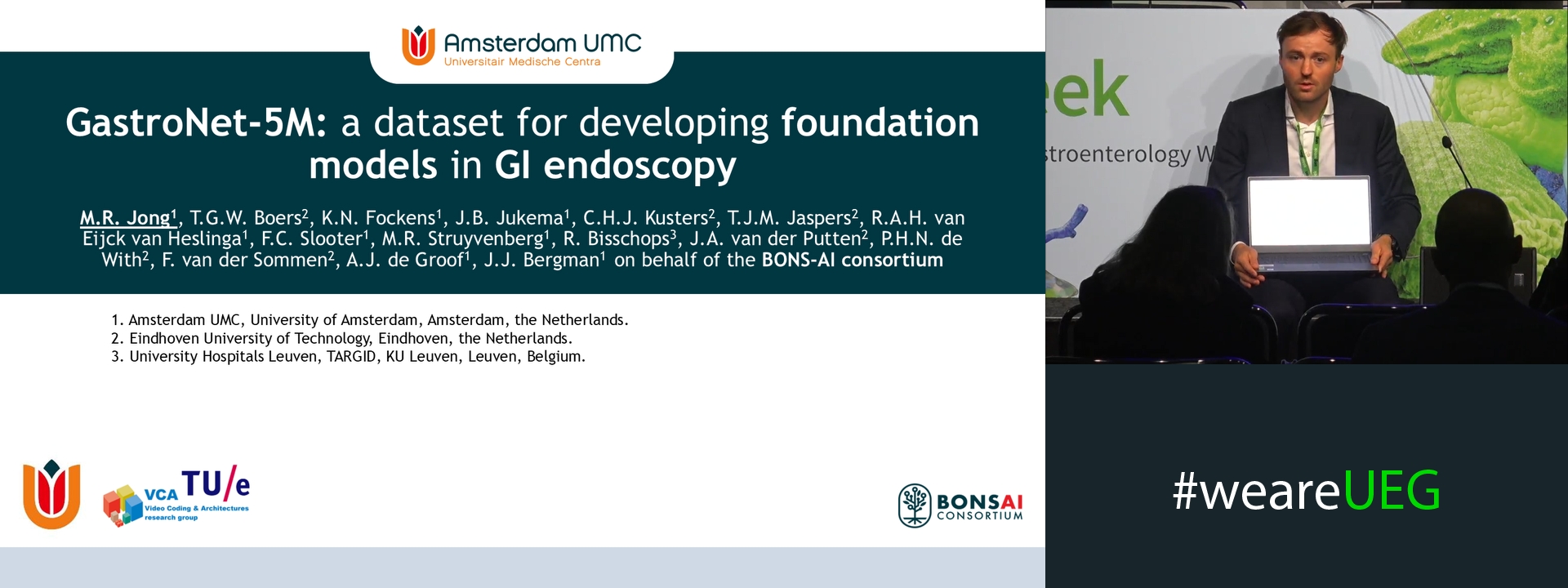
GASTRONET-5M: A MULTICENTER DATASET FOR FOUNDATION MODELS ADVANCING DEEP LEARNING SYSTEMS IN GASTROINTESTINAL ENDOSCOPY
Martijn R. Jong 1, Tim Boers 2, Kiki Fockens 1, Jelmer Jukema 1, Carolus Kusters 2, Tim Jaspers 2, Rixta van Eijck van Heslinga 1, Floor Slooter 1, Maarten Struyvenberg 1, Raf Bisschops 3, Joost van der Putten 2, Peter H. N. de With 2, Fons van der Sommen 2, Jeroen de Groof 1, Jacques J. Bergman 1
1 Amsterdam UMC, Amsterdam, Netherlands
2 TU Eindhoven, Eindhoven, Netherlands
3 Katholieke Universiteit Leuven, Leuven, Belgium
Event
Submission format
Citation
Published
Log in to access this content.
Free for all myUEG account holders. Your access level is set automatically based on your occupation. Medical professionals get full access to all content. If you are a non-medical user, you can only access UEG Week content from congresses you attended.
Not sure what you can access? Learn more about account types.
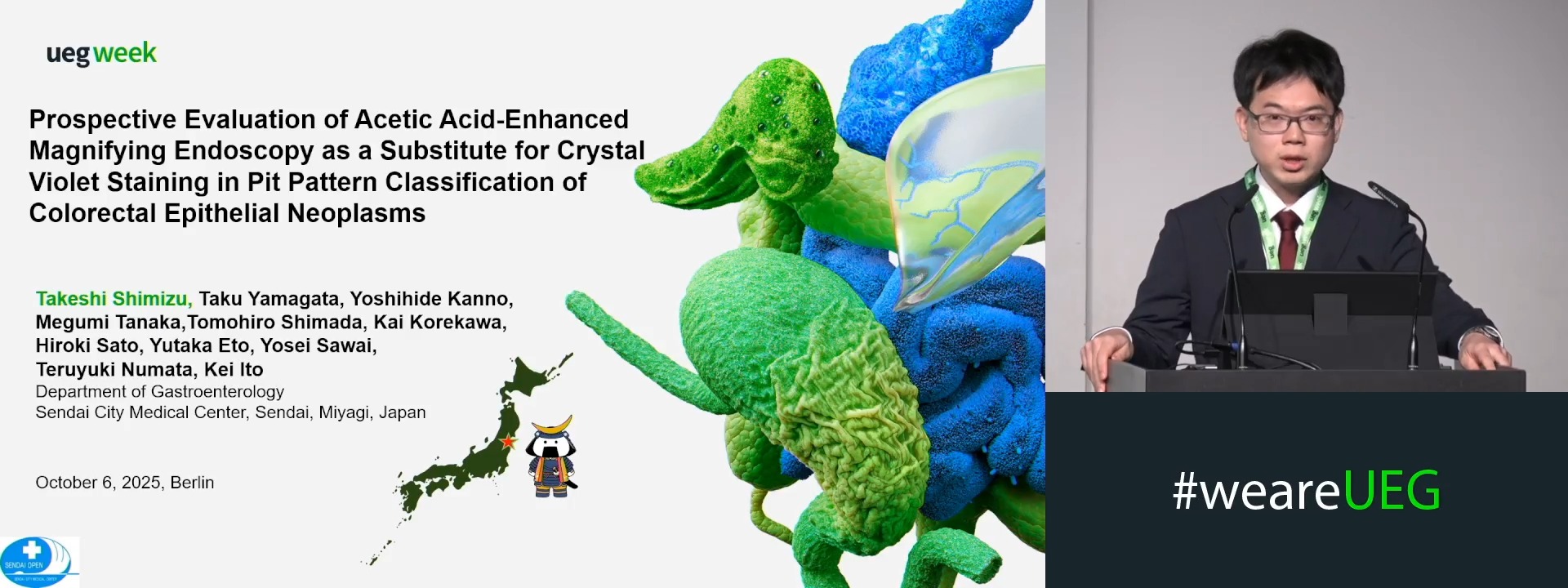
PROSPECTIVE EVALUATION OF ACETIC ACID-ENHANCED MAGNIFYING ENDOSCOPY AS A SUBSTITUTE FOR CRYSTAL VIOLET STAINING IN PIT PATTERN CLASSIFICATION OF COLORECTAL EPITHELIAL NEOPLASMS
Takeshi Shimizu 1, Taku Yamagata 1, Yoshihide Kanno 1, Megumi Tanaka 1, Tomohiro Shimada 1, Kai Korekawa 1, Hiroki Sato 1, Yutaka Eto 1, Yosei Sawai 1, Teruyuki Numata 1, Kei Ito 1
1 Sendai City Medical Center, Sendai, Japan
Event
Submission format
Citation
Published
Log in to access this content.
Free for all myUEG account holders. Your access level is set automatically based on your occupation. Medical professionals get full access to all content. If you are a non-medical user, you can only access UEG Week content from congresses you attended.
Not sure what you can access? Learn more about account types.
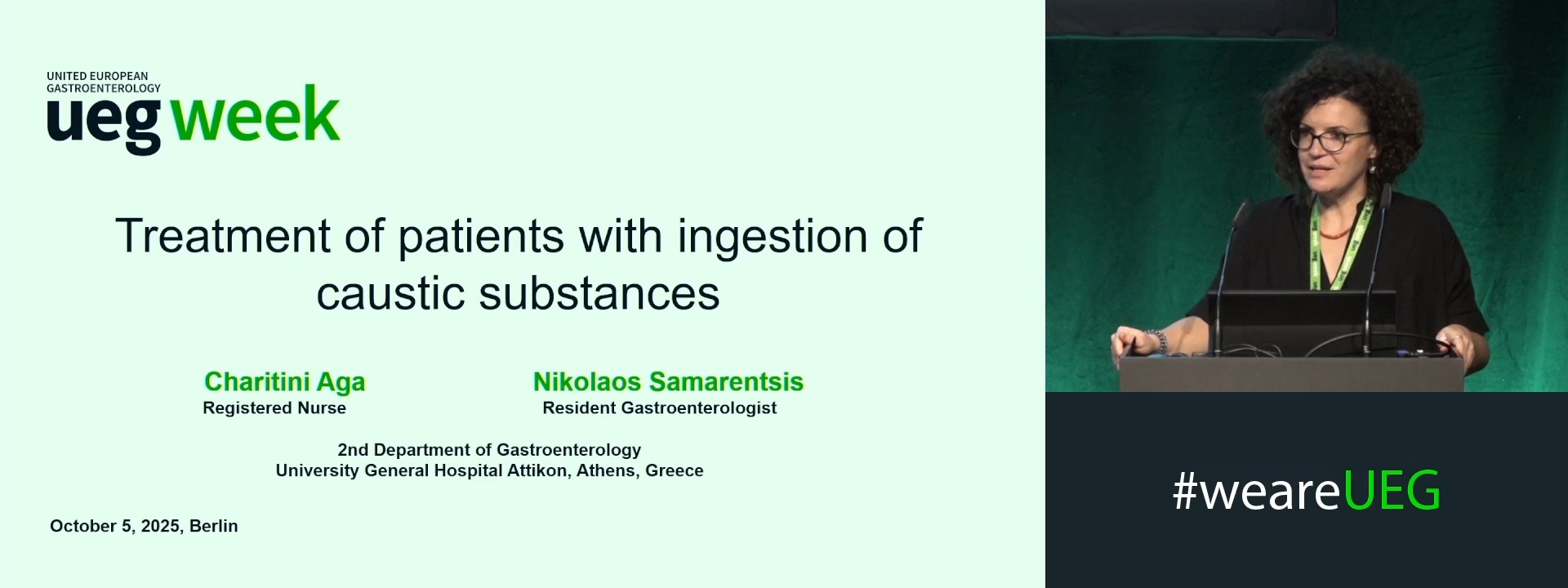
Treatment of patients with ingestion of caustic substances
1 None, None, Greece
Event
Topics
Citation
Published
Log in to access this content.
Free for all myUEG account holders. Your access level is set automatically based on your occupation. Medical professionals get full access to all content. If you are a non-medical user, you can only access UEG Week content from congresses you attended.
Not sure what you can access? Learn more about account types.
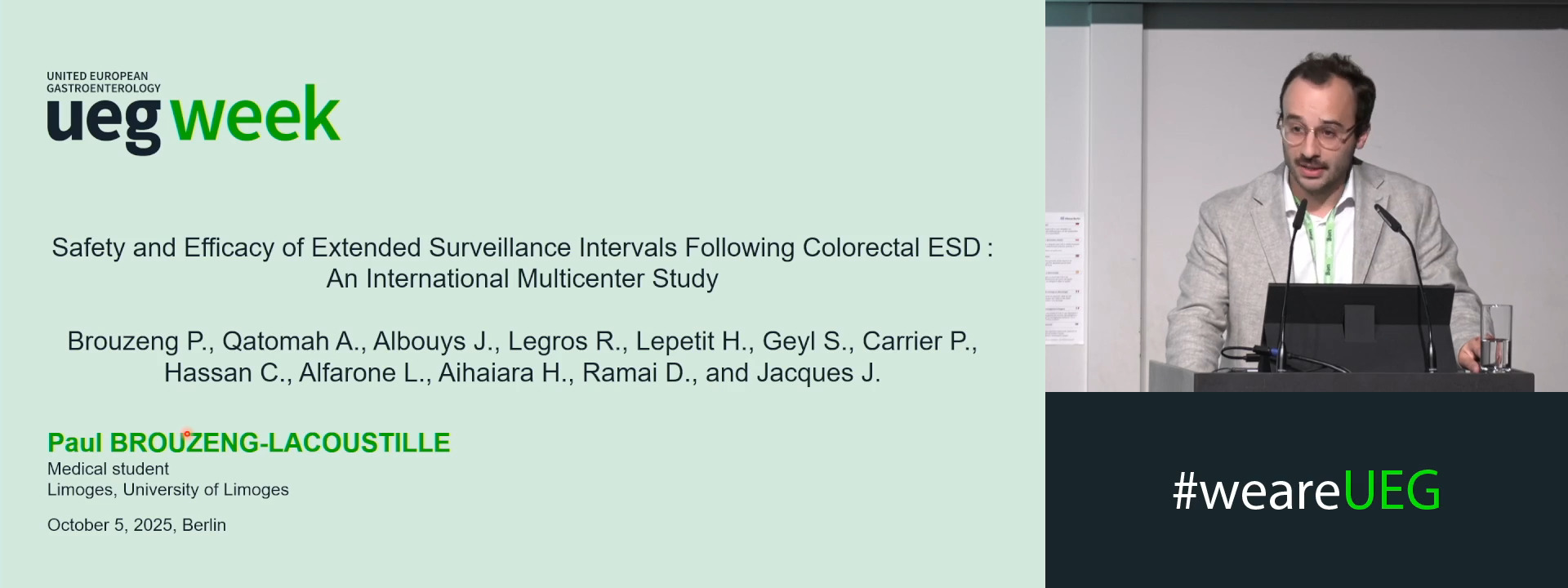
SAFETY AND EFFICACY OF EXTENDED SURVEILLANCE INTERVALS FOLLOWING COLORECTAL ESD: AN INTERNATIONAL MULTICENTER STUDY
Paul Brouzeng 1, Jérémie Jacques 2, Jeremie Albouys 3, Paul Carrier 2, Romain Legros 1, Hugo Lepetit 4, Sophie GEYL 1, Ludovico Alfarone 5, Abdulraman Qatomah 6, Cesare Hassan 7, Daryl Ramai 6, Hiroyki Aihaiara 6
1 CHU Limoges, Limoges, France
2 CHU Limoges - Hepato-Gastro-Enterology, CHU Limoges; Limoges/FR, Limoges, France
3 CHU Limoges / University of Limoges, Limoges, France
4 CHU Limoges France, Limoges, France
5 Milan, Milan, Italy
6 Brigham and Women's Hospital, Boston, United States
7 Humanitas University, Pieve Emanuele MI, Italy
Event
Submission format
Session
Citation
Published
Log in to access this content.
Free for all myUEG account holders. Your access level is set automatically based on your occupation. Medical professionals get full access to all content. If you are a non-medical user, you can only access UEG Week content from congresses you attended.
Not sure what you can access? Learn more about account types.
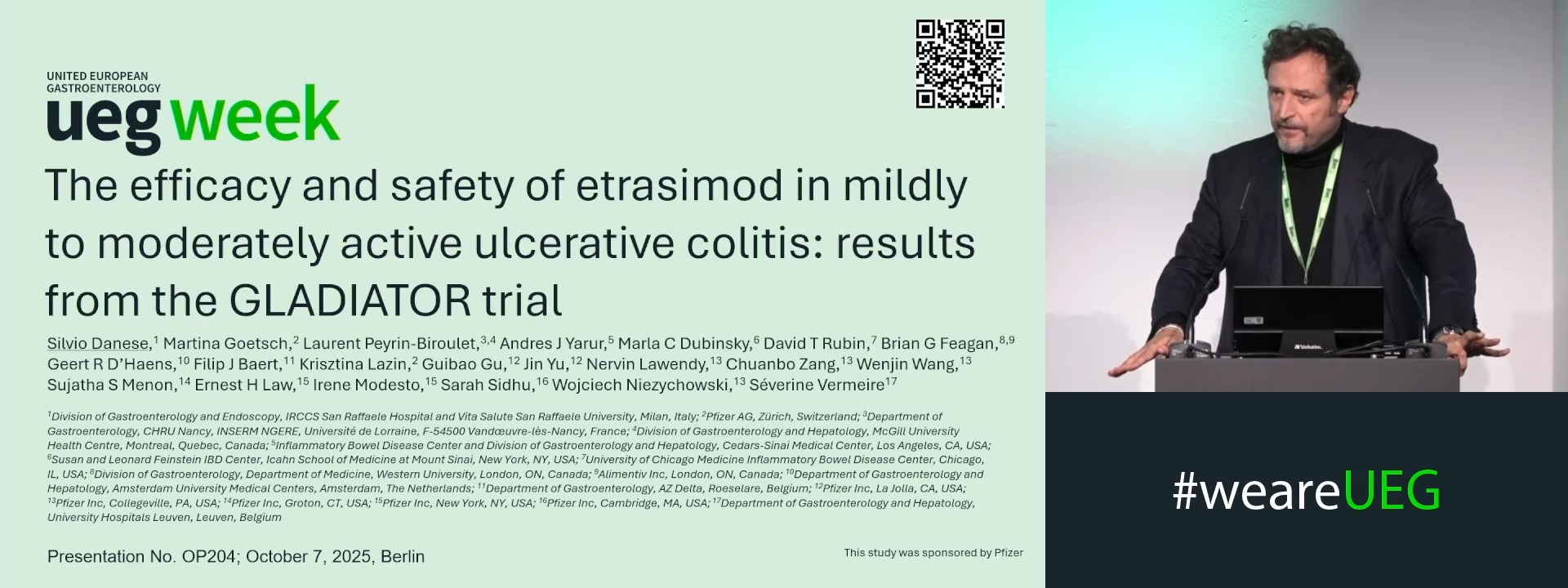
THE EFFICACY AND SAFETY OF ETRASIMOD IN MILDLY TO MODERATELY ACTIVE ULCERATIVE COLITIS: RESULTS FROM THE GLADIATOR TRIAL
Silvio Danese 1, Martina Goestch 2, Laurent Peyrin-Biroulet 3, Andres Yarur 4, Marla C. Dubinsky 5, David T. Rubin 6, Brian G. Feagan 7, Geert R. D'Haens 8, Filip Baert 9, Krisztina Lazin 2, Guibao Gu 10, Jin Yu 10, Nervin Lawendy 11, Chuanbo Zang 11, Wenjin Wang 11, Sujatha S. Menon 12, Ernest Law 13, Irene Modesto 13, Sarah Sidhu 13, Wojciech Niezychowski 11, Severine Vermeire 14
1 Division of Gastroenterology and Endoscopy, IRCCS San Raffaele Hospital and Vita Salute San Raffaele University, Milan, Italy
2 Pfizer AG, Zürich, Switzerland
3 Department of Gastroenterology, CHRU Nancy, INSERM NGERE, Université de Lorraine, Vandœuvre-lès-Nancy, France
4 Inflammatory Bowel Disease Center and Division of Gastroenterology and Hepatology, Cedars-Sinai Medical Center, Los Angeles, CA, United States
5 Susan and Leonard Feinstein IBD Center, Icahn School of Medicine, Mount Sinai, New York, NY, United States
6 University of Chicago Medicine Inflammatory Bowel Disease Center, Chicago, IL, United States
7 Division of Gastroenterology, Department of Medicine, Western University, London, ON, Canada|||Alimentiv Inc, London, ON, Canada
8 Department of Gastroenterology and Hepatology, Amsterdam University Medical Centers, Amsterdam, Netherlands
9 Department of Gastroenterology, AZ Delta, Roeselare, Belgium
10 Pfizer Inc, La Jolla, CA, United States
11 Pfizer Inc, Collegeville, PA, United States
12 Pfizer Inc, Groton, CT, United States
13 Pfizer Inc, New York, NY, United States
14 Department of Gastroenterology and Hepatology, University Hospitals Leuven, Leuven, Belgium
Event
Submission format
Citation
Published
Log in to access this content.
Free for all myUEG account holders. Your access level is set automatically based on your occupation. Medical professionals get full access to all content. If you are a non-medical user, you can only access UEG Week content from congresses you attended.
Not sure what you can access? Learn more about account types.
Panel discussion: Screening for colorectal cancer
Event
Citation
Published
Log in to access this content.
Free for all myUEG account holders. Your access level is set automatically based on your occupation. Medical professionals get full access to all content. If you are a non-medical user, you can only access UEG Week content from congresses you attended.
Not sure what you can access? Learn more about account types.
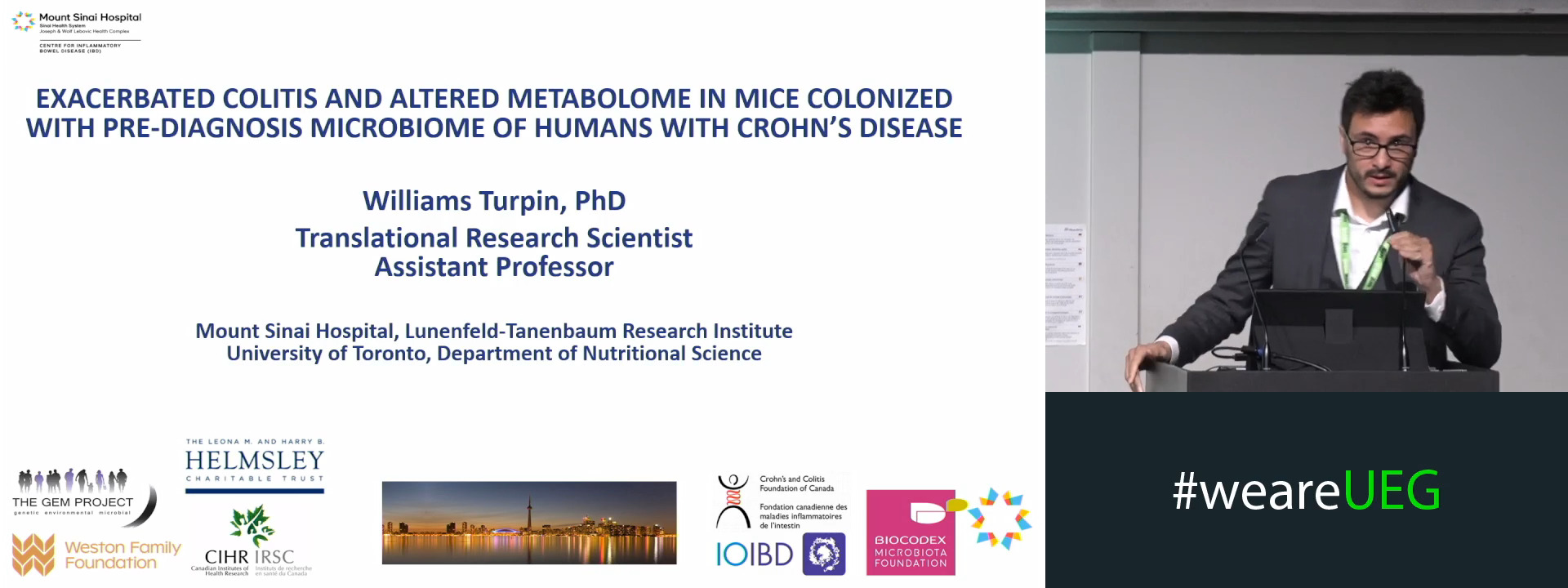
EXACERBATED COLITIS AND ALTERED METABOLOME IN MICE COLONIZED WITH PRE-DIAGNOSIS MICROBIOME OF HUMANS WITH CROHN’S DISEASE
Cong Phi Dang 1, Alice Chen-Liaw 2, Mingyue Xue 3, Alexander Luchak 1, Kaiwen Mu 1, Qilong Li 3, Ren Mu Yan 1, Sun-Ho Lee 3, Paul Moayyedi 4, Anne Griffiths 5, Colette Deslandres 6, Sanjay Murthy 7, Allan Hillary Steinhart 8, Anthony Otley 9, Levinus Dieleman 10, Kevan Jacobson 11, David T. Rubin 12, Remo Panaccione 13, Brian G. Feagan 14, Catherine Streutker 15, Ilaria Mogno 2, Graham J. Britton 2, Jeremiah J. Faith 2, Kenneth Croitoiru 3, Williams Turpin 3
1 University of Toronto, Toronto, Canada
2 Icahn School of Medicine at Mount Sinai, New York, United States
3 Mount Sinai Hospital, Toronto, Canada
4 McMaster University Dept. of Medicine Dept. of Gastroenterology - McMaster University Dept. of Medic, Hamilton, Canada
5 Hospital for Sick Children, Toronto, Canada
6 University of Montreal, Montreal, Canada
7 Ottawa Hospital Research Institute, Ottawa, Canada
8 Mount Sinai Hospital Dept. of Medicine, Toronto, Canada
9 Dalhousie University, Halifax, Canada
10 University of Alberta Division of Gastroenterology Dept. of Medicine, Edmonton, Canada
11 British Columbia Children's Hospital, Vancouver, Canada
12 University of Chicago Medicine, Chicago, United States
13 University of Calgary, Calgary, Canada
14 Alimentiv Inc., London, Canada
15 St Michael’s Hospital, Toronto, Canada