UEG's educational platform for gastroenterology education bringing recordings, courses, guidelines, and more together in one place.
Most popular content
Rate for better recommendations!
Your feedback helps us show you more of what you like and less of what you dislike!
Log in to access this content.
Free for all myUEG account holders. Your access level is set automatically based on your occupation. Medical professionals get full access to all content. If you are a non-medical user, you can only access UEG Week content from congresses you attended.
Not sure what you can access? Learn more about account types.

DOMINO TRIAL POST – HOC ANALYSIS: EVALUATION OF THE DIET EFFECTS ON SYMPTOMS IN IBS SUBTYPES
Claudia Di Rosa 1, Florencia Carbone 2, Karen Van den Houte 2, Annamaria Altomare 1, Michele Pier Luca Guarino 1, Jan Tack 2
1 Campus Bio Medico University, Rome, Italy
2 Leuven University Hospital, Leuven, Belgium
Conference
Topics
Submission format
Citation
Published
Log in to access this content.
Free for all myUEG account holders. Your access level is set automatically based on your occupation. Medical professionals get full access to all content. If you are a non-medical user, you can only access UEG Week content from congresses you attended.
Not sure what you can access? Learn more about account types.
LONG-TERM OUTCOMES AND OPTIMAL TREATMENT STRATEGIES AFTER ENDOSCOPIC SUBMUCOSAL DISSECTION FOR T1 COLORECTAL CANCER: A REAL-WORLD MULTICENTER PROSPECTIVE STUDY BY THE HIROSHIMA GI ENDOSCOPY RESEARCH GROUP
Toshio Kuwai 1, Takuro Hamada 1, Yuki Kamigaichi 1, Koki Nakamura 2, Tomohiro Miwata 3, Seiji Onogawa 4, Hideharu Okanobu 5, Akira Furudoi 6, Shinji Nagata 7, Shigeto Yoshida 8, Masaki Kunihiro 9, Yuko Hiraga 10, Shiro Okamoto 11, Shiro Oka 1
1 Hiroshima University Hospital, Hiroshima, Japan
2 Miyoshi Central Hospital, Miyoshi, Japan
3 Chugoku Rosai Hospital, Kure, Japan
4 Onomichi General Hospital, Onomichi, Japan
5 Hiroshima Red Cross Hospital and Atomic-Bomb Survivors Hospital, Hiroshima, Japan
6 JA Hiroshima General Hospital, Hatsukaichi, Japan
7 Hiroshima City Asa Citizens Hospital, Hiroshima, Japan
8 NHO Kure Medical Center, Kure, Japan
9 Hiroshima City Hiroshima Citizens Hospital, Hiroshima, Japan
10 Hiroshima Prefectural Hospital, Hiroshima, Japan
11 Kure Kyosai Hospital, Kure, Japan
Event
Submission format
Citation
Published
Log in to access this content.
Free for all myUEG account holders. Your access level is set automatically based on your occupation. Medical professionals get full access to all content. If you are a non-medical user, you can only access UEG Week content from congresses you attended.
Not sure what you can access? Learn more about account types.
Should we give probiotics a chance? For what?
1 Center for Biomarker Research in Medicine (CBmed), Graz, Austria
Event
Topics
Citation
Published
Log in to access this content.
Free for all myUEG account holders. Your access level is set automatically based on your occupation. Medical professionals get full access to all content. If you are a non-medical user, you can only access UEG Week content from congresses you attended.
Not sure what you can access? Learn more about account types.
A MULTICENTER RETROSPECTIVE STUDY OF INFLUENTIAL FACTORS ON STENOSIS AFTER MODERATE RESECTION OF CIRCUMFERENCE IN ESOPHAGEAL ENDOSCOPIC SUBMUCOSAL DISSECTION
Akira Dobashi 1, Tsugumi Habu 2, Osamu Goto 3, Toshiyuki Yoshio 4, Waku Hatta 5, Noboru Kawata 6, Atsushi Goto 7, Unknown Unknown 8, Yugo Iwaya 9, Tetsuya Tatsuta 10, Takuto Hikichi 11, Jun Nakamura 11, Shinjiro Yamaguchi 12, Takashi Ohta 12, Yohei Furumoto 13, Tsutomu Nishida 14, Masashi Yamamoto 14, Mikitaka Iguchi 15, Tatsuo Yachida 16, Hiroko Nebiki 17, Tomoaki Yamasaki 17, Toshiaki Narasaka 18, Eriko Koizumi 2, Yosuke Tsuji 19, Kazuki Sumiyama 1, Mitsuhiro Fujishiro 19
1 The Jikei University School of Medicine, Tokyo, Japan
2 Nippon Medical School Graduate School of Medicine, Bunkyo-ku, Tokyo, Japan
3 Nippon Medical School, Tokyo, Japan
4 Cancer Institute Hospital, Japanese Foundation for Cancer Reserch, Tokyo, Japan
5 Tohoku University, Graduate School of Medicine, Sendai, Japan
6 Shizuoka Cancer Center, Shizuoka, Japan
7 Yamaguchi University Graduate School of Medicine, Ube, Japan
8 Tonan Hospital, Hokkaido, Japan
9 Shinshu University School of Medicine, Matsumoto, Japan
10 Hirosaki University Hospital, Aomori, Japan
11 Fukushima Medical University Hospital, Fukushima, Japan
12 Kansai Rosai Hospital, Hyogo, Japan
13 Tokyo Metropolitan Bokutoh Hospital, Tokyo, Japan
14 Toyonaka Municipal Hospital, Toyonaka, Japan
15 Wakayama Medical University, Wakayama, Japan
16 Faculty of Medicine, Kagawa University, Kagawa, Japan
17 Osaka City General Hospital, Osaka, Japan
18 University of Tsukuba, Tsukuba, Japan
19 The University of Tokyo, Tokyo, Japan
Event
Topics
Submission format
Citation
Published
Log in to access this content.
Free for all myUEG account holders. Your access level is set automatically based on your occupation. Medical professionals get full access to all content. If you are a non-medical user, you can only access UEG Week content from congresses you attended.
Not sure what you can access? Learn more about account types.
TPM502, A TOLERIZING NANOPARTICLE MIXTURE FOR CELIAC DISEASE TREATMENT, INDUCES LONG-LASTING PHENOTYPIC CHANGES IN HLA-DQ2.5-GLIADIN-SPECIFIC TETRAMER+ CD4+ T CELLS, INDICATING ANTIGEN-SPECIFIC IMMUNOMODULATORY EFFECTS
Louise Fremgaard Risnes 1, Shu-Hung Wang 2, Knut E.A. Lundin 3, Ludvig M. Sollid 4, Naomi B. Klarenbeek 5, Anouk C. Meijs 5, Per Martin Hellström 6, Mika Scheinin 7, Rasmus Goll 8, A. James M. Daveson 9, Scott Schoeman 10, Erno A. Van Schaick 11, Veronica Asnaghi 2, Sabine Fleischer 2, Cristina de Min 2
1 University of Oslo and Oslo University Hospital, Oslo, Norway
2 Topas Therapeutics GmbH, Hamburg, Germany
3 Norwegian Coeliac Disease Research Centre, University of Oslo and Oslo University Hospital, Oslo, Norway
4 University of Oslo Inst. of Immunology Centre for Immune Regulation, Oslo, Norway
5 Centre for Human Drug Research, Leiden, Netherlands
6 Uppsala University, Uppsala, Sweden
7 Clinical Research Services Turku – CRST, Turku, Finland
8 University Hospital of North Norway, Tromsø, Norway
9 The Wesley Hospital, Auchenflower, Australia
10 Royal Adelaide Hospital, Adelaide, Australia
11 Calvagone SAS, Chazay d'Azergues, France
Event
Submission format
Citation
Published
Log in to access this content.
Free for all myUEG account holders. Your access level is set automatically based on your occupation. Medical professionals get full access to all content. If you are a non-medical user, you can only access UEG Week content from congresses you attended.
Not sure what you can access? Learn more about account types.
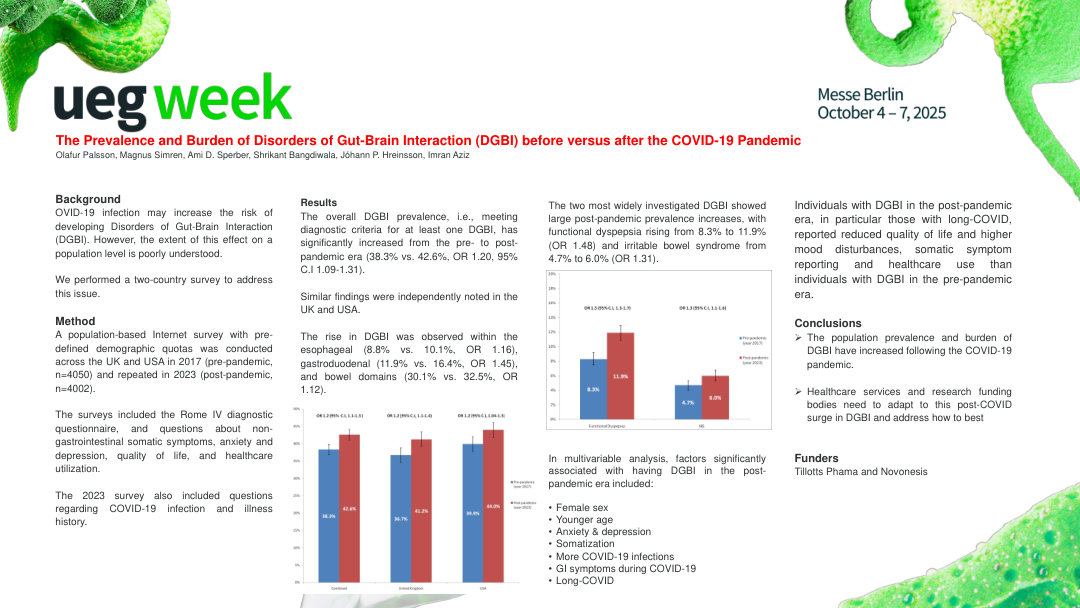
THE PREVALENCE AND BURDEN OF DISORDERS OF GUT-BRAIN INTERACTION (DGBI) BEFORE VERSUS AFTER THE COVID-19 PANDEMIC
Olafur S. Palsson 1, Magnus Simrén 2, Ami D. Sperber 3, Shrikant I. Bangdiwala 4, Jóhann Hreinsson 2, Imran Aziz 5
1 University of North Carolina, Chapel Hill, Chapel Hill, NC, United States
2 Sahlgrenska University Hospital, Gothenburg, Sweden
3 Ben-Gurion University of the Negev, Farod, Israel
4 McMaster University, Hamilton, Ontario, Canada
5 University of Sheffield, Sheffield, United Kingdom
Conference
Topics
Submission format
Session
Citation
Published
Log in to access this content.
Free for all myUEG account holders. Your access level is set automatically based on your occupation. Medical professionals get full access to all content. If you are a non-medical user, you can only access UEG Week content from congresses you attended.
Not sure what you can access? Learn more about account types.
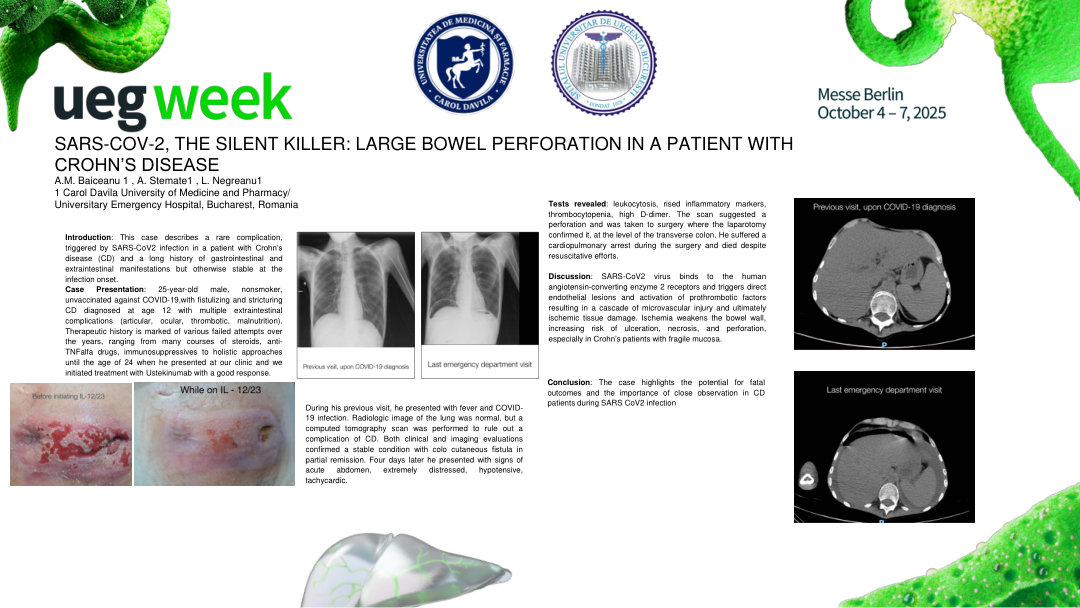
SARS-COV-2, THE SILENT KILLER: LARGE BOWEL PERFORATION IN A PATIENT WITH CROHN’S DISEASE
1 Carol Davila University of Medicine and Pharmacy/Universitary Emergency Hospital, Bucharest, Romania
Conference
Submission format
Session