UEG's educational platform for gastroenterology education bringing recordings, courses, guidelines, and more together in one place.
Most popular content
Rate for better recommendations!
Your feedback helps us show you more of what you like and less of what you dislike!
Log in to access this content.
Free for all myUEG account holders. Your access level is set automatically based on your occupation. Medical professionals get full access to all content. If you are a non-medical user, you can only access UEG Week content from congresses you attended.
Not sure what you can access? Learn more about account types.

BEYOND INFLAMMATION: PSYCHOLOGICAL & PHYSIOLOGICAL DETERMINANTS OF CHRONIC PAIN SEVERITY AND INTERFERENCE IN IBD REMISSION
Pavit Luthra 1, Ruqaya Idrees 1, Reuma Yehuda Margalit 1, Iman Khwaja 1, Miles Parkes 2, Ailsa L Hart 3, Christine Norton 4, Harry Sokol 5, Nathalie Vergnolle 6, David Bulmer 7, James O. Lindsay 8, Qasim Aziz 9
1 Wingate Institute of Neurogastroenterology, Queen Mary University of London, London, United Kingdom
2 Inflammatory Bowel Disease Research Group, Addenbrooke's Hospital, Cambridge, United Kingdom
3 St Mark’s Hospital and Academic Institute, Harrow, United Kingdom
4 King's College London, London, United Kingdom
5 Saint-Antoine Hospital, Paris, France
6 INSERM UMR-1220, Toulouse, France
7 University of Cambridge, Cambridge, United Kingdom
8 Blizard Institute, Queen Mary University of London, London, United Kingdom
9 Wingate Institute for Neurogastroenterology - Centre for Neuroscience and Trauma, London, United Kingdom
Conference
Topics
Submission format
Citation
Published
Log in to access this content.
Free for all myUEG account holders. Your access level is set automatically based on your occupation. Medical professionals get full access to all content. If you are a non-medical user, you can only access UEG Week content from congresses you attended.
Not sure what you can access? Learn more about account types.
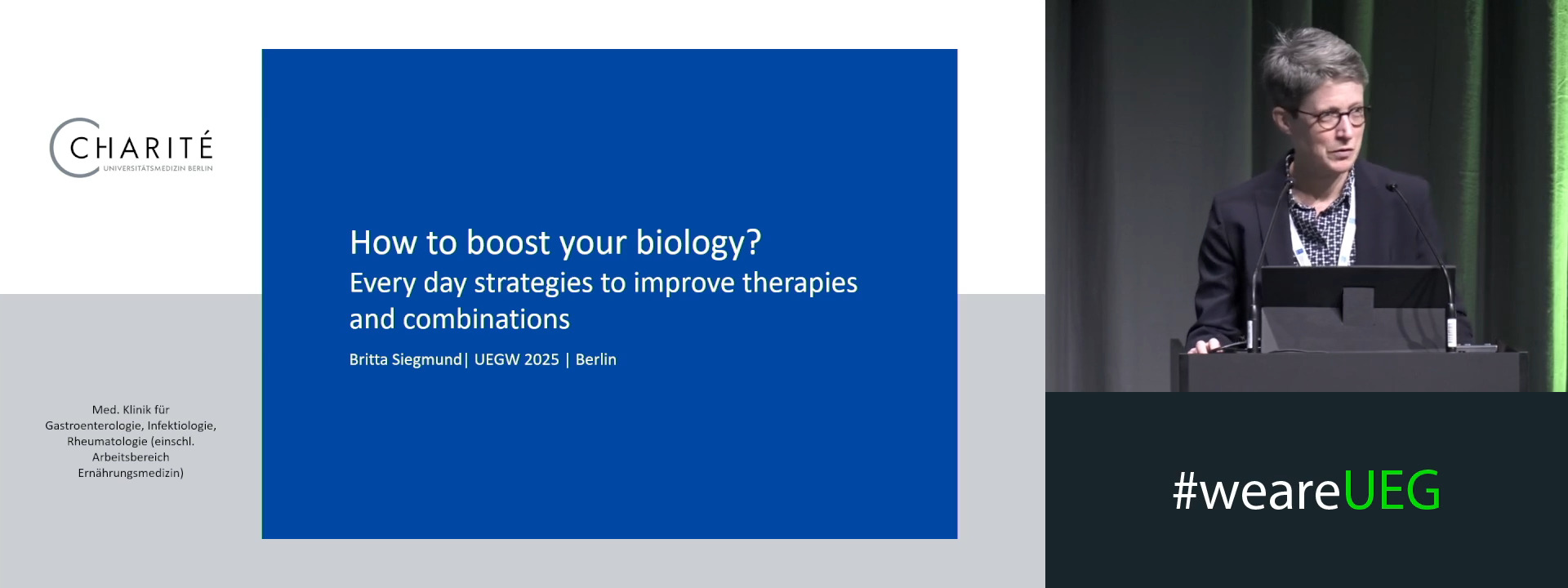
How to boost your biology? Every day strategies to improve therapies and combinations
1 Charité - Universitätsmedizin Berlin, Berlin, Germany
Event
Citation
Published
Log in to access this content.
Free for all myUEG account holders. Your access level is set automatically based on your occupation. Medical professionals get full access to all content. If you are a non-medical user, you can only access UEG Week content from congresses you attended.
Not sure what you can access? Learn more about account types.
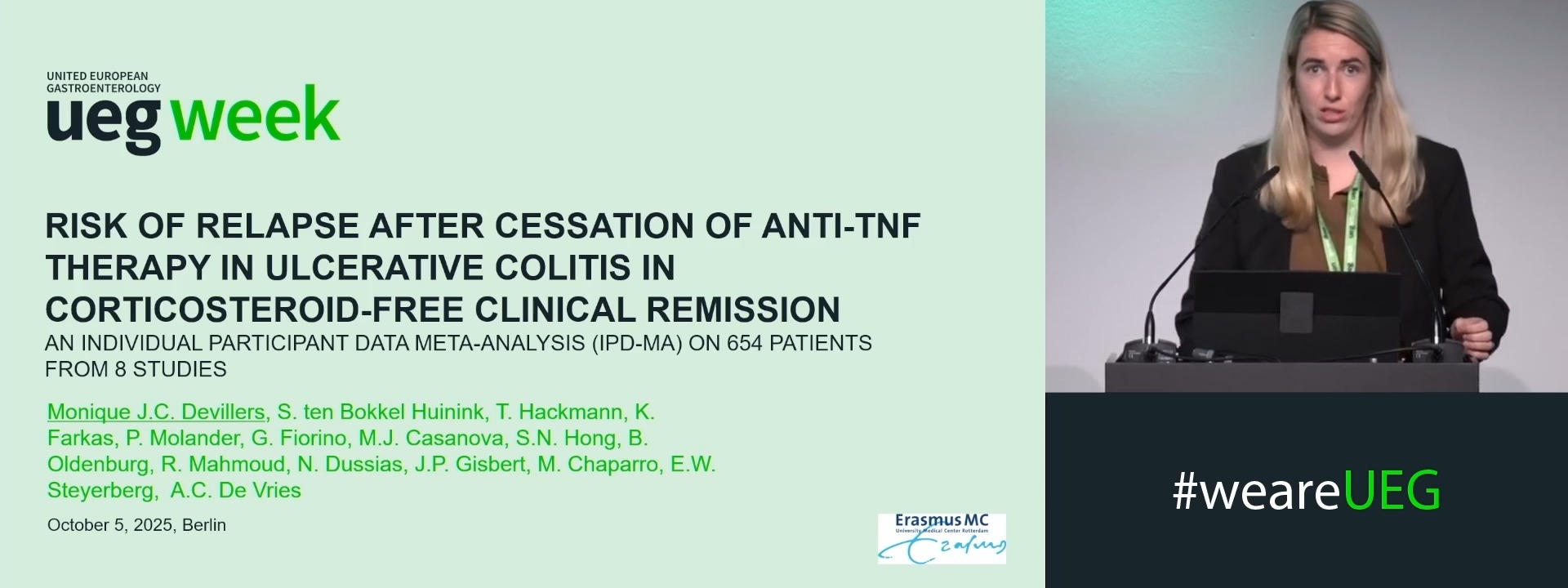
RISK OF RELAPSE AFTER CESSATION OF ANTI-TNF THERAPY IN ULCERATIVE COLITIS IN CORTICOSTEROID-FREE CLINICAL REMISSION: AN INDIVIDUAL PARTICIPANT DATA META-ANALYSIS (IPD-MA) ON 654 PATIENTS FROM 8 STUDIES
Monique Devillers 1, Sebastiaan ten Bokkel Huinink 1, Toby Hackmann 2, Ewout Steyerberg 3, Bas Oldenburg 4, Remi Mahmoud 4, Pauliina Molander 5, Klaudia Farkas 6, Gionata Fiorino 7, María Chaparro 8, Javier Gisbert 8, María José Casanova 8, Sung-Noh Hong 9, Nikolas Dussias 10, Annemarie de Vries 1
1 Erasmus MC University Medical Center, Rotterdam, Netherlands
2 Leiden University Medical Center, Leiden, Netherlands
3 Utrecht University Medical Center, Utrecht, Netherlands
4 University Medical Center Utrecht, Utrecht, Netherlands
5 Helsinki University Hospital, Helsinki, Finland
6 University of Szeged 1st Dept. of Medicine, Szeged, Hungary
7 San Camillo-Forlanini Hospital, Rome, Italy
8 Hospital Universitario de La Princesa, Instituto de Investigación Sanitaria Princesa (IIS-Princesa), Universidad Autónoma de Madrid (UAM), Centro de Investigación Biomédica en Red de Enfermedades Hepáticas y Digestivas (CIBEREHD), Madrid, Spain
9 Samsung Medical Center, Seoul, Korea, Republic of
10 IRCCS Azienda Ospedaliero-Universitaria di Bologna, Bologna, Italy
Event
Submission format
Session
Citation
Published
Log in to access this content.
Free for all myUEG account holders. Your access level is set automatically based on your occupation. Medical professionals get full access to all content. If you are a non-medical user, you can only access UEG Week content from congresses you attended.
Not sure what you can access? Learn more about account types.
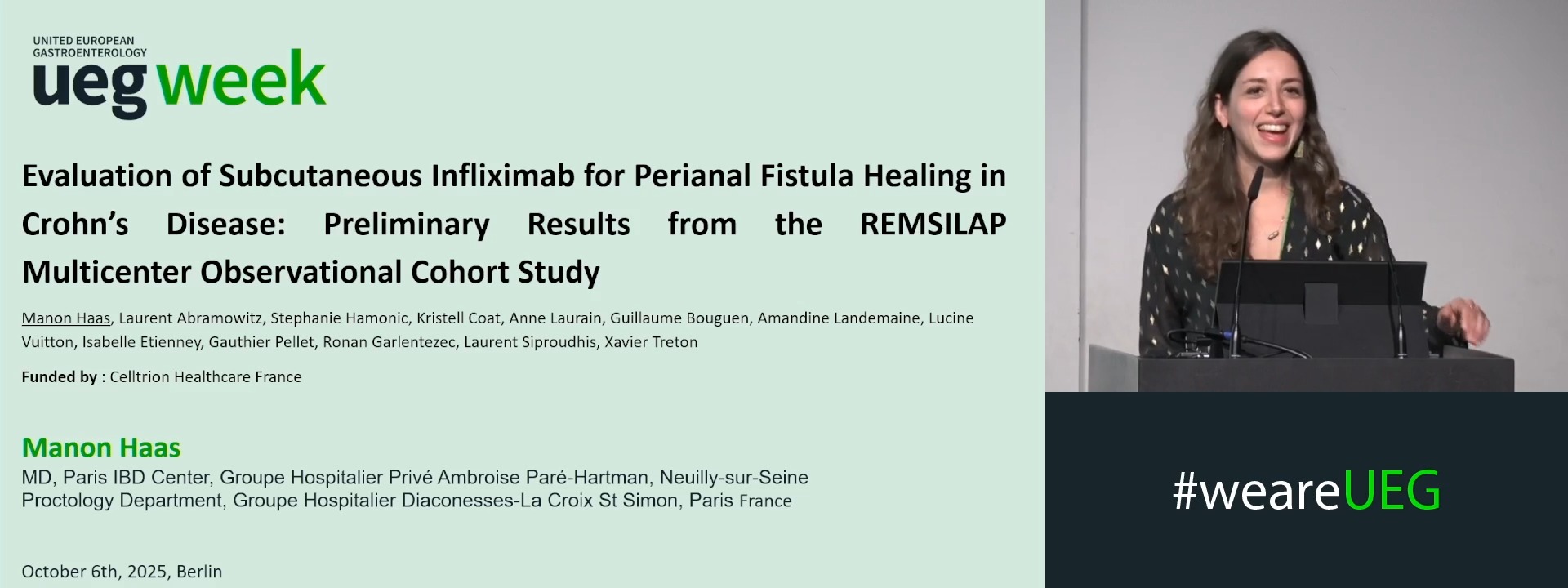
EVALUATION OF SUBCUTANEOUS INFLIXIMAB FOR PERIANAL FISTULA HEALING IN CROHN’S DISEASE: PRELIMINARY RESULTS FROM THE REMSILAP MULTICENTER OBSERVATIONAL COHORT STUDY
Manon Haas 1, Laurent Abramowitz 2, Stephanie Hamonic 3, Amandine Landemaine 3, Guillaume Bouguen 3, Anne Laurain 2, Lucine Vuitton 4, Isabelle Etienney 5, Gauthier Pellet 6, Kristell Coat 3, Ronan Garlantezec 3, Laurent Siproudhis 3, Xavier Treton 1
1 Institut des MICI - Clinique Ambroise Paré Hartmann, Neuilly sur Seine, France
2 CHU Bichat, Paris, France
3 CHU Pontchaillou, Rennes, France
4 Besançon university hospital gastroenterology, Courbevoie, France
5 Diaconesses-Croix St Simon Hospital, Paris, France
6 CHU Bordeaux, Bordeaux, France
Event
Topics
Submission format
Citation
Published
Log in to access this content.
Free for all myUEG account holders. Your access level is set automatically based on your occupation. Medical professionals get full access to all content. If you are a non-medical user, you can only access UEG Week content from congresses you attended.
Not sure what you can access? Learn more about account types.
BIOLOGICAL TREATMENT SEQUENCES AND MUCOSAL HEALING IN ULCERATIVE COLITIS: A REAL-LIFE SINGLE-CENTER COHORT
Elena De Cristofaro 1, Alice Colella 1, Silvia Calderone 1, Luca Basile 1, Laura Doni 1, Jessica Vesely 1, Francesca Zorzi 1, Irene Marafini 1, Elisa Cuccagna 1, Giovanni Monteleone 1, Emma Calabrese 1
1 University of Rome Tor Vergata, Rome, Italy
Conference
Topics
Submission format
Session
Citation
Published
Log in to access this content.
Free for all myUEG account holders. Your access level is set automatically based on your occupation. Medical professionals get full access to all content. If you are a non-medical user, you can only access UEG Week content from congresses you attended.
Not sure what you can access? Learn more about account types.
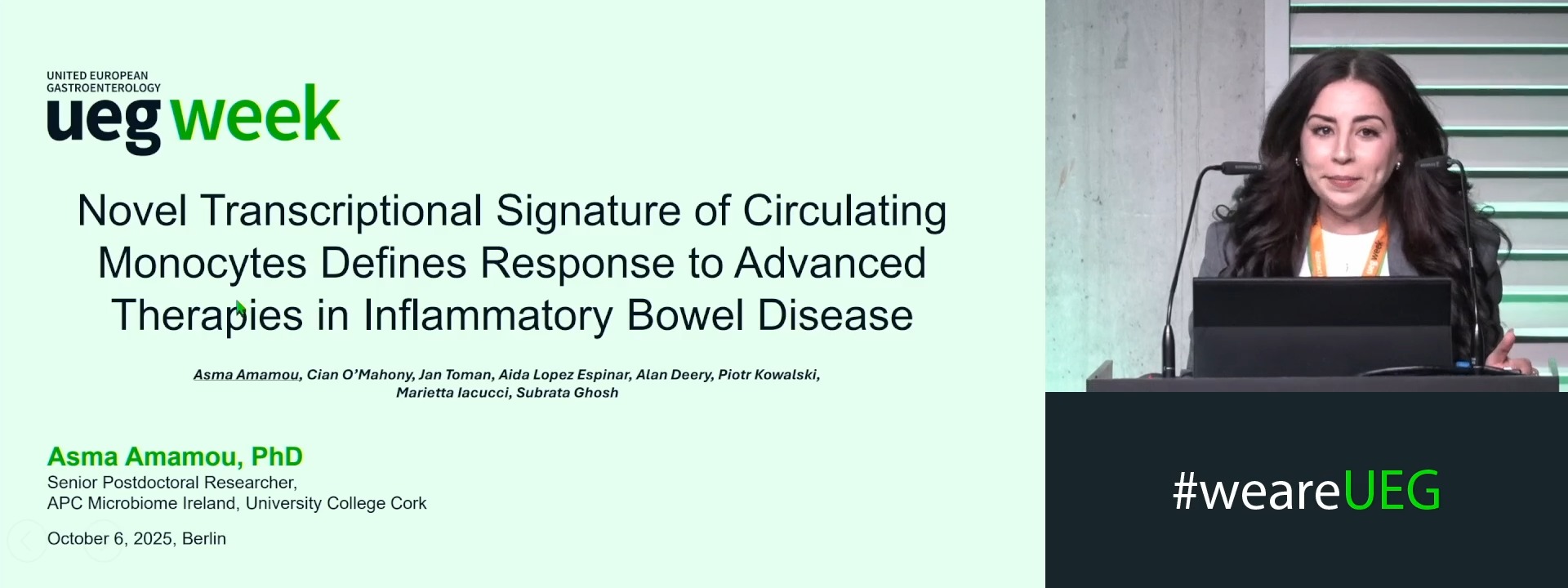
NOVEL TRANSCRIPTIONAL SIGNATURE OF CIRCULATING MONOCYTES DEFINES RESPONSE TO ADVANCED THERAPIES IN INFLAMMATORY BOWEL DISEASE
Asma Amamou 1, Cian O'Mahony 1, Jan Toman 1, Aida Lopez Espinar 2, Alan Deery 1, Piotr Kowalski 3, Marietta Iacucci 1, Subrata Ghosh 1
1 APC Microbiome Ireland, College of Medicine and Health, University College Cork, Cork, Ireland
2 School of Pharmacy, University College Cork, Cork, Ireland
3 APC Microbiome Ireland, College of Medicine and Health, University College Cork, Cork, Ireland|||School of Pharmacy, University College Cork, Cork, Ireland
Event
Submission format
Citation
Published
Log in to access this content.
Free for all myUEG account holders. Your access level is set automatically based on your occupation. Medical professionals get full access to all content. If you are a non-medical user, you can only access UEG Week content from congresses you attended.
Not sure what you can access? Learn more about account types.
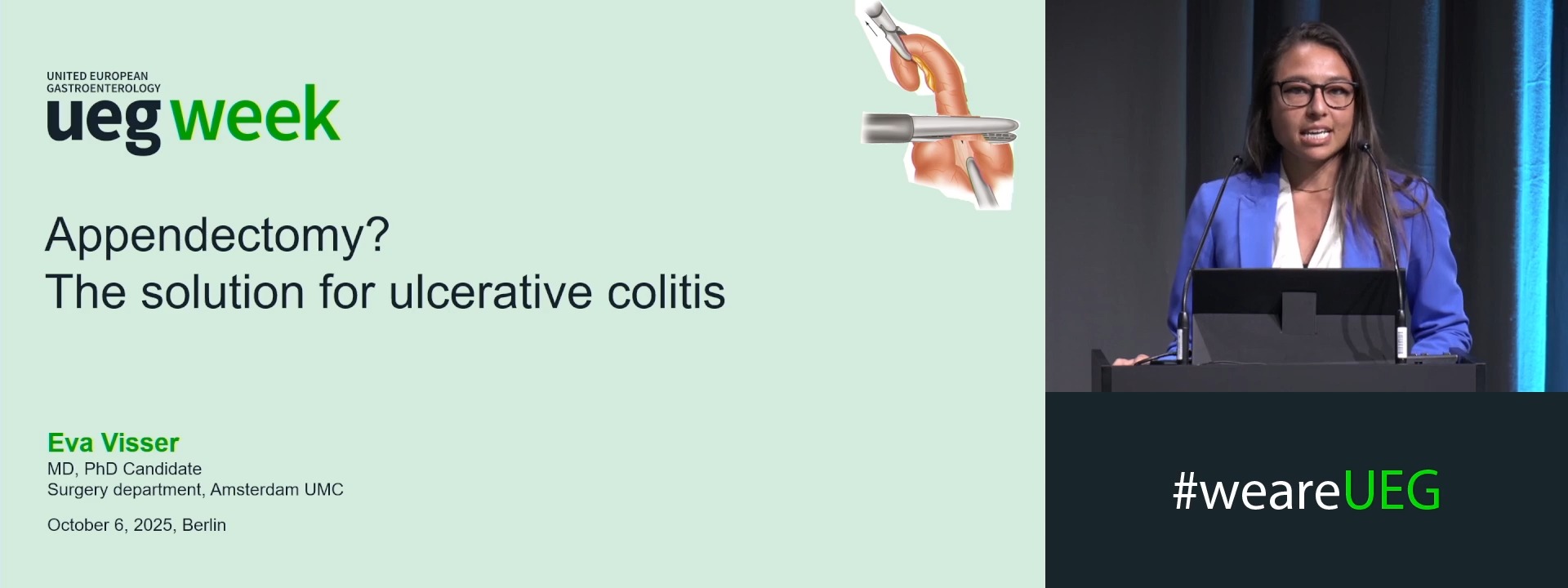
Appendectomy? The solution for ulcerative colitis
1 Amsterdam University Medical Centre, Amsterdam, Netherlands