Introduction
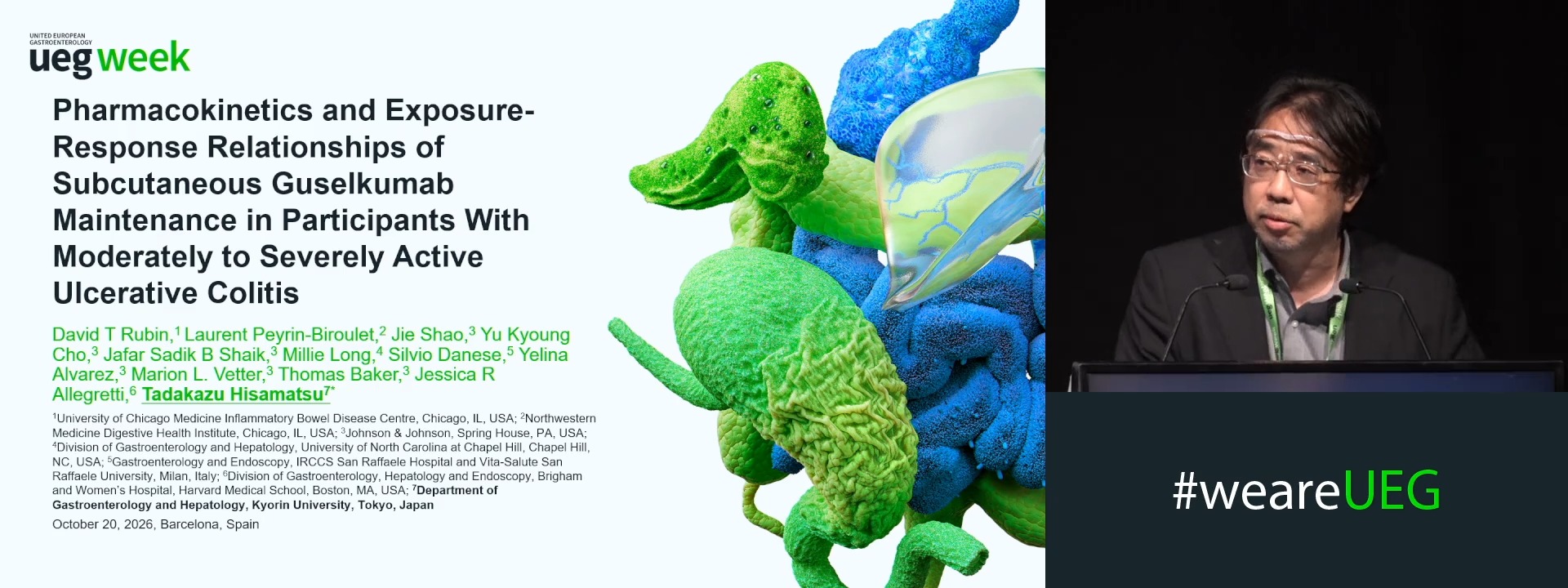
Guselkumab (GUS), a dual-acting IL-23p19 subunit inhibitor, is highly efficacious in participants (pts) with ulcerative colitis (UC) after intravenous (IV) or subcutaneous (SC) induction followed by SC maintenance. Here, we evaluated covariate impacts on pharmacokinetics (PK) and exposure-response (E-R) of GUS SC maintenance regimens (100 mg every 8 weeks [q8w] or 200 mg every 4 weeks [q4w]) using data from the Phase 2/3 QUASAR program in pts with moderately to severely active UC.
Aims & Methods
Pts had a modified Mayo of 5–9 at induction baseline (BL), had received ≥1 GUS dose, and had ≥1 PK measurement (and efficacy data, for E-R). Population PK modeling was performed using pooled QUASAR PK data through maintenance week 44 (M-44). E-R efficacy relationships (clinical remission, endoscopic improvement, histologic-endoscopic mucosal improvement [HEMI]) at week M-44 were explored descriptively and via modeling. Associations between exposure and safety, covariate impacts on E-R, and immunogenicity impacts on efficacy and safety were also analyzed.
Results
Higher body weight, lower serum albumin, higher C-reactive protein, and prior inadequate response or intolerance to biologics or JAK inhibitors were associated with increased GUS clearance (CL), but these effects were not clinically meaningful. Higher serum GUS concentrations were associated with greater efficacy at week M-44 across efficacy outcomes; respective rates of clinical remission, endoscopic improvement, and HEMI by trough concentration quartiles (week M-44; µg/mL) were 29.5%, 32.6%, and 28.4% for ≥0.01–≤0.894, 51.1%, 56.4%, and 50.0% for >0.894–≤2.23, 44.7%, 47.9%, and 43.6% for >2.23–≤7.93, and 65.3%, 65.3%, and 61.1% for >7.93–≤32.5. These trends remained after accounting for CL or half-life, suggesting that higher exposure may benefit some pts. Pts with extensive UC at induction BL showed a greater treatment effect with 200 mg q4w vs 100 mg SC q8w maintenance (Table). No associations were found between GUS concentrations and infections, serious infections, serious adverse events, or abnormal liver function tests. Immunosuppressant (AZA, 6-MP, MTX) use did not impact GUS concentrations. The incidence of anti-drug antibodies and neutralizing antibodies to GUS was low and not associated with GUS PK, efficacy, or safety.
| Model-predicted clinical remission and endoscopic improvement rates at week M-44 by median Ctrough in each of the subcutaneous maintenance treatment groups, stratified by extent of disease at induction baseline and clinical remission or endoscopic healing status at maintenance baseline |
|---|
CI=confidence interval, Ctrough=serum trough concentration, SC=subcutaneous, q4w=every 4 weeks, q8w=every 8 weeks, week M-44=maintenance week 44.
|
| Treatment Group
| Median Ctrough, week 44
| Clinical Remission Predicted Rates %, Estimate (95% CI)
| Endoscopic Improvement Predicted Rates %, Estimate (95% CI)
|
Extensive disease
| 100 mg SC q8w
200 mg SC q4w
| 1.05
7.92
| 40.2 (29.1, 51.3)
63.0 (51.4, 74.7)
| 45.8 (36.6, 55.1)
55.0 (44.2, 65.9)
|
Limited disease
| 100 mg SC q8w
200 mg SC q4w
| 1.05
7.92
| 25.1 (18.7, 31.6)
36.4 (27.2, 45.6)
| 38.2 (30.5, 45.9)
43.8 (35.4, 52.3)
|
Clinical remission at maintenance baseline
| 100 mg SC q8w
200 mg SC q4w
| 1.05
7.92
| 54.4 (44.6, 64.1)
67.0 (57.4, 76.6)
| -
|
Non-clinical remission at maintenance baseline
| 100 mg SC q8w
200 mg SC q4w
| 1.05
7.92
| 25.1 (18.7, 31.6)
36.4 (27.2, 45.6)
| -
|
Endoscopic improvement at maintenance baseline
| 100 mg SC q8w
200 mg SC q4w
| 1.05
7.92
| -
| 53.2 (43.7, 62.7)
65.2 (54.9, 75.5)
|
| Non-endoscopic improvement at maintenance baseline | 100 mg SC q8w
200 mg SC q4w | 1.05
7.92
| -
| 38.2 (30.5, 45.9)
43.8 (35.4, 52.3)
|
Conclusion
The absence of clinically meaningful covariate impacts on GUS CL supports the use of fixed-dose maintenance regimens. E-R efficacy trends suggest that some pts may benefit from higher GUS exposure. Pts with extensive UC may further benefit from the 200 mg q4w maintenance dose. GUS concentrations were not associated with safety events and were not impacted by immunosuppressant use. Immunogenicity was low and did not impact GUS PK, efficacy, or safety.
Disclosure
David T Rubin reports consulting and/or speaker fees and/or advisory board participation for AbbVie, Altrubio, Apex, Avalo, Bristol Myers Squibb, Buhlmann Diagnostics, Celgene, Connect BioPharma, Intouch Group, Iterative Health, Johnson & Johnson, Lilly, Pfizer, Samsung Neurologica, and Takeda; Altrubio, Datos Health, and Iterative Health stock options; grants from Takeda; and membership on the Board of Directors of Cornerstones Health, Inc and on the Crohn’s & Colitis Foundation’s Board of Trustees.
Laurent Peyrin-Biroulet reports grants or contracts from Celltrion, Fresenius Kabi, Medac, MSD, and Takeda; consulting and/or payment or honoraria and/or data safety monitoring board or advisory board participation for AbbVie, Abivax, Adacyte, Alfasigma, Alimentiv, Amgen, Applied Molecular Transport, Arena, Banook, Biogen, Bristol Myers Squibb, Celltrion, Connect Biopharm, Cytoki Pharma, Enthera, Ferring, Fresenius Kabi, Galapagos, Genentech, Gilead, Gossamer Bio, GlaxoSmithKline, IAC Image Analysis, Index Pharmaceuticals, Inotrem, Johnson & Johnson, Kern Pharma, Lilly, Medac, Mopac, Morphic, MSD, Nordic Pharma, Novartis, Oncodesign Precision Medicine, ONO Pharma, OSE Immunotherapeutics, Pandion Therapeutics, Par' Immune, Pfizer, Prometheus, Protagonist, Roche, Samsung, Sandoz, Sanofi, Satisfay, Takeda, Telavant, Theravance, Thermo Fischer, Tigenix, Tillots, Viatris, Vectivbio, Ventyx, and Ysopia; and meeting attendance/travel support from Abbvie, Alfasigma, Amgen, Celltrion, Connect Biopharm, Ferring, Galapagos, Genentech, Gilead, Gossamer Bio, Johnson & Johnson, Lilly, Medac, Morphic, MSD, Pfizer, Sandoz, Takeda, Thermo Fischer, and Tillots.
Jie Shao, Yu kyoung Cho, Jafar Sadik B. Shaik, Yelina Alvarez, Marion L. Vetter, and Thomas Baker are employees of and may own stock in Johnson & Johnson.
Millie Long reports research support from Lilly, Pfizer, Takeda, and Celltrion; and consulting for AbbVie, Pfizer, Bristol-Myers Squibb, Roivant, Johnson & Johnson, Merck, Takeda, Prometheus, Lilly, Intercept, Target RWE, Celltrion, Sanofi, and Spyre.
Silvio Danese reports consultancy fees from AbbVie, Alimentiv, Allergan, Amgen, AstraZeneca, Athos, Biogen, Boehringer Ingelheim, Celgene, Celltrion, Eli Lilly, Enthera, Ferring, Gilead, Hospira, Inotrem, Johnson & Johnson, MSD, Mundipharma, Mylan, Pfizer, Roche, Sandoz, Sublimity, Takeda, TiGenix, UCB, and Vifor and reports lecture fees from AbbVie, Amgen, Ferring, Gilead, Johnson & Johnson, Mylan, Pfizer, and Takeda.
Jessica R Allegretti reports grant support from Johnson & Johnson, Merck, and Pfizer; consultancy fees from AbbVie, Adiso, Bristol Myers Squibb, Ferring, Genentech, GlaxoSmithKline, Johnson & Johnson, Merck, Pfizer, Roivant, and Seres Therapeutics; payments for speaking from AbbVie, Bristol Myers Squibb, and Johnson & Johnson; and is a steering committee member and investigator for Johnson & Johnson.
Tadakazu Hisamatsu reports research grants from AbbVie GK, Boston Scientific Corporation, EA Pharma Co. Ltd., JIMRO Co. Ltd., Kissei Pharmaceutical Co. Ltd., Kyorin Pharmaceutical Co. Ltd., Mitsubishi Tanabe Pharma Corporation, Mochida Pharmaceutical Co. Ltd., Nippon Kayaku Co. Ltd., Pfizer Inc., Takeda Pharmaceutical Co. Ltd., and Zeria Pharmaceutical Co. Ltd.; consulting fees from AbbVie GK, Abivax, Bristol Myers Squibb, EA Pharma Co. Ltd., Gilead Sciences, Johnson & Johnson, Lilly, Mitsubishi Tanabe Pharma Corporation, and Pfizer Inc.; and lecture fees from AbbVie GK, EA Pharma Co. Ltd., Johnson & Johnson, JIMRO Co., Kissei Pharmaceutical Co. Ltd., Kyorin Pharmaceutical Co. Ltd., Mitsubishi Tanabe Pharma Corporation, Mochida Pharmaceutical Co., Ltd., Pfizer Inc., and Takeda Pharmaceutical Co. Ltd.