UEG Week Recordings UEG Week Posters Online courses Guidelines Mistakes in... Podcasts Webinars
Visit ueg.eu Create myUEG account Log In

Filters:

UEG Presentation
Share via Email Share on Facebook Share on X Share on LinkedIn Share on Bluesky
UEG Week 2025: Top Abstract Awards

Log in to access this content.

Free for all myUEG account holders. Your access level is set automatically based on your occupation. Medical professionals get full access to all content. If you are a non-medical user, you can only access UEG Week content from congresses you attended.

Log In Create a free account

Not sure what you can access? Learn more about account types.
UEG Week 2025: Top Abstract Awards

Event

UEG Week Berlin 2025

Topics

Immunology

Session

Opening Plenary

Citation

United European Gastroenterology Journal 2025; 13 (Supplement 8)

Published

2025
UEG Podcast Episode
New
UEG Podcast
Share via Email Share on Facebook Share on X Share on LinkedIn Share on Bluesky

Log in to access this content.

Free for all myUEG account holders. Your access level is set automatically based on your occupation. Medical professionals get full access to all content. If you are a non-medical user, you can only access UEG Week content from congresses you attended.

Log In Create a free account

Not sure what you can access? Learn more about account types.

Nutrition in coeliac disease for a clinician with Cristian Costas

Pradeep Mundre

Topics

Small Intestine & Nutrition

Published

2026
UEG Presentation
Share via Email Share on Facebook Share on X Share on LinkedIn Share on Bluesky
Words of welcome

Log in to access this content.

Free for all myUEG account holders. Your access level is set automatically based on your occupation. Medical professionals get full access to all content. If you are a non-medical user, you can only access UEG Week content from congresses you attended.

Log In Create a free account

Not sure what you can access? Learn more about account types.

Words of welcome

Julia Mayerle 1

1 Klinikum der LMU München-Grosshadern, München, Germany

Event

UEG Week Berlin 2025

Topics

Immunology

Session

Opening Plenary

Citation

United European Gastroenterology Journal 2025; 13 (Supplement 8)

Published

2025
UEG Presentation
Share via Email Share on Facebook Share on X Share on LinkedIn Share on Bluesky
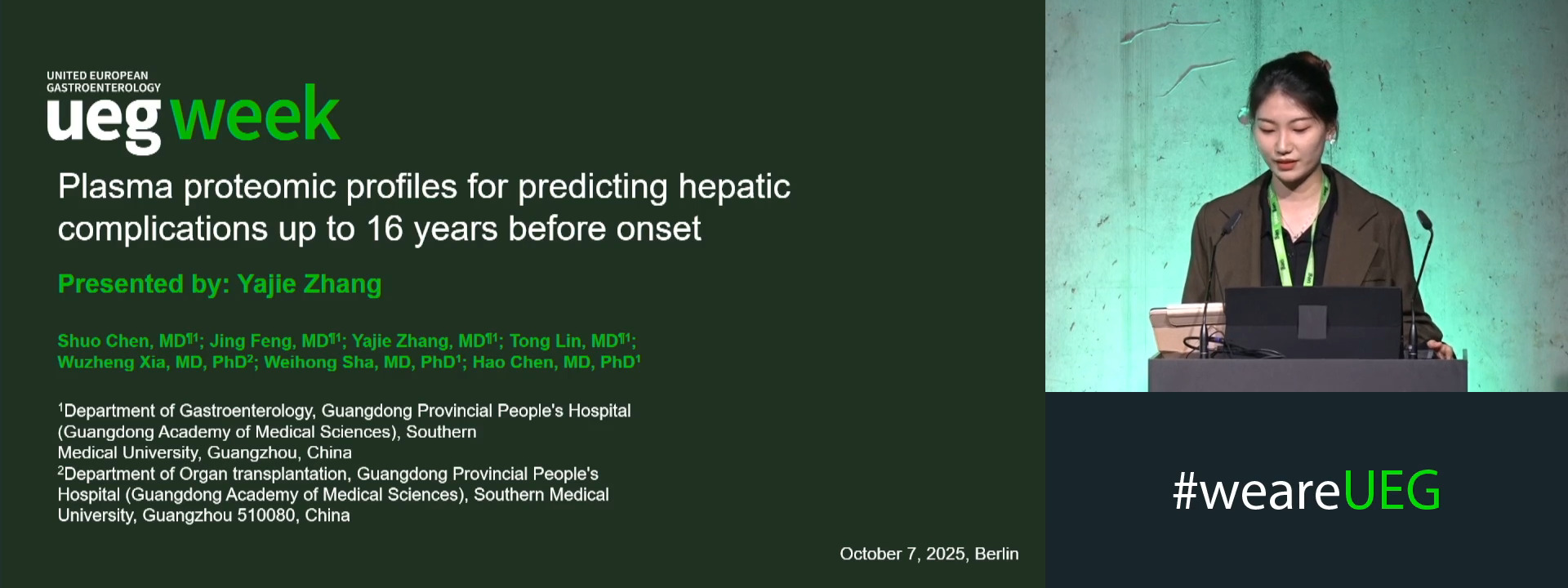
PLASMA PROTEOMIC PROFILES FOR PREDICTING HEPATIC COMPLICATIONS UP TO 16 YEARS BEFORE ONSET

Log in to access this content.

Free for all myUEG account holders. Your access level is set automatically based on your occupation. Medical professionals get full access to all content. If you are a non-medical user, you can only access UEG Week content from congresses you attended.

Log In Create a free account

Not sure what you can access? Learn more about account types.

Introduction

Chronic liver disease is a major global health concerns, contributing to over 1.4 million annual deaths worldwide1. Its primary fatal outcomes, hepatic complications2,3, arise from liver cirrhosis, hepatocellular carcinoma and hepatic decompensation. The early, reversible stages of chronic liver disease are frequently asymptomatic and overlooked, leading to delayed diagnoses and irreversible complications that treatment options are limited.4,5. Therefore, reliable tools to identify whether a person will develop hepatic complications in the future have become a public health priority, enabling early diagnosis and timely intervention in high-risk populations.

Aims & Methods

This study aimed to employ machine learning to develop proteomics-based models for the early identification of hepatic complications. In this study, 37,178 adults without hepatic complications at baseline were analyzed from a prospective cohort from United Kingdom, with plasma levels of 2,736 proteins measured using Olink technology. Cox regression was used to identify significant proteins associated with incident hepatic complications. Models based on importance-top-ranking proteins were constructed using LightGBM learners of Automated Machine Learning (AutoML) and internal validated through 5-fold cross validation in the derivation set (n = 37,178). Independent validation was then conducted in a geographically distinct UKB cohort (n = 15,767).

Results

Over a median follow-up of 13.8 years, 338 participants developed hepatic complications. Cox regression identified 593 proteins significantly associated with incident hepatic complications. Among them, GDF15, PROC, GGT1, ANXA10, IL18, MFAP4, COL4A1, CDCP1 and IL6 were ranked highest in protein importance ordering. The protein model showed a considerable predictive accuracy for hepatic complications under different time scenarios in the UKB validation set: all-year (area under the curve [AUC] = 0.89), within 5 years (AUC = 0.88), within 10 years (AUC = 0.91), over 10 years (AUC = 0.81), and achieved superior predictive performance compared to models with demographic predictors, laboratory indicators, polygenic risk score (PRS) and traditional risk score models (Protein 0.89 vs. Demographics 0.83, Laboratory 0.85, PRS 0.49; Fibrosis-4 index [FIB-4] 0.76, Aspartate aminotransferase to platelet ratio index [APRI] 0.78; all P < 0.05). Combined with clinical data and PRS, the predictor performance is further enhanced: all-year (AUC = 0.91), within 5 years (AUC = 0.91), within 10 years (AUC = 0.90), over 10 years (AUC = 0.83). Individuals in the high-risk group stratified by the protein model were 16.27 times more likely to develop hepatic complications.

Conclusion

Our study constructed a novel protein model for hepatic complications risk stratification and could be used to predict individuals who will develop hepatic complications up to 16 years in advance in the general population.

References

1. Tham EKJ, Tan DJH, Danpanichkul P, et al. The Global Burden of Cirrhosis and Other Chronic Liver Diseases in 2021. Liver Int 2025;45:e70001.
2. Åberg F, Asteljoki J, Männistö V, et al. Combined use of the CLivD score and FIB-4 for prediction of liver-related outcomes in the population. Hepatol Baltim Md 2024;80:163–172.
3. Innes H, Morling JR, Buch S, et al. Performance of routine risk scores for predicting cirrhosis-related morbidity in the community. J Hepatol 2022;77:365–376.
4. Karlsen TH, Sheron N, Zelber-Sagi S, et al. The EASL–Lancet Liver Commission: protecting the next generation of Europeans against liver disease complications and premature mortality. The Lancet 2022;399:61–116.
5. Serra-Burriel M, Juanola A, Serra-Burriel F, et al. Development, validation, and prognostic evaluation of a risk score for long-term liver-related outcomes in the general population: a multicohort study. Lancet Lond Engl 2023;402:988–996.

PLASMA PROTEOMIC PROFILES FOR PREDICTING HEPATIC COMPLICATIONS UP TO 16 YEARS BEFORE ONSET

Shuo Chen 1, Jing Feng 1, Yajie Zhang 1, Tong Lin 1, Wuzheng Xia 2, Weihong Sha 1, Hao Chen 1

1 Department of Gastroenterology, Guangdong Provincial People's Hospital (Guangdong Academy of Medical Sciences), Southern Medical University, Guangzhou, China

2 Department of Organ transplantation, Guangdong Provincial People's Hospital (Guangdong Academy of Medical Sciences), Southern Medical University, Guangzhou, China

Event

UEG Week Berlin 2025

Topics

Hepatobiliary IBD Mechanisms & Personalised Medicine

Submission format

Abstract

Session

Predicting and understanding early stages of advanced liver disease

Citation

United European Gastroenterology Journal 2025; 13 (Supplement 8)

Published

2025
UEG Presentation
Share via Email Share on Facebook Share on X Share on LinkedIn Share on Bluesky
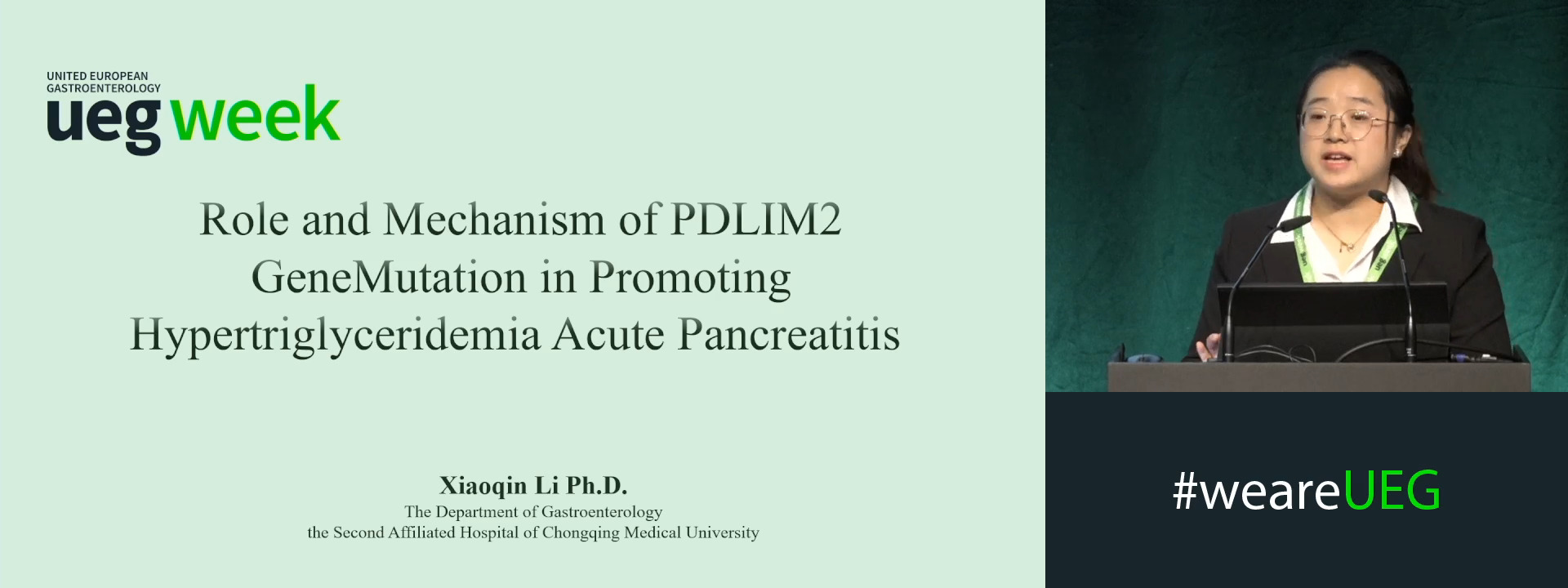
ROLE AND MECHANISM OF PDLIM2 GENE MUTATION IN PROMOTING HYPERTRIGLYCERIDEMIA ACUTE PANCREATITIS

Log in to access this content.

Free for all myUEG account holders. Your access level is set automatically based on your occupation. Medical professionals get full access to all content. If you are a non-medical user, you can only access UEG Week content from congresses you attended.

Log In Create a free account

Not sure what you can access? Learn more about account types.

Introduction

Acute pancreatitis (AP) is an acute inflammatory autodigestive disorder triggered by dysfunction of pancreatic exocrine activity and represents the most common gastrointestinal emergency in clinical practice. Global data indicate an annual incidence rate of 33.74 per 100,000 population and a mortality rate of 1.16 per 100,000. Despite ongoing optimization of therapeutic strategies, current clinical management primarily relies on supportive care and surgery. Hypertriglyceridemia (HTG) is the second leading etiological factor for AP, accounting for 10.36% of cases. Compared to other causes, HTG-associated acute pancreatitis (HTG-AP) exhibits higher recurrence rates and more severe complications (e.g., pancreatic necrosis and renal insufficiency). With the rising prevalence of HTG, the disease burden of HTG-AP is increasing, yet its specific pathogenic mechanisms remain unclear.

Aims & Methods

This study integrated whole-genome sequencing (WGS) and next-generation sequencing (NGS) to screen for shared mutations in the exonic regions of 5 HTG-AP family members. Candidate genes were identified based on MutationTaster classification and CADD scores. A mouse model carrying the PDLIM2 gene rs145349678 mutation was constructed using CRISPR/Cas9 technology, and an HTG-AP animal model was established. Pancreatic and hepatic histopathology (HE staining) and serological markers (TG, lipase, amylase, IL-6) were analyzed to evaluate the impact of the mutation on pancreatitis severity and hepatic lipid deposition.

Results

A clinical HTG-AP family was identified, with all 5 members exhibiting hypertriglyceridemia, including 2 cases of recurrent pancreatitis. WGS revealed 278 mutation sites across 10 chromosomes (involving 23 genes) in the family, and NGS validation narrowed these to 7 candidate loci. The PDLIM2 rs145349678 mutation (NM_001368120.1:exon9:c.C1055T:p.A352V), located within the LIM domain (which mediates protein localization and signaling transduction), was selected as the target due to cross-species conservation. Experimental results demonstrated that HTG-AP mice with the PDLIM2 mutation exhibited significantly aggravated pancreatic pathological damage (edema, hemorrhage, and inflammatory cell infiltration; *P* < 0.05), elevated serological markers (TG: 2.3 ± 0.4 vs. 1.5 ± 0.3 mmol/L; lipase: 520 ± 68 vs. 320 ± 45 U/L; IL-6: 48.2 ± 6.1 vs. 28.5 ± 4.3 pg/mL; *P* < 0.01 for all), and a 2.3-fold increase in hepatic lipid deposition (*P* < 0.001) compared to controls.

Conclusion

The PDLIM2 rs145349678 mutation exacerbates inflammatory responses and hepatic lipid accumulation in HTG-AP by modulating lipid metabolism. This finding provides new insights into the pathogenesis of HTG-AP and potential therapeutic targets.

ROLE AND MECHANISM OF PDLIM2 GENE MUTATION IN PROMOTING HYPERTRIGLYCERIDEMIA ACUTE PANCREATITIS

Li Xiaoqin 1, Huize Li 1, Qin Tang 1, Song He 1, Zhihang Zhou 1

1 The Second Affiliated Hospital of Chongqing Medical University, Chongqing, China

Event

UEG Week Berlin 2025

Topics

Mechanisms & Personalised Medicine Pancreas

Submission format

Abstract

Session

Cogulation, lipids and bugs: All relevant for pancreatitis

Citation

United European Gastroenterology Journal 2025; 13 (Supplement 8)

Published

2025
UEG Presentation
Share via Email Share on Facebook Share on X Share on LinkedIn Share on Bluesky
Perceived satisfaction of outpatients undergoing endoscopic examination: Cross-sectional observational study

Log in to access this content.

Free for all myUEG account holders. Your access level is set automatically based on your occupation. Medical professionals get full access to all content. If you are a non-medical user, you can only access UEG Week content from congresses you attended.

Log In Create a free account

Not sure what you can access? Learn more about account types.

Perceived satisfaction of outpatients undergoing endoscopic examination: Cross-sectional observational study

Fabio Grilli 1

1 Fondazione Policlinico Universitario Agostino Gemelli IRCCS, Roma, Italy

Event

UEG Week Berlin 2025

Topics

Nurses

Session

Patient care: Differences matter

Citation

United European Gastroenterology Journal 2025; 13 (Supplement 8)

Published

2025
UEG Presentation
Share via Email Share on Facebook Share on X Share on LinkedIn Share on Bluesky
European survey on physical and mental health in endoscopy

Log in to access this content.

Free for all myUEG account holders. Your access level is set automatically based on your occupation. Medical professionals get full access to all content. If you are a non-medical user, you can only access UEG Week content from congresses you attended.

Log In Create a free account

Not sure what you can access? Learn more about account types.

European survey on physical and mental health in endoscopy

Ute Pfeifer 1

1 Evangel. Krankenhaus Düsseldorf Abt. Endoskopie, Düsseldorf, Germany

Event

UEG Week Berlin 2025

Topics

Nurses

Session

Staff safety and management  

Citation

United European Gastroenterology Journal 2025; 13 (Supplement 8)

Published

2025

The global reference point for the digestive health community

Platform Publisher

United European Gastroenterology

Wickenburggasse 1 1080 Vienna, Austria

Contact us

support@ueg.eu

ueg.eu

T: +43 1 997 1639

Legal

Terms & Conditions

Imprint

Privacy Policy

Explore

My Bookmarks

My recommendations

My fields of interest

© 2026 United European Gastroenterology

Change fields of interest

These fields are selected based on the interests in your myUEG profile.
Click the item to unselect it. You can select multiple items.