UEG's educational platform for gastroenterology education bringing recordings, courses, guidelines, and more together in one place.
Most popular content
Rate for better recommendations!
Your feedback helps us show you more of what you like and less of what you dislike!
Log in to access this content.
Free for all myUEG account holders. Your access level is set automatically based on your occupation. Medical professionals get full access to all content. If you are a non-medical user, you can only access UEG Week content from congresses you attended.
Not sure what you can access? Learn more about account types.

QUALYFAP STUDY: PRELIMINARY FINDINGS ON THE IMPACT OF ENDOSCOPIC SURVEILLANCE QUALITY ON ADVANCED NEOPLASIA AFTER PROPHYLACTIC (PROCTO)COLECTOMY IN PATIENTS WITH FAMILIAL ADENOMATOUS POLYPOSIS
Romina Ariadne Vergara Quispe 1, Mariana Ortiz-Reyes 1, Maria Daca Alvarez 1, Oswaldo Ortiz 1, Teresa Ocaña 1, Francesc Balaguer 1, Maria Pellisé Urquiza 1, Liseth Rivero Sánchez 1
1 Hospital Clinic de Barcelona, Barcelona, Spain
Conference
Topics
Submission format
Citation
Published
Log in to access this content.
Free for all myUEG account holders. Your access level is set automatically based on your occupation. Medical professionals get full access to all content. If you are a non-medical user, you can only access UEG Week content from congresses you attended.
Not sure what you can access? Learn more about account types.
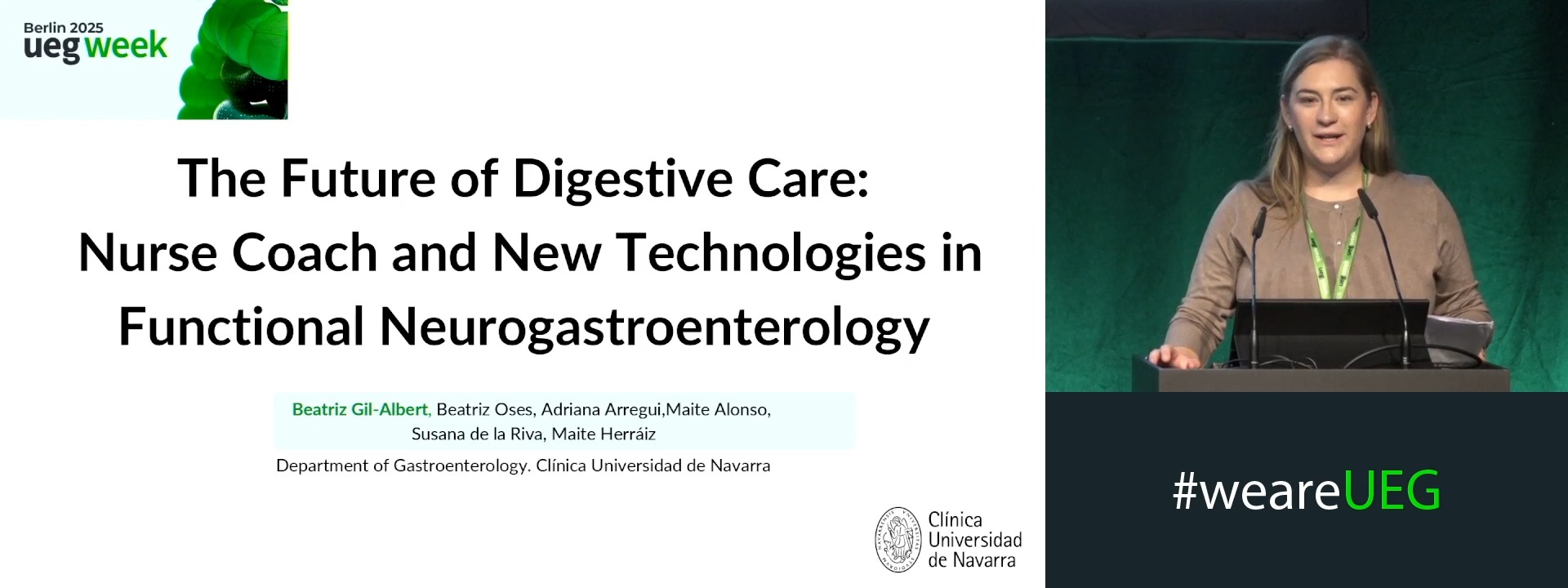
THE FUTURE OF DIGESTIVE CARE: NURSE COACH AND NEW TECHNOLOGIES IN FUNCTIONAL NEUROGASTROENTEROLOGY
Beatriz Oses 1, Adriana Arregui-Azagra 1, Beatriz Gil-Albert Sáenz de Cabezón 2, María Teresa Alonso Sierra 2, Susana de la Riva 1, Maite Herraiz Bayod 1
1 Clinica Universidad de Navarra, Pamplona, Spain
2 Clinica Universidad de Navarra, Madrid, Spain
Event
Topics
Submission format
Citation
Published
Log in to access this content.
Free for all myUEG account holders. Your access level is set automatically based on your occupation. Medical professionals get full access to all content. If you are a non-medical user, you can only access UEG Week content from congresses you attended.
Not sure what you can access? Learn more about account types.
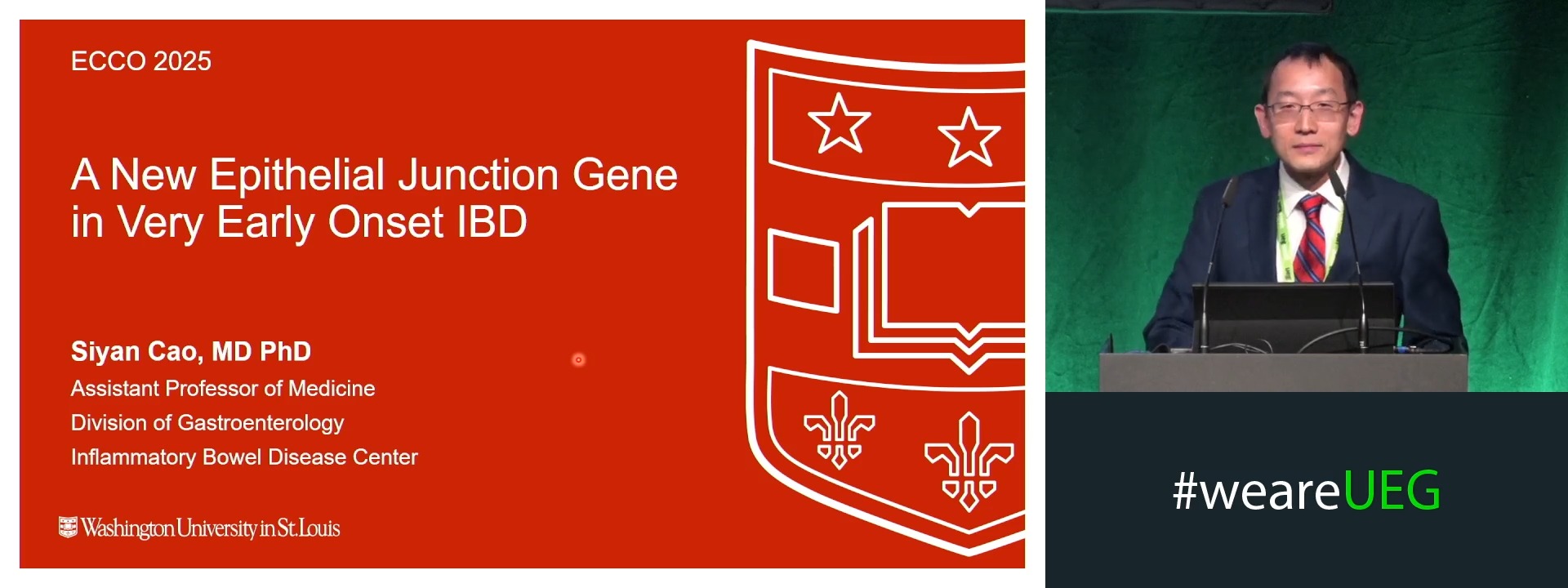
NEW PATHOGENIC MUTATIONS IN AN EPITHELIAL JUNCTION GENE CONTRIBUTING TO VERY EARLY ONSET INFLAMMATORY BOWEL DISEASE
1 Washington University in St. Louis, St. Luis, United States
2 Washington University in St. Louis, St. Louis, United States
3 Matthew Ciorba, MD Professor of Medicine, Director of Inflammatory Bowel Disease Center, Waschington University in Saint Louis, Washington DC, United States
Event
Submission format
Session
Citation
Published
Log in to access this content.
Free for all myUEG account holders. Your access level is set automatically based on your occupation. Medical professionals get full access to all content. If you are a non-medical user, you can only access UEG Week content from congresses you attended.
Not sure what you can access? Learn more about account types.
THE COMPARISON OF ENDOSCOPIC SUBMUCOSAL DISSECTION OF PHARYNGEAL CANCERS BETWEEN PATIENTS WITH AND WITHOUT PREVIOUS HISTORY OF RADIOTHERAPY INCLUDING THE LONG-TERM OUTCOMES
1 Kagawa Prefectural Central Hospital, Takamatsu, Japan
Conference
Topics
Submission format
Citation
Published
Log in to access this content.
Free for all myUEG account holders. Your access level is set automatically based on your occupation. Medical professionals get full access to all content. If you are a non-medical user, you can only access UEG Week content from congresses you attended.
Not sure what you can access? Learn more about account types.
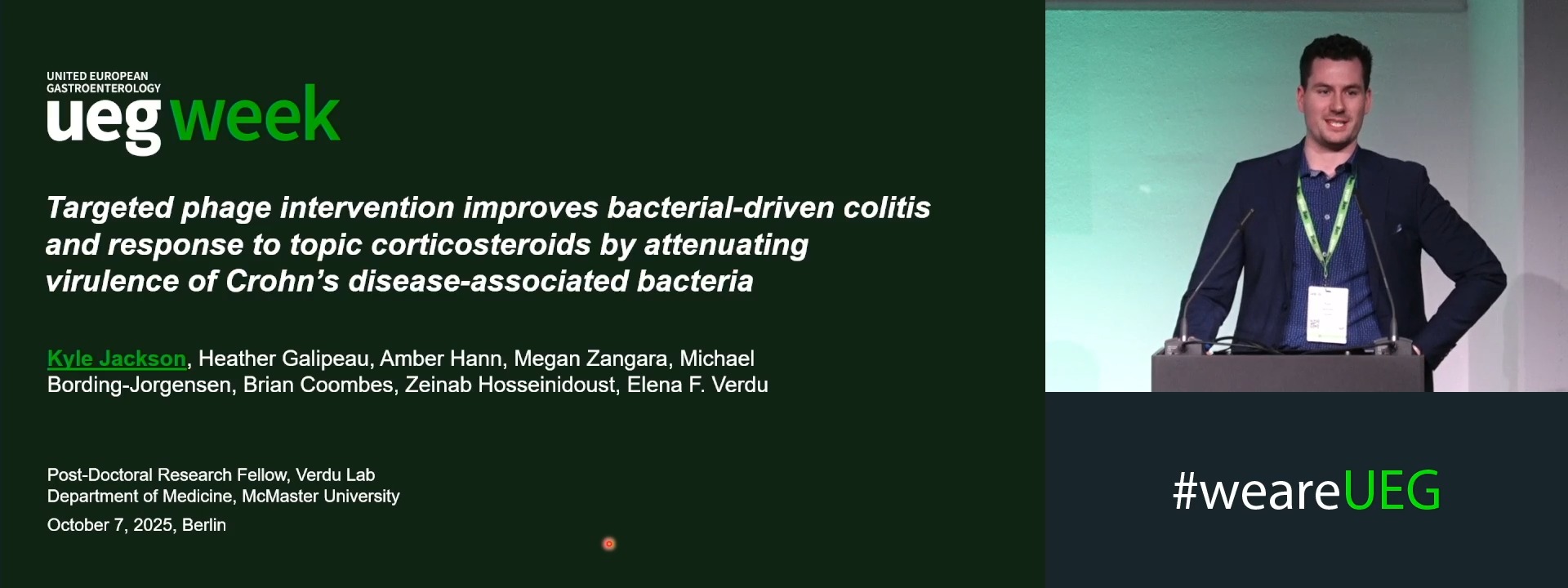
TARGETED PHAGE INTERVENTION IMPROVES BACTERIAL-DRIVEN COLITIS AND RESPONSE TO TOPICAL CORTICOSTEROIDS BY ATTENUATING VIRULENCE OF CROHN’S DISEASE-ASSOCIATED BACTERIA
Kyle Jackson 1, Heather Galipeau 2, Amber Hann 2, Marco Constante 2, Megan Zangara 3, Alexandra Fuentas 2, Chiko Shimbori 2, Premysl Bercik 2, Brian Coombes 3, Zeinab Hosseinidoust 1, Elena Verdu 2
1 McMaster University, Hamilton, Canada|||Farncombe Family Digestive Health Research Institute, Hamilton, Canada
2 Farncombe Family Digestive Health Research Institute, Hamilton, Canada
3 McMaster University, Hamilton, Canada
Event
Topics
Submission format
Citation
Published
Log in to access this content.
Free for all myUEG account holders. Your access level is set automatically based on your occupation. Medical professionals get full access to all content. If you are a non-medical user, you can only access UEG Week content from congresses you attended.
Not sure what you can access? Learn more about account types.
TREAT-TO-TARGET IN ULCERATIVE COLITIS IN A REAL-WORLD SETTING: CLINICAL REMISSION AFTER INDUCTION AND COMPLETE MUCOSAL HEALING CORRELATE WITH SUPERIOR LONG-TERM OUTCOMES.
Georgios Kokkotis 1, Polyniki Kolovou 1, VASILIKI KITSOU 1, Konstantina Chalakatevaki 1, Panagiotis Avatziadis 1, Michalis Gizis 1, Effrosyni Laoudi 1, Matina Lydia Chatzinikolaou 1, Ioannis Koutsounas 1, Giorgos Bamias 1
1 3rd Department of Internal Medicine, University of Athens, Athens, Greece
Conference
Topics
Submission format
Citation
Published
Log in to access this content.
Free for all myUEG account holders. Your access level is set automatically based on your occupation. Medical professionals get full access to all content. If you are a non-medical user, you can only access UEG Week content from congresses you attended.
Not sure what you can access? Learn more about account types.
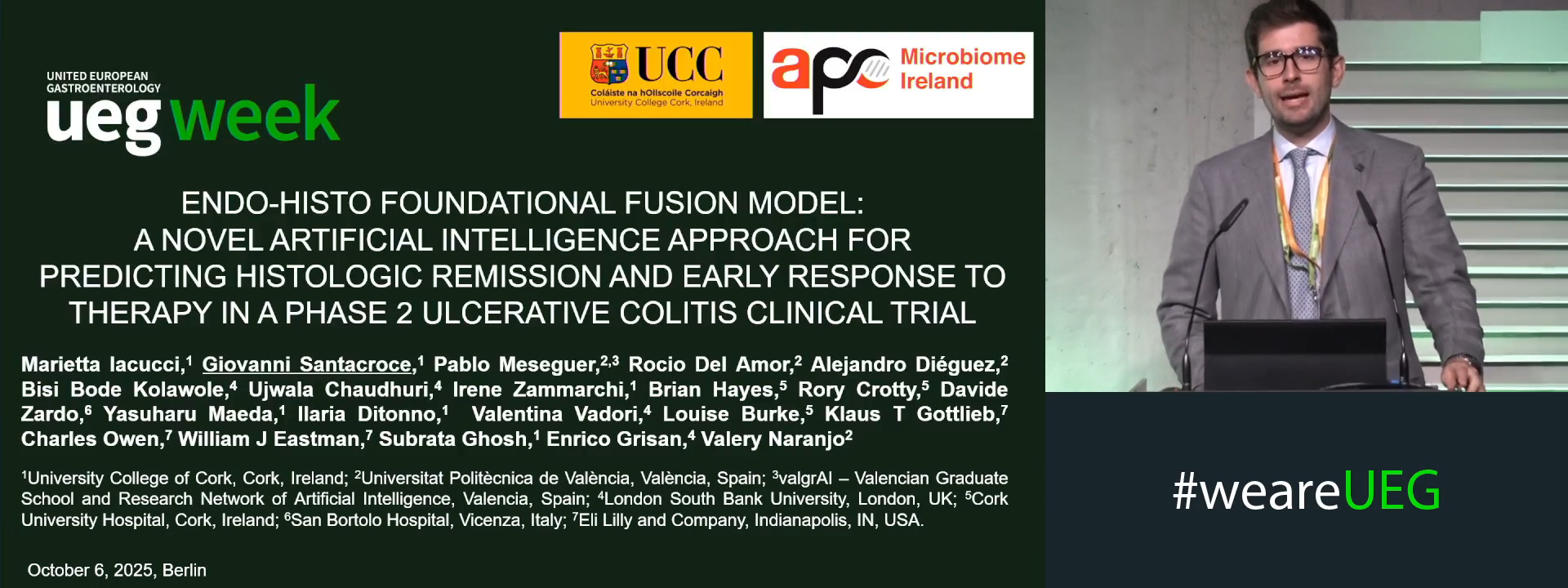
ENDO-HISTO FOUNDATIONAL FUSION MODEL: A NOVEL ARTIFICIAL INTELLIGENCE APPROACH FOR PREDICTING HISTOLOGIC REMISSION AND EARLY RESPONSE TO THERAPY IN A PHASE 2 ULCERATIVE COLITIS CLINICAL TRIAL
Marietta Iacucci 1, Giovanni Santacroce 1, Pablo Meseguer 2, Rocio Del Amor 3, Alejandro Diéguez 3, Bisi Bode Kolawole 4, Ujwala Chaudhari 4, Irene Zammarchi 1, Brian Hayes 5, Rory Crotty 5, Davide Zardo 6, Yasuharu Maeda 1, Ilaria Ditonno 1, Valentina Vadori 4, Louise Burke 5, Klaus Gottlieb 7, Charles Owen 7, William J. Eastman 7, Subrata Ghosh 1, Enrico Grisan 4, Valery Naranjo 3
1 University College Cork, Cork, Ireland
2 Universitat Politècnica de València, Valencia, Spain|||valgrAI – Valencian Graduate School and Research Network of Artificial Intelligence, Valencia, Spain
3 Universitat Politècnica de València, Valencia, Spain
4 London South Bank University, London, United Kingdom
5 Cork University Hospital, Cork, Ireland
6 San Bortolo Hospital, Vicenza, Italy
7 Eli Lilly and Company, Indianapolis, United States
Event
Topics
Submission format
Session