UEG Week Recordings UEG Week Posters Online courses Guidelines Mistakes in... Podcasts Webinars
new
Gut Guide online
Visit ueg.eu Create myUEG account Log In

Filters:

UEG Presentation
Share via Email Share on Facebook Share on X Share on LinkedIn Share on Bluesky
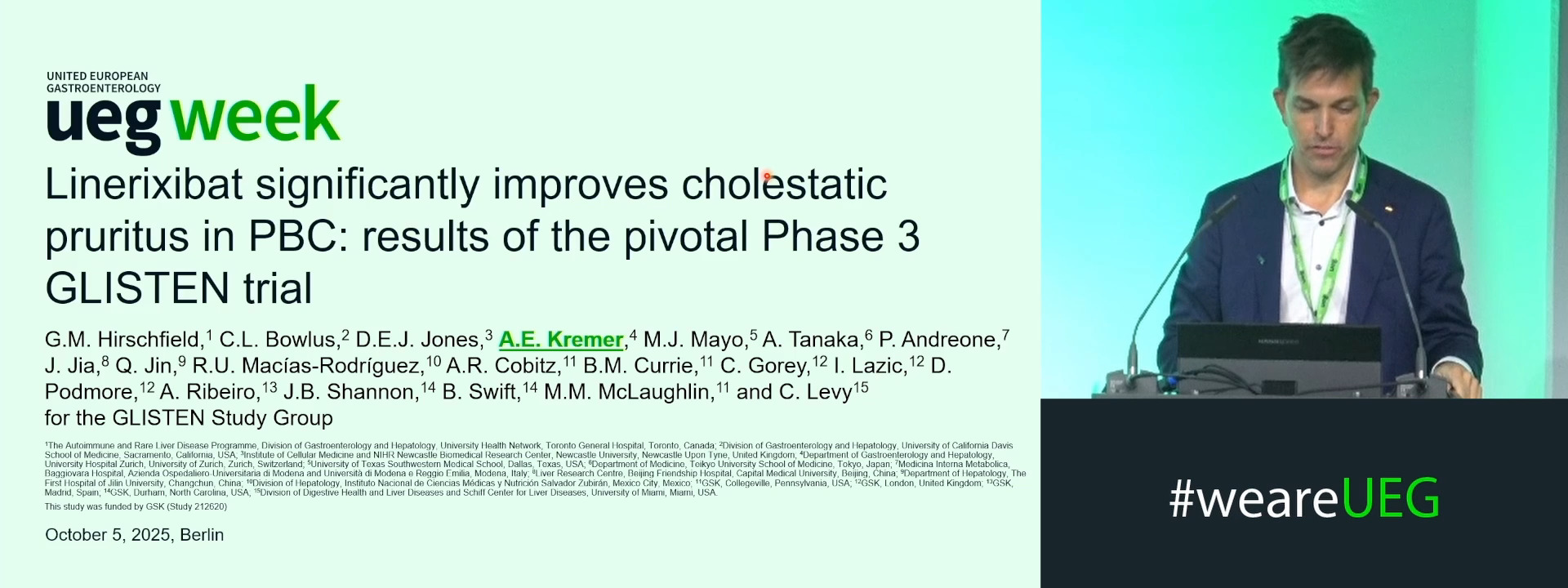
LINERIXIBAT SIGNIFICANTLY IMPROVES CHOLESTATIC PRURITUS IN PRIMARY BILIARY CHOLANGITIS: RESULTS OF THE PIVOTAL PHASE 3 GLISTEN TRIAL

Log in to continue.

This content is part of Gutflix. Log in with your myUEG account, or create one free, to watch it.

Log In Create a free account

Not sure what you can access? Learn more about account types.

LINERIXIBAT SIGNIFICANTLY IMPROVES CHOLESTATIC PRURITUS IN PRIMARY BILIARY CHOLANGITIS: RESULTS OF THE PIVOTAL PHASE 3 GLISTEN TRIAL

Gideon M. Hirschfield 1, Christopher L. Bowlus 2, David Jones 3, Andreas E. Kremer 4, Marlyn J. Mayo 5, Atsushi Tanaka 6, Pietro Andreone 7, Jidong Jia 8, Qinglong Jin 9, Ricardo Macias-Rodriguez 10, Alexander R. Cobitz 11, Brooke M. Currie 11, Ciara Gorey 12, Ivana Lazic 12, Danielle J. Podmore 12, Andrea Ribiero 13, Jennifer B. Shannon 14, Brandon Swift 14, Megan M. McLaughlin 11, Cynthia Levy 15

Affiliations

1 Toronto General Hospital, Toronto, Canada

2 University of California Davis School of Medicine, Sacramento, United States

3 Newcastle University, Newcastle Upon Tyne, United Kingdom

4 University Hospital Zurich, Zurich, Switzerland

5 University of Texas Southwestern Medical School, Dallas, United States

6 Teikyo University School of Medicine, Tokyo, Japan

7 Azienda Ospedaliero-Universitaria di Modena and Università di Modena e Reggio Emilia, Modena, Italy

8 Capital Medical University, Beijing, China

9 The First Hospital of Jilin University, Changchun, China

10 Instituto Nacional de Ciencias Médicas y Nutrición Salvador Zubirán, Mexico City, Mexico

11 GSK, Collegeville, United States

12 GSK, London, United Kingdom

13 GSK, Madrid, Spain

14 GSK, Durham, United States

15 University of Miami, Miami, United States

Summary

AI Generated

GLISTEN, a Phase 3 trial in 238 PBC patients with moderate-to-severe pruritus, showed that linerixibat 40 mg twice daily significantly improved worst itch over 24 weeks compared to placebo (LS mean change -2.86 vs -2.15, adjusted difference -0.72, p=0.001).

  • Linerixibat produced rapid pruritus improvement, demonstrating superiority over placebo as early as Week 2 (LS mean change -1.78 vs -1.07, adjusted difference -0.71, p<0.001).
  • At Week 24, 56% of linerixibat-treated patients achieved a ≥3-point reduction in pruritus versus 43% on placebo, and 21% reported absent pruritus versus 9% on placebo.
  • Linerixibat significantly improved pruritus-related sleep interference over 24 weeks versus placebo (LS mean change -2.77 vs -2.24, adjusted difference -0.53, p=0.024).
  • Diarrhoea was the most common adverse event, occurring in 61% of linerixibat-treated patients versus 18% on placebo, but only 4% discontinued treatment due to diarrhoea.
  • The study enrolled 238 patients, 95% female, with baseline mean itch severity 7.34, of whom 47% were receiving stable antipruritic therapy and 52% had alkaline phosphatase <1.67 times upper limit of normal.
Download PDF

Was this helpful?

Thanks for your feedback.

This summary was generated by an AI large language model based on the content transcript. It is for informational purposes only and should not be considered a substitute for clinical judgment. Always rely on your professional expertise and the full clinical context when making clinical decisions.

Abstract

Introduction

Cholestatic pruritus is common, debilitating and undertreated in patients with primary biliary cholangitis (PBC). Here, we describe the results of GLISTEN (NCT04950127), a Phase 3 study investigating the efficacy and safety of the ileal bile acid transporter inhibitor linerixibat for pruritus in PBC.

Aims & Methods

In this double-blind, randomised, placebo-controlled study, patients with PBC and moderate-to-severe pruritus received oral linerixibat 40 mg or placebo twice daily. Pruritus severity and pruritus-related sleep interference were assessed using a 0–10 numerical rating scale. The primary endpoint was change from baseline in worst itch over 24 weeks. Secondary endpoints included: at Week 2, change in worst itch; over 24 weeks, change in sleep interference; at Week 24, proportion of responders (≥ 2-, ≥ 3-, ≥ 4-point reduction in worst itch) and analysis of responses to 2 patient global impression items (itch severity and change). Safety endpoints included adverse event (AE) reporting.

Results

238 patients were randomised; 95% were female, itch severity was mean (standard deviation [SD]) 7.34 (1.54), 52% had alkaline phosphatase < 1.67 times upper limit of normal, and 47% were receiving stable therapy for pruritus. Pruritus improvement over 24 weeks was significantly greater with linerixibat than placebo: least-squares (LS) mean change -2.86 versus -2.15, adjusted mean difference -0.72; p = 0.001. At Week 24, the observed mean (SD) difference from baseline in pruritus was -3.66 (2.50) with linerixibat and -2.82 (2.32) with placebo. The effect of linerixibat was rapid and superior to placebo at Week 2: LS mean change -1.78 versus -1.07, adjusted mean difference -0.71; p < 0.001. Linerixibat also significantly improved pruritus-related sleep interference over 24 weeks versus placebo: LS mean change ‑2.77 versus -2.24, adjusted mean difference -0.53; p = 0.024. At Week 24, more patients on linerixibat than placebo achieved a ≥ 2-point (68% vs 64%), ≥ 3-point (56% vs 43%) or ≥ 4-point (41% vs 29%) reduction in pruritus and a higher proportion of linerixibat than placebo-treated patients reported their pruritus was very much improved (55% vs 37%) or absent (21% vs 9%). AEs reported more frequently with linerixibat than placebo were predominantly gastrointestinal (GI), including diarrhoea (61% vs 18% of patients) and abdominal pain (18% vs 3% of patients); 4% of patients in the linerixibat group discontinued treatment due to diarrhoea.

Conclusion

In patients with PBC and moderate-to-severe pruritus, linerixibat rapidly and significantly improved pruritus and pruritus-related sleep interference versus placebo. While GI AEs were more common with linerixibat than placebo, they rarely led to treatment discontinuation.

Disclosure

Funded by GSK. Various authors declare conflicts of interest as consultants, employee, recipients of grants and stockholders. These will be reported in full during the presentation.

Event

UEG Week Berlin 2025

Topics

Hepatobiliary Immunology Mechanisms & Personalised Medicine

Submission format

Abstract

Session

Advances in management of immune-mediated biliary disease

Citation

United European Gastroenterology Journal 2025; 13 (Supplement 8)

Published

2025

More Like This:

MASLD with Sven Francque - Part 1

MASLD with Sven Francque - Part 1

Pradeep Mundre Pradeep Mundre, Sven Francque

Episode 5: UEG Journal September Spotlight

Episode 5: UEG Journal September Spotlight

Djuna L. Cahen Djuna L. Cahen, Mohsan Subhani

UEG Journal Best Paper Award

UEG Journal Best Paper Award

Maria Manuela Estevinho Maria Manuela Estevinho, Mohsan Subhani, Malte Buchholz

European Consensus Recommendations for Direct Cholangioscopy and Pancreatoscopy Using a Modified Delphi Process

European Consensus Recommendations for Direct Cholangioscopy and Pancreatoscopy Using a Modified Delphi Process

Sebastian Stefanovic Sebastian Stefanovic, Enrico Palmeri

EASL Clinical Practice Guidelines on vascular diseases of the liver

EASL Clinical Practice Guidelines on vascular diseases of the liver

Early diet and the risk of coeliac disease. An update 2024 position paper by the ESPGHAN special interest group on coeliac disease

Early diet and the risk of coeliac disease. An update 2024 position paper by the ESPGHAN special interest group on coeliac disease

Hania Szajewska Hania Szajewska

UEG Podcast Episode
UEG Podcast
Share via Email Share on Facebook Share on X Share on LinkedIn Share on Bluesky

Log in to continue.

This content is part of Gutflix. Log in with your myUEG account, or create one free, to watch it.

Log In Create a free account

Not sure what you can access? Learn more about account types.

MASLD with Sven Francque - Part 1

Sven Francque, Pradeep Mundre

Summary

AI Generated

Summary is not available for this content yet.

Download PDF

Was this helpful?

Thanks for your feedback.

This summary was generated by an AI large language model based on the content transcript. It is for informational purposes only and should not be considered a substitute for clinical judgment. Always rely on your professional expertise and the full clinical context when making clinical decisions.

Abstract

Topics

Hepatobiliary

Published

2026

More Like This:

MASLD with Sven Francque - Part 1

MASLD with Sven Francque - Part 1

Pradeep Mundre Pradeep Mundre, Sven Francque

Episode 5: UEG Journal September Spotlight

Episode 5: UEG Journal September Spotlight

Djuna L. Cahen Djuna L. Cahen, Mohsan Subhani

UEG Journal Best Paper Award

UEG Journal Best Paper Award

Maria Manuela Estevinho Maria Manuela Estevinho, Mohsan Subhani, Malte Buchholz

European Consensus Recommendations for Direct Cholangioscopy and Pancreatoscopy Using a Modified Delphi Process

European Consensus Recommendations for Direct Cholangioscopy and Pancreatoscopy Using a Modified Delphi Process

Sebastian Stefanovic Sebastian Stefanovic, Enrico Palmeri

EASL Clinical Practice Guidelines on vascular diseases of the liver

EASL Clinical Practice Guidelines on vascular diseases of the liver

Early diet and the risk of coeliac disease. An update 2024 position paper by the ESPGHAN special interest group on coeliac disease

Early diet and the risk of coeliac disease. An update 2024 position paper by the ESPGHAN special interest group on coeliac disease

Hania Szajewska Hania Szajewska

UEG Podcast Episode
Journal Podcast
Share via Email Share on Facebook Share on X Share on LinkedIn Share on Bluesky

Log in to continue.

This content is part of Gutflix. Log in with your myUEG account, or create one free, to watch it.

Log In Create a free account

Not sure what you can access? Learn more about account types.

Episode 5: UEG Journal September Spotlight

Mohsan Subhani, Djuna L. Cahen

Summary

AI Generated

Summary is not available for this content yet.

Download PDF

Was this helpful?

Thanks for your feedback.

This summary was generated by an AI large language model based on the content transcript. It is for informational purposes only and should not be considered a substitute for clinical judgment. Always rely on your professional expertise and the full clinical context when making clinical decisions.

Abstract

Published

2025

More Like This:

MASLD with Sven Francque - Part 1

MASLD with Sven Francque - Part 1

Pradeep Mundre Pradeep Mundre, Sven Francque

Episode 5: UEG Journal September Spotlight

Episode 5: UEG Journal September Spotlight

Djuna L. Cahen Djuna L. Cahen, Mohsan Subhani

UEG Journal Best Paper Award

UEG Journal Best Paper Award

Maria Manuela Estevinho Maria Manuela Estevinho, Mohsan Subhani, Malte Buchholz

European Consensus Recommendations for Direct Cholangioscopy and Pancreatoscopy Using a Modified Delphi Process

European Consensus Recommendations for Direct Cholangioscopy and Pancreatoscopy Using a Modified Delphi Process

Sebastian Stefanovic Sebastian Stefanovic, Enrico Palmeri

EASL Clinical Practice Guidelines on vascular diseases of the liver

EASL Clinical Practice Guidelines on vascular diseases of the liver

Early diet and the risk of coeliac disease. An update 2024 position paper by the ESPGHAN special interest group on coeliac disease

Early diet and the risk of coeliac disease. An update 2024 position paper by the ESPGHAN special interest group on coeliac disease

Hania Szajewska Hania Szajewska

UEG Podcast Episode
Journal Podcast
Share via Email Share on Facebook Share on X Share on LinkedIn Share on Bluesky

Log in to continue.

This content is part of Gutflix. Log in with your myUEG account, or create one free, to watch it.

Log In Create a free account

Not sure what you can access? Learn more about account types.

UEG Journal Best Paper Award

Mohsan Subhani, Maria Manuela Estevinho, Malte Buchholz

Summary

AI Generated

Summary is not available for this content yet.

Download PDF

Was this helpful?

Thanks for your feedback.

This summary was generated by an AI large language model based on the content transcript. It is for informational purposes only and should not be considered a substitute for clinical judgment. Always rely on your professional expertise and the full clinical context when making clinical decisions.

Abstract

Published

2025

More Like This:

MASLD with Sven Francque - Part 1

MASLD with Sven Francque - Part 1

Pradeep Mundre Pradeep Mundre, Sven Francque

Episode 5: UEG Journal September Spotlight

Episode 5: UEG Journal September Spotlight

Djuna L. Cahen Djuna L. Cahen, Mohsan Subhani

UEG Journal Best Paper Award

UEG Journal Best Paper Award

Maria Manuela Estevinho Maria Manuela Estevinho, Mohsan Subhani, Malte Buchholz

European Consensus Recommendations for Direct Cholangioscopy and Pancreatoscopy Using a Modified Delphi Process

European Consensus Recommendations for Direct Cholangioscopy and Pancreatoscopy Using a Modified Delphi Process

Sebastian Stefanovic Sebastian Stefanovic, Enrico Palmeri

EASL Clinical Practice Guidelines on vascular diseases of the liver

EASL Clinical Practice Guidelines on vascular diseases of the liver

Early diet and the risk of coeliac disease. An update 2024 position paper by the ESPGHAN special interest group on coeliac disease

Early diet and the risk of coeliac disease. An update 2024 position paper by the ESPGHAN special interest group on coeliac disease

Hania Szajewska Hania Szajewska

UEG Standards and Guidelines
Consensus
Share via Email Share on Facebook Share on X Share on LinkedIn Share on Bluesky

Log in to continue.

This content is part of Gutflix. Log in with your myUEG account, or create one free, to watch it.

Log In Create a free account

Not sure what you can access? Learn more about account types.

European Consensus Recommendations for Direct Cholangioscopy and Pancreatoscopy Using a Modified Delphi Process

Enrico Palmeri, Sebastian Stefanovic

Summary

AI Generated

Summary is not available for this content yet.

Download PDF

Was this helpful?

Thanks for your feedback.

This summary was generated by an AI large language model based on the content transcript. It is for informational purposes only and should not be considered a substitute for clinical judgment. Always rely on your professional expertise and the full clinical context when making clinical decisions.

Guideline

ABSTRACT

Background and Aim

Direct cholangioscopy and pancreatoscopy have become widely implemented techniques in the diagnostic and therapeutic algorithms of several pancreaticobiliary disorders. This study aimed to generate general and indication-specific European consensus recommendations on cholangioscopy and pancreatoscopy.

Methods

Supported by the available literature, statements were formulated and grouped into the following categories: (1) pre-procedural considerations, (2) general technical aspects, (3) biliopancreatic stones, (4) biliary strictures, and (5) other indications. The evidence level of each statement was determined using the GRADE methodology. Cholangioscopy experts were invited to participate in a modified Delphi process. When 80% consensus was not reached, the statement was modified based on expert feedback and subjected to an additional Delphi round. Statements were rejected if they failed to reach consensus after three Delphi rounds.

Results

Thirty cholangioscopy experts completed the Delphi process. Forty-two (97.6%) generated statements were accepted, of which 39 (92.9%) in the first Delphi round. 12 statements on preprocedural and periprocedural settings, 8 statements on biliopancreatic stones, 13 statements on biliary strictures, and 9 statements on other indications were accepted.

Conclusion

Using a modified Delphi process, we developed general and indication-specific consensus recommendations for cholangioscopy to guide clinical practice.

Guideline

Consensus

Topics

Endoscopy Pancreas

Citation

United European Gastroenterology Journal, 2025; 13:1652–1667

Published

2025

More Like This:

MASLD with Sven Francque - Part 1

MASLD with Sven Francque - Part 1

Pradeep Mundre Pradeep Mundre, Sven Francque

Episode 5: UEG Journal September Spotlight

Episode 5: UEG Journal September Spotlight

Djuna L. Cahen Djuna L. Cahen, Mohsan Subhani

UEG Journal Best Paper Award

UEG Journal Best Paper Award

Maria Manuela Estevinho Maria Manuela Estevinho, Mohsan Subhani, Malte Buchholz

European Consensus Recommendations for Direct Cholangioscopy and Pancreatoscopy Using a Modified Delphi Process

European Consensus Recommendations for Direct Cholangioscopy and Pancreatoscopy Using a Modified Delphi Process

Sebastian Stefanovic Sebastian Stefanovic, Enrico Palmeri

EASL Clinical Practice Guidelines on vascular diseases of the liver

EASL Clinical Practice Guidelines on vascular diseases of the liver

Early diet and the risk of coeliac disease. An update 2024 position paper by the ESPGHAN special interest group on coeliac disease

Early diet and the risk of coeliac disease. An update 2024 position paper by the ESPGHAN special interest group on coeliac disease

Hania Szajewska Hania Szajewska

UEG Standards and Guidelines
Clinical Practice Guideline
Share via Email Share on Facebook Share on X Share on LinkedIn Share on Bluesky

Log in to continue.

This content is part of Gutflix. Log in with your myUEG account, or create one free, to watch it.

Log In Create a free account

Not sure what you can access? Learn more about account types.

EASL Clinical Practice Guidelines on vascular diseases of the liver

Summary

AI Generated

Summary is not available for this content yet.

Download PDF

Was this helpful?

Thanks for your feedback.

This summary was generated by an AI large language model based on the content transcript. It is for informational purposes only and should not be considered a substitute for clinical judgment. Always rely on your professional expertise and the full clinical context when making clinical decisions.

Guideline

Summary

Vascular diseases of the liver include portal vein thrombosis (with or without cirrhosis), portosinusoidal vascular disorder, Budd-Chiari syndrome, sinusoidal obstruction syndrome, non-obstructive sinusoidal dilatation and peliosis, splanchnic artery aneurysms, and hepatic arteriovenous fistulas. Except for portal vein thrombosis in cirrhosis, these are all rare conditions. Since the last Clinical Practice Guidelines were issued by the European Association for the Study of the Liver in 2016, much data has been published on the diagnosis and management &ndash; medical and interventional &ndash; of patients with vascular liver diseases. Based on a thorough review of the relevant literature, recommendations are provided to address key clinical dilemmas. The document emphasises personalised care, considering individual risk factors and clinical presentation. Multidisciplinary management involving hepatologists, haematologists, pathologists, interventional radiologists and surgeons is essential in this area. Our aim is to provide guidance on the management of patients with vascular liver diseases based on the best available evidence.

Publisher

European Association for the Study of the Liver logo
European Association for the Study of the Liver

Guideline

Clinical Practice Guideline

Topics

Hepatobiliary

Citation

Journal of Hepatology; Volume 84, Issue 2, 399-456

Published

2025

More Like This:

MASLD with Sven Francque - Part 1

MASLD with Sven Francque - Part 1

Pradeep Mundre Pradeep Mundre, Sven Francque

Episode 5: UEG Journal September Spotlight

Episode 5: UEG Journal September Spotlight

Djuna L. Cahen Djuna L. Cahen, Mohsan Subhani

UEG Journal Best Paper Award

UEG Journal Best Paper Award

Maria Manuela Estevinho Maria Manuela Estevinho, Mohsan Subhani, Malte Buchholz

European Consensus Recommendations for Direct Cholangioscopy and Pancreatoscopy Using a Modified Delphi Process

European Consensus Recommendations for Direct Cholangioscopy and Pancreatoscopy Using a Modified Delphi Process

Sebastian Stefanovic Sebastian Stefanovic, Enrico Palmeri

EASL Clinical Practice Guidelines on vascular diseases of the liver

EASL Clinical Practice Guidelines on vascular diseases of the liver

Early diet and the risk of coeliac disease. An update 2024 position paper by the ESPGHAN special interest group on coeliac disease

Early diet and the risk of coeliac disease. An update 2024 position paper by the ESPGHAN special interest group on coeliac disease

Hania Szajewska Hania Szajewska

UEG Standards and Guidelines
Position Paper
Share via Email Share on Facebook Share on X Share on LinkedIn Share on Bluesky

Log in to continue.

This content is part of Gutflix. Log in with your myUEG account, or create one free, to watch it.

Log In Create a free account

Not sure what you can access? Learn more about account types.

Early diet and the risk of coeliac disease. An update 2024 position paper by the ESPGHAN special interest group on coeliac disease

Hania Szajewska

Summary

AI Generated

Summary is not available for this content yet.

Download PDF

Was this helpful?

Thanks for your feedback.

This summary was generated by an AI large language model based on the content transcript. It is for informational purposes only and should not be considered a substitute for clinical judgment. Always rely on your professional expertise and the full clinical context when making clinical decisions.

Guideline

Abstract

This position paper by the European Society for Paediatric Gastroenterology, Hepatology and Nutrition (ESPGHAN) Special Interest Group on Coeliac Disease (SIG-CD) presents an update to the 2016 recommendations concerning early diet and the risk of coeliac disease (CD). This update adheres to the policy that mandates reviewing guidelines every 5 years, particularly when new data emerge. The 2024 statements and recommendations are essentially similar to the 2016 recommendations. Breastfeeding, whether any amount, exclusive, or of any duration, does not reduce the risk of developing CD. Introducing gluten into an infant's diet at any time between completed 4 months (≥17 weeks) and 12 months of age does not affect the cumulative incidence of CD, although earlier introduction may lead to earlier seroconversion and CD. In observational studies involving cohorts with a known risk for CD, consuming a high amount of gluten compared to a low amount during weaning and in the subsequent childhood years—specifically the first 2–3 years, and even up to 5 years in some studies—was associated with an increased risk for CD. However, the specific optimal amounts of gluten consumption remain undetermined due to insufficient evidence on safe thresholds, and the impact of restricting gluten in the diet of healthy children of unknown risk for CD is unknown. Thus, any recommendation on the gluten amount is currently unjustifiable for the general population and infants with known HLA risk types. There is no specific guidance on the type of gluten-containing foods to be introduced at weaning.

Publisher

European Society for Paediatric Gastroenterology, Hepatology and Nutrition logo
European Society for Paediatric Gastroenterology, Hepatology and Nutrition

Guideline

Position Paper

Topics

Immunology Paediatrics Small Intestine & Nutrition

Citation

J Pediatr Gastroenterol Nutr. 2024;79:438–445

Published

2024

More Like This:

MASLD with Sven Francque - Part 1

MASLD with Sven Francque - Part 1

Pradeep Mundre Pradeep Mundre, Sven Francque

Episode 5: UEG Journal September Spotlight

Episode 5: UEG Journal September Spotlight

Djuna L. Cahen Djuna L. Cahen, Mohsan Subhani

UEG Journal Best Paper Award

UEG Journal Best Paper Award

Maria Manuela Estevinho Maria Manuela Estevinho, Mohsan Subhani, Malte Buchholz

European Consensus Recommendations for Direct Cholangioscopy and Pancreatoscopy Using a Modified Delphi Process

European Consensus Recommendations for Direct Cholangioscopy and Pancreatoscopy Using a Modified Delphi Process

Sebastian Stefanovic Sebastian Stefanovic, Enrico Palmeri

EASL Clinical Practice Guidelines on vascular diseases of the liver

EASL Clinical Practice Guidelines on vascular diseases of the liver

Early diet and the risk of coeliac disease. An update 2024 position paper by the ESPGHAN special interest group on coeliac disease

Early diet and the risk of coeliac disease. An update 2024 position paper by the ESPGHAN special interest group on coeliac disease

Hania Szajewska Hania Szajewska

The global reference point for the digestive health community

Platform Publisher

United European Gastroenterology

Wickenburggasse 1 1080 Vienna, Austria

Contact us

support@ueg.eu

ueg.eu

T: +43 1 997 1639

Legal

Terms & Conditions

Imprint

Privacy Policy

Explore

My Bookmarks

My recommendations

My fields of interest

© 2026 United European Gastroenterology

Change fields of interest

These fields are selected based on the interests in your myUEG profile.
Click the item to unselect it. You can select multiple items.